
The Endless Cycle of Distraction and My Breaking Point
I remember sitting at my desk just a few months ago, staring blindly at a blank computer screen. I had a massive project due, and I told myself I would work on it all morning. But every time I typed a sentence, my hand instinctively reached for my phone to check notifications. Three hours passed, and I had absolutely nothing to show for my time except a feeling of heavy guilt. I felt completely frustrated with myself, wondering why my brain refused to concentrate on simple tasks. My attention span felt broken, and my self-confidence hit rock bottom.
Millions of normal people wake up every single day facing this exact same invisible battle. You sit down with the best intentions, holding a fresh cup of coffee and a long to-do list. Yet, within minutes, your mind wanders off to social media, random emails, or mindless scrolling.
This daily struggle creates an overwhelming amount of mental fatigue. We end up working longer hours but getting significantly less done. You might feel like you are always busy, but your actual meaningful progress remains painfully slow.
The stress of unfinished tasks starts to bleed into your personal life. You cannot enjoy your evening rest because the anxiety of uncompleted work hangs heavy over your head. It feels like you are constantly running on a treadmill but never actually moving forward.
Our brains are naturally wired to seek instant gratification. Every time your phone buzzes, you get a tiny hit of dopamine, making it nearly impossible to focus on boring or difficult tasks. This is not a personal failure on your part.
You are fighting against highly engineered algorithms designed to steal your attention. Without a solid system to protect your mental energy, your peace of mind will continue to suffer.
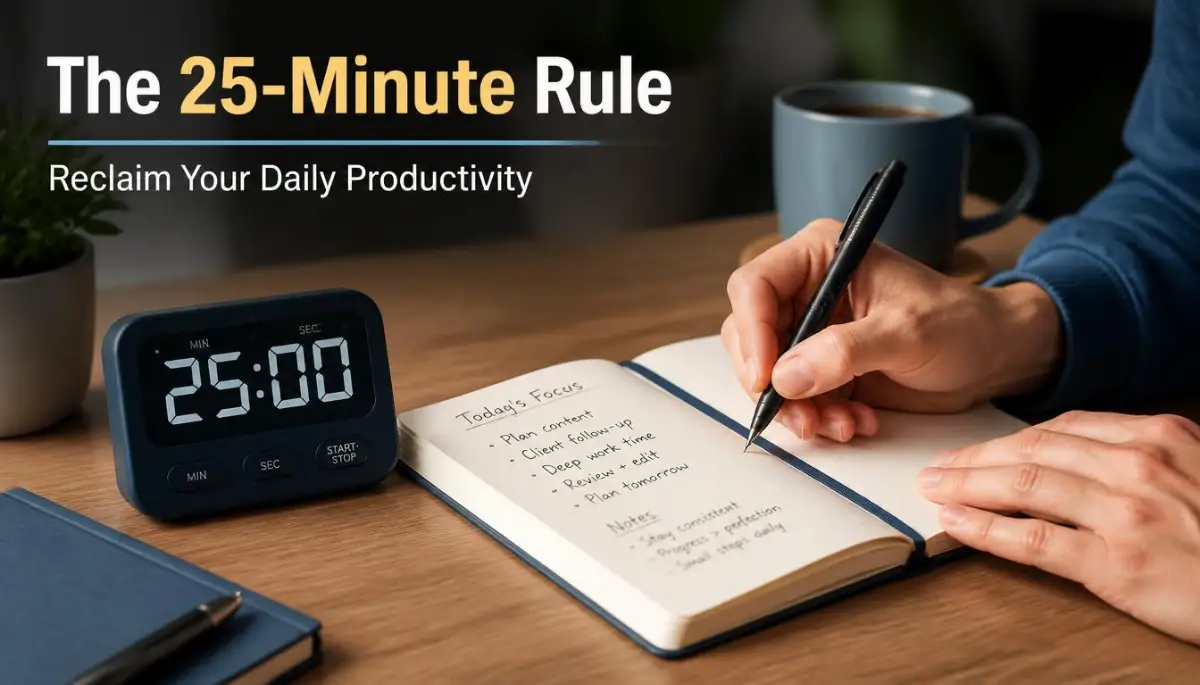
What Actually Happens to Your Brain During Focused Work
To understand how to fix our broken attention spans, we first need to look at how the brain processes information. Think of your mind like a computer's active memory. When you have too many browser tabs open, the whole system slows down and eventually crashes.
Every time you switch between writing an email and checking a text message, your brain experiences something called "attention residue." A small piece of your mental energy stays stuck on the previous task. This makes it incredibly difficult to fully immerse yourself in the current moment.
By forcing your brain to focus on just one single task, you eliminate this exhausting mental friction. This state of singular concentration is where your highest quality work actually happens.
The Core Concept of Breaking Time into Pieces
Most people try to work for four hours straight, hoping sheer willpower will carry them through. Human beings are simply not designed to maintain high-level concentration for that long. Your mental energy naturally rises and falls in rhythmic cycles throughout the day.
Working in short, highly concentrated bursts aligns perfectly with our natural biological rhythms. Instead of seeing a massive project as a huge mountain to climb, you break it down into tiny, manageable steps.
This approach completely removes the fear and overwhelm that usually causes procrastination. You tell your brain that it only needs to work hard for a very short period.
An Introduction to the Famous Time-Boxing Strategy
Are you ready to completely change how you approach daily tasks? Check out this incredible visual breakdown that explains exactly how a timer can trick your brain into loving hard work.
Myth vs Reality: The Truth About Deep Work
There are a lot of misconceptions about what it actually takes to be highly productive. Let us clear up some of the most common misunderstandings right now.
- Myth: You need to work for eight hours straight to be considered successful.
- Reality: Four hours of intense, uninterrupted focus will always beat eight hours of distracted, half-hearted effort.
- Myth: Multitasking makes you get things done much faster.
- Reality: Multitasking destroys your accuracy and severely damages your short-term memory.
- Myth: Taking breaks means you are lazy and wasting time.
- Reality: Strategic resting actually recharges your cognitive battery, allowing you to work faster afterward.
A Practical Blueprint to Reclaim Your Attention Span
Now that we understand the psychology behind our distractions, we need a concrete plan of action. You do not need any expensive software or complicated apps to get started. All you need is a simple timer and a willingness to follow a few basic rules.
Let us walk through the exact framework you can apply to your daily routine right now.
Phase One: Defining Your Singular Target
The biggest mistake people make is sitting down to work without a clear goal. If you do not know exactly what you are trying to achieve, your mind will naturally look for distractions. You must be aggressively specific about your immediate objective.
Do not just write "work on the presentation" on your notepad. Instead, write down "finish the first three slides of the marketing presentation."
This clarity gives your brain a highly specific target to hit. When the brain knows exactly what success looks like, it becomes much easier to ignore outside noise.
Phase Two: Building a Zero-Distraction Environment
You cannot expect to focus deeply if your phone is sitting face-up next to your keyboard. Your environment plays a massive role in dictating your behavior. You must protect your physical and digital space before you even start the timer.
Put your phone on silent and physically move it to another room. Close every single computer tab that is not directly related to your current task.
If you work in a noisy environment, invest in a good pair of noise-canceling headphones. Treat your workspace like a sacred area where interruptions are simply not allowed.
Phase Three: Riding the Short Wave of Effort
Once your target is set and your environment is clear, it is time to start the clock. Set your timer for exactly 25 minutes. During this window, you have only one job: work exclusively on the task you chose.
You must act as if the rest of the world does not exist for those 25 minutes. If an unrelated thought pops into your head, quickly write it down on a piece of paper and immediately return to your work.
Do not stop to research that random thought or check your email. The ticking timer creates a healthy sense of urgency that forces you to keep moving forward.
I used to skip my short breaks entirely, thinking I was saving time and being highly efficient. I quickly realized my brain would completely crash by the afternoon, leaving me exhausted and unable to finish my daily goals. Now, I strictly honor my resting periods, and my energy levels remain incredibly stable all day long.
Phase Four: The Art of Strategic Recovery
When the timer finally goes off, you must stop working immediately. Even if you are right in the middle of a sentence, put your pen down or take your hands off the keyboard.
Set the timer again for 5 minutes and step away from your desk. This is your time to let your brain completely disconnect and relax.
Stretch your legs, drink a glass of water, or look out the window at some greenery. Do not use this 5-minute window to check social media, as that will just drain your mental energy further.
The Productivity Comparison Table
To clearly see why this method is so effective, let us compare a normal workday with a strategically timed workday.
Customizing the Clock to Fit Your Unique Mind
The standard 25-minute work block is a fantastic starting point for beginners. However, every single person has a slightly different natural attention span. You might find that 25 minutes is actually too short for the kind of work you do.
If you are writing code or drafting a complex essay, it can take 15 minutes just to get into a state of flow. In these cases, you can easily adjust the intervals to better suit your specific needs.
Many professionals prefer a 50-minute work block followed by a 10-minute break. This allows for much deeper immersion while still protecting against mental burnout.
Figuring Out Your Personal Rhythm
You should experiment with different time blocks to see what feels most natural to you. Start with the traditional 25 minutes for a few days to build the habit. Pay close attention to how you feel when the timer rings.
If you consistently feel like you are being interrupted right when you hit your stride, increase the work time. If you find your mind wandering after 15 minutes, shorten the blocks until your focus improves.
The goal is not to blindly follow a rigid set of rules. The goal is to build a personalized system that genuinely supports your daily workflow.
Managing Internal vs External Interruptions
Even with the best preparation, interruptions will inevitably happen. It is highly important to know how to handle them without completely derailing your progress. We generally face two distinct types of interruptions during our work sessions.
External interruptions come from your environment, like a coworker asking a question or a sudden phone call. Internal interruptions come from your own brain, like suddenly remembering you need to buy groceries.
When a coworker approaches you, politely let them know you are in the middle of a timed session. Tell them you will gladly help them in exactly 10 minutes when your break starts.
For internal thoughts, use a "distraction notepad" kept right beside your keyboard. Simply dump the thought onto the paper and instantly push it out of your active memory.
The Long-Term Impact on Your Mental Well-being
Practicing this kind of structured focus does much more than just clear your to-do list. It fundamentally changes how you view your own capabilities and limits. You stop feeling like a victim to your never-ending workload.
By actively controlling your time, you massively reduce your daily anxiety levels. You finally get to experience the deep satisfaction of knowing you gave your absolute best effort.
At the end of the day, you can close your laptop without any lingering guilt. You know exactly how many focused blocks you completed, giving you measurable proof of your hard work.
This level of organization creates a healthy boundary between your professional obligations and your personal life. You earn the right to truly relax in the evening because you managed your daytime hours correctly.
Developing a strong attention span is completely possible for anyone willing to practice. It just requires a simple timer, clear intentions, and the patience to start small.
Taking Your Focus to the Next Level: Pro Strategies
Once you master the basic rules of working in short, timed bursts, an entirely new world of productivity opens up for you. You are no longer just surviving your workday. You are actually commanding your schedule with real confidence.
At this stage, you can start applying advanced strategies to squeeze even more value out of your focused minutes. These are the exact methods high-performing professionals use to stay incredibly sharp without burning out.
The most powerful secret lies in understanding how to group your tasks intelligently. We call this strategy "task batching," and it will save you massive amounts of mental energy.
When you jump from writing an email to reading a complicated spreadsheet, your brain burns a lot of fuel. By understanding the science behind cognitive load, we see that the human brain hates constantly shifting gears.
Instead of randomly attacking your to-do list, group similar tasks together into a single timed block. For example, use one entire block just for replying to messages. Use the next block strictly for creative writing or intense problem-solving.
I use this batching method when dealing with heavy, stressful tasks. When I sit down to figure out how to create a realistic monthly budget and crush debt, I do all the math in one dedicated session. I never mix that stressful financial planning with my relaxed creative work.
The Sound of Silence Versus Strategic Noise
Your physical environment plays a huge role in your long-term success with this method. A lot of beginners assume they need absolute, pin-drop silence to concentrate properly.
However, complete silence can actually be incredibly distracting for many people. In a totally quiet room, every single tiny sound suddenly feels like a massive interruption. Your brain naturally searches for audio stimulation.
Research published on the effects of background noise on human cognition shows that consistent, low-level sound actually improves concentration. This is why coffee shops are surprisingly great places to get work done.
If you work in a busy office, try listening to brown noise or gentle rain sounds through good headphones. It creates a solid wall of sound that blocks out distracting conversations.
Tracking Your Personal Golden Hours
We all have specific times of the day when our brains feel naturally awake and powerful. Some people do their absolute best thinking at six in the morning. Other people do not fully wake up until late in the afternoon.
You must identify your own "golden hours" to get the best results from your timed sessions. Do not waste your highest energy hours on low-value tasks like organizing folders or reading standard emails.
Save your most difficult, brain-heavy projects for the time of day when you feel strongest. For instance, comparing the long-term math of fixed vs variable personal loans requires intense logical thinking. You should only tackle that kind of complicated analysis during your peak mental hours.
When your energy naturally dips in the late afternoon, switch to easier tasks. Use those low-energy blocks for simple administrative duties that do not require deep thought.
Handling the Unplanned Chaos of Daily Life
No matter how perfectly you plan your day, life will eventually throw a curveball at you. An emergency meeting gets called, or your child suddenly needs help with homework.
The worst thing you can do in these moments is panic or get intensely angry at the interruption. You have to build flexibility into your daily system.
If a true emergency breaks your timed session, simply stop the clock. Handle the real-life situation with your full attention. Once the issue is completely resolved, sit back down and start a brand new timer from zero.
A great trick is to keep a "distraction pad" right beside your mouse. Let us say you are working, and suddenly you remember you need to research how a low credit score affects loan approvals. Instead of opening a new tab, just write that thought down on the paper.
This simple physical action tells your brain that the thought is safe and will not be forgotten. You can then immediately return to your deep work without losing your momentum.

The Hidden Pitfalls: Where Most People Fail
Even the most perfect productivity system can become a nightmare if you use it incorrectly. Many people try this method for three days, get totally frustrated, and then completely quit.
They usually abandon the system because they fall into a few very common psychological traps. If you know what these hidden dangers are, you can easily avoid them and keep your momentum going strong.
The Trap of Extreme Mental Rigidity
The single biggest mistake people make is treating the timer like a harsh, unforgiving prison guard. They become completely obsessed with the exact minutes on the screen.
If they accidentally get distracted at the 24-minute mark, they feel like a total failure. This kind of toxic perfectionism completely ruins the entire purpose of the method. The timer is supposed to be a helpful guide, not a tool to punish yourself.
Some days, your brain will simply refuse to cooperate, and that is perfectly okay. On those heavy days, give yourself permission to lower your expectations. Do not beat yourself up if you only complete two focused blocks instead of your usual six.
If you are dealing with massive life stress, like trying to manage your finances after suddenly losing a job, your brain is already exhausted. Pushing yourself too hard during these times will only lead to a complete mental breakdown.
Skipping the Mandatory Recovery Phases
When you first start hitting your stride, you will feel incredibly powerful. You will finish a 25-minute block and think, "I feel great, I do not need a break right now."
This is a very dangerous illusion that leads directly to afternoon burnout. You might skip your first two breaks and get a lot done in the morning. But by two o'clock in the afternoon, your brain will feel like completely useless mush.
Medical experts at the Cleveland Clinic emphasize that brain downtime is absolutely necessary for maintaining long-term memory. When you rest, your brain is actually working hard in the background to organize the information you just learned.
Force yourself to step away from the desk when the timer rings. Go stretch your arms, look at the sky, or drink some cold water. Treating your rest periods as strictly as your work periods is the real secret to all-day energy.
Forcing Creativity into Tiny Boxes
Another major mistake is trying to use a strict timer for absolutely everything in your life. This method is amazing for writing reports, studying textbooks, or clearing out heavy emails.
However, forced time limits can actually destroy pure creative thinking. If you are trying to paint a picture, write a song, or brainstorm a totally new business idea, staring at a ticking clock will cause intense anxiety.
Creative work usually requires long, uninterrupted periods of daydreaming and unstructured thought. Use your timers for the heavy lifting, but leave your creative sessions completely open and free.
The Disaster of Over-Scheduling Your Day
When people discover topic36.com or similar sites offering amazing productivity hacks, they often get overly excited. They look at an eight-hour workday and try to schedule sixteen consecutive work blocks.
This is a mathematically impossible goal for any normal human being. You must account for bathroom breaks, lunch, simple fatigue, and random daily conversations.
A highly successful day might actually only consist of four or five perfect blocks of deep focus. That might not sound like a lot, but those few hours of pure concentration will produce massive results.
Trying to schedule every single minute of your day will just make you feel rushed and panicked. Always leave plenty of empty buffer space in your daily calendar.
Your Roadmap to Lasting Mental Clarity
Improving your daily focus is a lot like training a muscle at the gym. You cannot expect to lift the heaviest weights on your very first day.
You have to start with small, manageable weights and slowly build up your strength over several weeks. Your attention span has likely been damaged by years of smartphone use, so give it time to heal.
Do not focus on being perfectly productive every single day. Instead, focus entirely on being just a little bit more consistent than you were yesterday.
Some days will feel incredibly easy, and the words will just flow right out of you. Other days will feel like you are walking through thick mud, and every sentence will be a painful struggle.
The beauty of this method is that it protects you on those really bad days. Just like learning the real truth about unsecured borrowing protects your financial future, a good time management system protects your mental future.
You no longer have to rely on random bursts of motivation to get your heavy projects finished. You finally have a reliable, scientific framework that carries you across the finish line safely.
Even highly complex tasks, like calculating how a strict debt-to-income ratio impacts mortgage chances, become simple when broken down into tiny pieces. You simply take it one single timer block at a time.
Start tomorrow morning with just one simple goal: complete exactly one uninterrupted work session. Turn your phone completely off, set your specific target, and press start.
I finally stopped fighting against my own brain and started working with my natural biological rhythms instead. My daily output doubled, and more importantly, my constant background anxiety completely disappeared. You have the exact same power to take control of your precious time starting right this minute.
Common Questions About Mastering Your Work Intervals
Can I listen to music during my deep work blocks?
Yes, you absolutely can, but you need to be very careful about your choices. It is highly recommended to listen to music without any lyrics, like classical pieces or low-fi beats. Songs with heavy vocals will force your brain to subconsciously process the words, which instantly drains your mental focus.
What should I do if I finish my task before the timer rings?
This is a wonderful problem to have, and it happens quite often once you get fast. Use the remaining minutes to carefully review your work, check for small errors, or plan your next step. You can also use that extra time to organize your digital files before taking your scheduled break.
Is it perfectly normal to feel totally exhausted after just two sessions?
It is completely normal, especially if you are totally new to this kind of intense concentration. Your brain is burning a massive amount of glucose when you focus deeply without any distractions. Make sure you are drinking plenty of water and eating healthy snacks to keep your physical energy up.
Does this timing method actually work for students studying for massive exams?
It is actually one of the absolute best study techniques ever created for students. Breaking huge textbooks into tiny, manageable reading chunks stops the feeling of overwhelming panic. It also forces students to take breaks, which scientifically helps lock the new information into their long-term memory.
How do I politely stop my family from interrupting me when working from home?
Communication and clear boundaries are your best tools here. Let your family know that when your office door is closed, or when you are wearing your headphones, you cannot be disturbed unless it is a real emergency. You can even put a fun, physical sign on your desk that clearly says you are in a focused session.
Disclaimer: The productivity strategies, time management methods, and general information provided in this article are meant for educational and informational purposes only. Individual results may highly vary based on personal work environments, physical health, and specific job requirements. This content does not constitute professional medical, psychological, or financial advice. Always consult with a qualified professional before making significant changes to your work habits or lifestyle.

![The Proven KonMari System to Declutter Your Space [Save Time & Money]](https://topic36.com/storage/uploads/blogs/1787468513_the-proven-konmari-system-to-declutter-your-space-save-time-money.webp)