
The Hidden Frustration of Traditional Banking
Have you ever looked at your bank statement and felt a small sting of annoyance? Maybe it was a fee you didn't expect. Or perhaps you realized your money has been sitting there for years, but the interest you earned isn't even enough to buy a cup of coffee.
I remember talking to a friend who tried to send money to his sister abroad for an emergency. The bank took three days to process it. They asked for paperwork, charged a heavy fee, and gave a poor exchange rate. In that moment, he didn't feel like he owned his money. He felt like he was asking for permission to use it.
This is the reality for millions of us. We work hard, we save, and then we hand our life savings over to a giant building with a logo. We trust them to keep it safe. But in return, they control when we can move it, how much we can spend, and who we can send it to.
It creates a sense of powerlessness. You start to wonder if there is a better way to handle your hard-earned cash. You want security, but you also want freedom. That feeling of being "stuck" in an old system is why so many people are looking toward the world of digital finance.
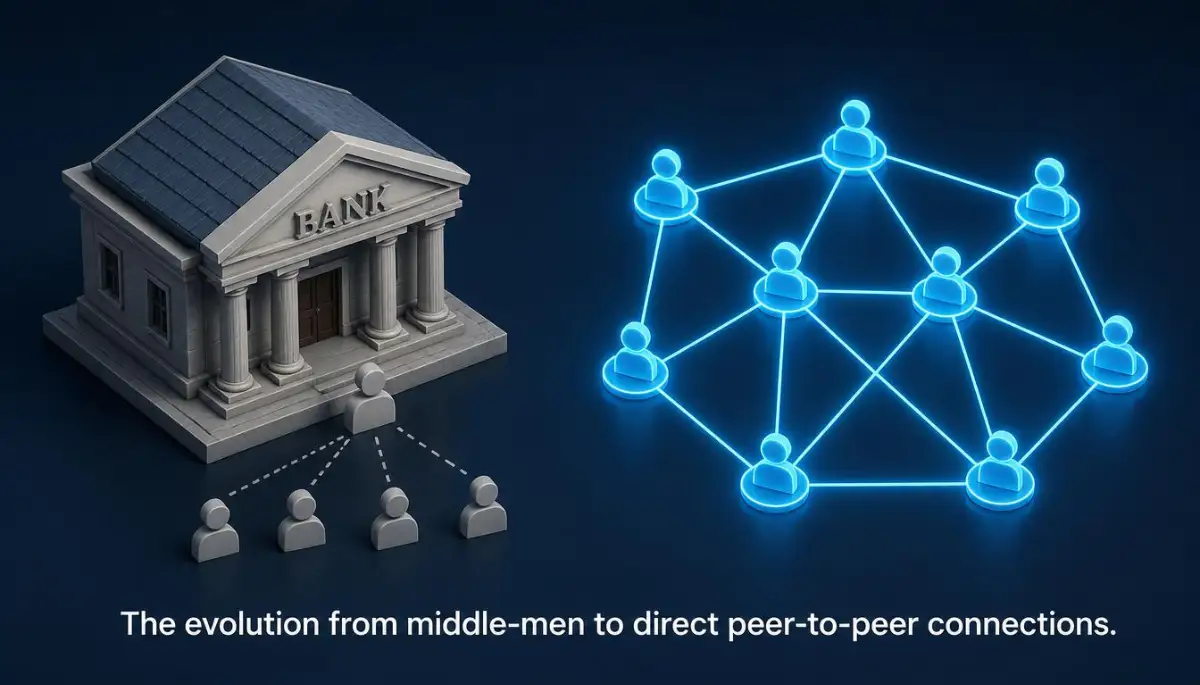
Breaking Down the Wall: What is Centralized Finance (CeFi)?
To understand where we are going, we first have to look at where we are. Centralized Finance, or CeFi, is the system most of us use every day. Think of your local bank, your credit card company, or even big crypto exchanges like Coinbase or Binance.
In this system, there is always a "middle-man" in the room. When you swipe your card, the bank verifies the transaction. They act as the gatekeeper. The main feature of CeFi is trust in an institution.
You trust the bank to keep your balance accurate. You trust them to protect you from fraud. In the crypto world, CeFi platforms work similarly. You give them your coins, and they manage the security for you. It feels familiar and safe for many.
The Pros and Cons of Staying Centralized
The Rise of the Machine: What is Decentralized Finance (DeFi)?
Now, imagine a world where the bank building doesn't exist. Imagine a system where the "rules" are written in computer code instead of being decided by a board of directors. This is Decentralized Finance, or DeFi.
In DeFi, there is no central authority. No one can freeze your account. No one can tell you that you aren't allowed to send money on a Sunday. Everything happens directly between people using blockchain technology.
Instead of a human teller, you interact with "Smart Contracts." These are pieces of code that automatically execute an action when certain conditions are met. If I want to lend you money, the code handles the collateral and the interest without a bank taking a cut.
Why DeFi Feels Like Freedom
For many, DeFi is about ownership. When you use a decentralized system, you hold the "keys" to your wallet. If you don't have those keys, you don't truly own the assets.
In a traditional bank, you technically have a "claim" on the money, but the bank has the physical cash. In DeFi, the money stays in your digital pocket until the exact second you decide to move it.
Comparing the Two Paths: A Simple Analogy
Let’s look at this like a library versus an automated vending machine.
The CeFi Library: You go to a building. You talk to a librarian. They check your ID. They decide if you are allowed to borrow the book. If the library is closed, you get nothing.
The DeFi Vending Machine: The machine is on the sidewalk 24/7. You put in the required amount, and the machine gives you the item immediately. It doesn't care who you are or what time it is. The rules are built into the machine.
How to Navigate the Shift Safely
Moving from a bank to a decentralized system can feel scary. It is a big jump. But you don't have to do it all at once. Most people start by learning the basic steps of digital safety.
Step 1: Understanding Your Identity (KYC vs. Anonymity)
In the CeFi world, you have to prove who you are. This is called Know Your Customer (KYC). You upload your passport and your address. This helps prevent crime, but it also means the company knows everything about your spending habits.
In DeFi, your identity is just a string of numbers called a wallet address. You don't need to show an ID to use a decentralized exchange. This protects your privacy, but it also means there is no "Forgot Password" button if you lose your access.
Step 2: Choosing Your Storage Method
Where you keep your assets is the most important choice you will make.
- Custodial Wallets (CeFi): The exchange keeps the keys. This is good for beginners. If you lose your login, they can help you get back in.
- Non-Custodial Wallets (DeFi): You keep the keys. You have total power. However, if you lose your "seed phrase" (your master password), the money is gone forever.
Pro Tip: Always write your seed phrase on paper and hide it. Never keep a photo of it on your phone where hackers can find it.
The Reality of Risks in Both Systems
It would be wrong to say one system is perfect and the other is broken. Both have risks that you need to be aware of.
In CeFi, the risk is the institution. Banks can go bankrupt. Exchanges can be hacked or can freeze your funds during a market panic. You are betting on the honesty and stability of a company.
In DeFi, the risk is the technology. Since there is no human oversight, a bug in the code can be exploited by hackers. There is no insurance fund to pay you back if a smart contract fails. You are betting on the math and the code.
Myth vs. Reality: Clearing the Confusion
Myth: DeFi is only for hackers and criminals.
Reality: Most DeFi users are regular people looking for better interest rates and faster transactions. It is a transparent system where every transaction is public.
Myth: Centralized banks are 100% safe.
Reality: History shows that banks can fail. Inflation can also eat away the value of the money sitting in your savings account.
Myth: You need to be a computer genius to use DeFi.
Reality: Modern apps are becoming very user-friendly. If you can use a banking app, you can learn to use a crypto wallet.
The Role of Transparency in Your Wealth
One of the most beautiful things about decentralized systems is transparency. In a traditional bank, you don't know what they are doing with your money behind closed doors. They might be lending it out for risky investments that you don't approve of.
In the world of DeFi, the "ledger" is open. Anyone can look at the blockchain and see exactly how much money is in a lending pool. You can see the code. You can see the transactions. Nothing is hidden. This builds a different kind of trust—trust in data rather than trust in a CEO.
Why Fees Matter More Than You Think
Over a lifetime, bank fees and slow transfer costs can add up to thousands of dollars. When you use a centralized system, everyone takes a small bite of your sandwich. The payment processor, the clearinghouse, and the bank all want a fee.
In a decentralized system, you usually only pay a "gas fee" to the network itself. This fee goes to the people (miners or validators) who keep the network running. Often, especially on newer networks, these fees are much lower than traditional international wire fees.
Taking the First Step Toward Financial Literacy
The goal isn't necessarily to quit your bank tomorrow. The goal is to have options.
Start by opening a small digital wallet. Learn how to send a tiny amount of a stable asset to a friend. Watch how it arrives in minutes, not days. Feel what it's like to be your own bank.
We are living through a change in how the world thinks about value. Whether you prefer the safety net of a centralized company or the raw freedom of a decentralized network, knowing the difference is your greatest asset.
Wealth is not just about how much money you have. It is about how much control you have over that money. By learning these systems, you are putting the power back into your own hands.
Now that you understand the basic differences between central banks and decentralized apps, it is time to look at the professional secrets. Moving from a beginner to an expert in this field requires a shift in how you think about risk and reward.
Strategies for a Balanced Financial Life
Most people think they have to choose only one side. They think they must be 100% with a traditional bank or 100% in the world of crypto. In my experience, the smartest way to manage your wealth is to build a bridge between both.
Think of your money like a garden. You wouldn't plant only one type of seed, right? You want different plants that grow in different seasons. Using a hybrid strategy allows you to keep the safety of a bank while enjoying the high growth of decentralized platforms.
I personally keep my emergency savings in a traditional bank. This is money I can withdraw at an ATM at any time. But for my long-term wealth, I look toward decentralized options. By understanding the real power of blockchain technology, you can see how these systems offer more than just a place to store coins.
The Power of "Stable" Assets
One of the best expert secrets is the use of stablecoins. These are digital assets pegged to the value of a physical currency like the Dollar. In the DeFi world, these act as your "safe harbor."
When the market gets wild, experts move their funds into these stable assets. They still stay within the decentralized system, but they aren't worried about price drops. This allows you to earn interest that is often much higher than a local bank would ever offer.
I often tell people to treat their stablecoins like a digital high-yield savings account. You are bypassing the bank's overhead costs. Since the app doesn't have a CEO or a physical building, those savings are passed directly to you.
Why Diversification is Your Best Friend
Never put all your digital eggs in one basket. Even within the decentralized world, there are different "networks." Some networks have low fees, while others are known for being the most secure.
I suggest splitting your assets across at least two or three different platforms. This protects you if one platform has a technical glitch. It is the same reason why people don't keep all their cash in a single wallet in their pocket.
If you are just starting to rebuild your financial life after a rough patch, you might find that rebuilding your credit score is easier when you have a clear view of your digital and physical assets. Keeping a clean record in both worlds makes you a much stronger borrower in the future.
Learning to Read the Room
The world of decentralized finance moves on data. You can actually see how many people are using a platform before you put your money there. This is a huge advantage over traditional banks.
Check the "Total Value Locked" on sites that track these things. It tells you how much trust other people have placed in that specific code. If a platform has millions of dollars and has been running for a long time, it is generally considered more reliable.
Research from groups like the Ethereum Foundation shows that open-source code is audited by thousands of eyes. This community-driven security is something a private bank can never truly offer.
The Secret of Cold Storage
If you plan on holding your wealth for a long time, you need to know about "cold storage." This means taking your digital keys off the internet entirely. You put them on a physical device that looks like a USB drive.
When your keys are offline, hackers cannot reach them. It is the digital version of putting gold in a basement safe. I highly recommend learning the mechanics of cold storage if you want to sleep peacefully at night.
It might seem like extra work, but the peace of mind is worth every second. Once your wealth is in cold storage, you are truly the only person on earth who can move it. That is the ultimate form of financial independence.

The Invisible Hazards That Catch People Off Guard
When you step outside the traditional banking system, you are entering a world without a safety net. This can be exciting, but it is also where many people make mistakes that cost them dearly. I have seen people lose years of savings in a single afternoon because they ignored a few simple rules.
The biggest trap is the "Free Money" lure. You might see an ad on social media promising to double your money in a day. Or you might get a message from someone pretending to be "Support."
Always remember this: No real finance company will ever ask for your secret 12-word seed phrase. If anyone asks for it, they are trying to steal from you. I have seen the heartbreak of people who shared that phrase and watched their balance go to zero in seconds. It is a pain I never want you to feel.
The Danger of Ignoring "Gas" Fees
In the decentralized world, every move costs a tiny bit of money. This is paid to the network. Sometimes, if the network is very busy, these fees can get very high.
I knew a student who tried to move $50 worth of assets, but the fee was $60. He clicked "Confirm" without looking and ended up losing money on the deal. Always check the transaction cost before you hit the button.
Think of it like driving a car. You wouldn't drive across the state to buy a cheaper loaf of bread if the gas cost more than the savings. Always be mindful of the "overhead" of your digital moves.
Emotional Trading and the "FOMO" Effect
The "Fear Of Missing Out" is a real psychological struggle. You see a new digital coin going up in price and you feel like you are being left behind. This is when most people buy.
But buying when everyone is excited is usually the worst time to enter. Experts do the opposite. They buy when things are quiet and boring. They sell when everyone else is screaming with excitement.
If you find yourself checking your phone every five minutes to see the price, you are trading with your heart, not your head. This leads to exhaustion and poor choices. True wealth is built with patience, not panic.
Verifying the Code
In DeFi, the code is the law. But sometimes, that code has hidden "backdoor" left by dishonest developers. This is called a "Rug Pull."
The developers wait for people to put money in, and then they suddenly drain the account and disappear. To avoid this, only use platforms that have been audited by professional security firms.
According to a cybersecurity report from CertiK, platforms that undergo regular audits are significantly less likely to suffer from major exploits. Never trust a brand-new app that hasn't been tested by the community.
Starting Your Journey Toward True Ownership
As we wrap up this look into the future of money, I want you to feel empowered. We are living in a time where the gatekeepers are losing their power. You no longer have to wait in line at a bank to take control of your life.
The path between centralized and decentralized finance isn't a race. It is a slow walk. Start by simply watching and learning. Read the news. Understand how different systems work.
Every time you learn a new term or set up a new security feature, you are building a wall around your future. You are making sure that no matter what happens to the world economy, you have the tools to survive and grow.
Your Action Plan for This Week
I want you to take one small step today. Don't worry about being perfect. Just start.
First, look at your current bank fees. See how much they are charging you just to hold your money. Then, download a highly-rated digital wallet and just explore the interface. You don't even have to put money in yet. Just see how it feels to have the controls in your hand.
If you enjoy learning about how technology changes our lives, you might also find it interesting to learn about how to protect your electric vehicle battery. Just like managing your digital wealth, taking care of your modern tools requires a bit of knowledge and the right habits.
A Final Word of Encouragement
You have the brain and the ability to master this. Don't let the technical words scare you. At the end of the day, finance is just about people and trust.
We are moving into an era where we trust math and transparency more than big logos and tall buildings. This is a good thing for the average person. It levels the playing field. It gives everyone, regardless of where they live, the same access to financial tools.


![7 Hidden Traps in Decentralized Finance You Must Know [Step-by-Step Defense]](https://topic36.com/storage/uploads/blogs/1788868861_7-hidden-traps-in-decentralized-finance-you-must-know-step-by-step-defense.webp)