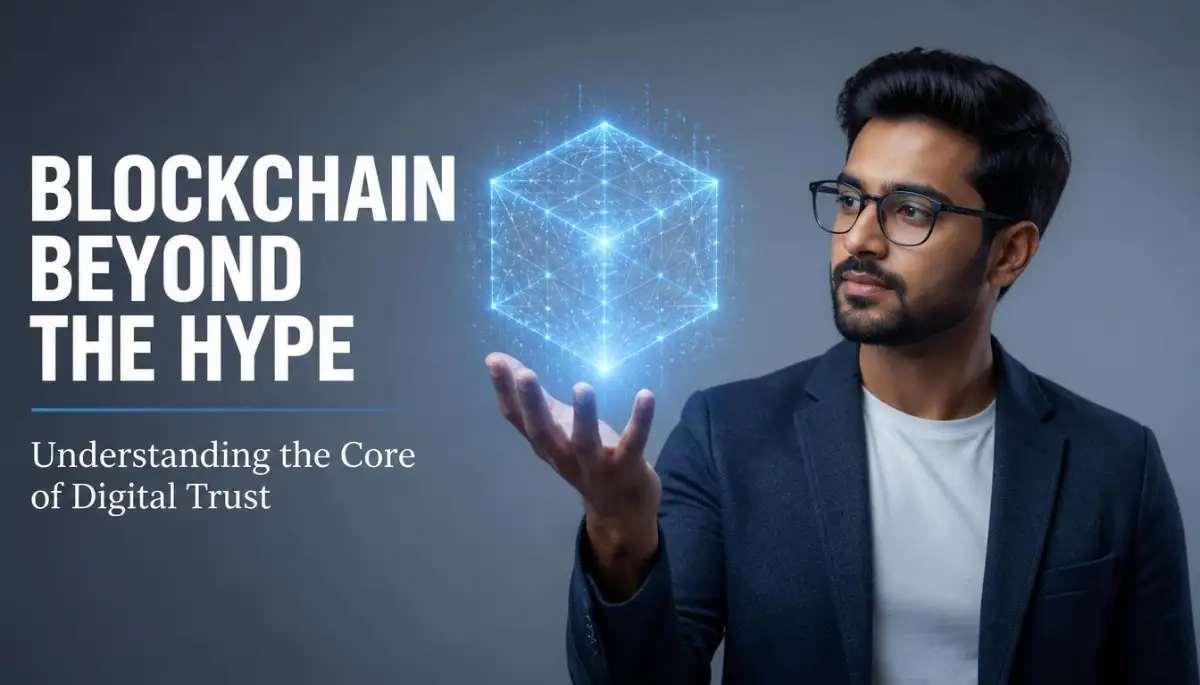
The Frustrating Noise of the Modern Digital Gold Rush
Have you ever felt like you are standing in the middle of a crowded room where everyone is shouting in a language you don't understand? That is exactly how most people feel when they hear the word blockchain.
You see it on the news every day. People talk about getting rich overnight or losing everything in a market crash. This constant noise makes it very hard to see what is actually happening under the hood.
I remember talking to a friend who spent his life savings on a coin he didn't understand. He thought blockchain was just a gambling tool. When the market dipped, his peace of mind vanished. He couldn't sleep, and he felt a deep sense of regret.
This is the reality for millions. We are surrounded by "hype" that promises quick wealth, but we are starving for real knowledge. This lack of understanding creates a deep sense of anxiety. We feel like we are missing out on the future, yet we are too scared to touch it because it feels like a house of cards.
Is it just about money? Or is there something deeper?
The truth is, the mental stress of trying to follow the "next big thing" without knowing how it works is exhausting. It feels like trying to build a house on shifting sand. We want security. We want to know that the technology we use is honest and transparent.
Blockchain was not created to make people rich in a week. It was created to solve a very old human problem: Trust.
When we can't trust the systems around us, we feel stuck. We feel like the "big players" always have the upper hand. This is the "pain" of the digital age. We want to take back control, but the technical jargon keeps us locked out.
Let’s stop looking at the price charts for a moment. Let's look at the actual engine. When you understand the engine, you no longer fear the speed of the car.
Why We Need a System That Doesn't Need a Middleman
To understand why this tech is a big deal, we have to look at how we live right now. Think about your bank account.
When you send money to a friend, you are not actually sending "money." You are asking a bank to change a number in their private book. You trust the bank to do it right. You trust them not to lose your record.
But what if the bank's system fails? What if they charge you high fees just to move your own money? This is what we call a centralized system. One big boss holds all the cards.
The Problem with Single Points of Failure
In a normal world, we rely on "middlemen" for everything. We use them for banking, for social media, and for legal contracts.
This creates a big risk. If the middleman gets hacked, everyone suffers. If the middleman wants to block you, they can. You don't truly own your data or your transactions.
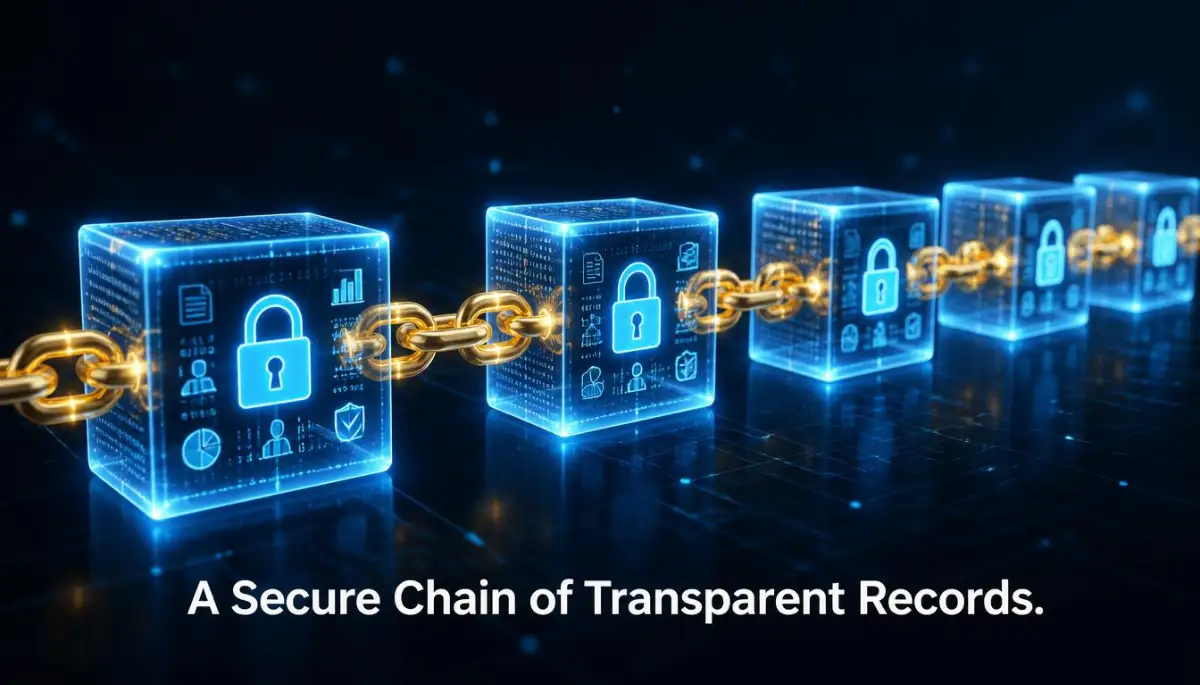
Blockchain changes this dynamic. It is like a shared digital notebook that everyone can see but nobody can secretly change.
Imagine a village where every single person has a copy of a record book. Every time someone buys a bag of grain, everyone writes it down at the same time. If one person tries to lie and say they didn't buy it, their book won't match the other 99 books. The village will know the truth immediately.
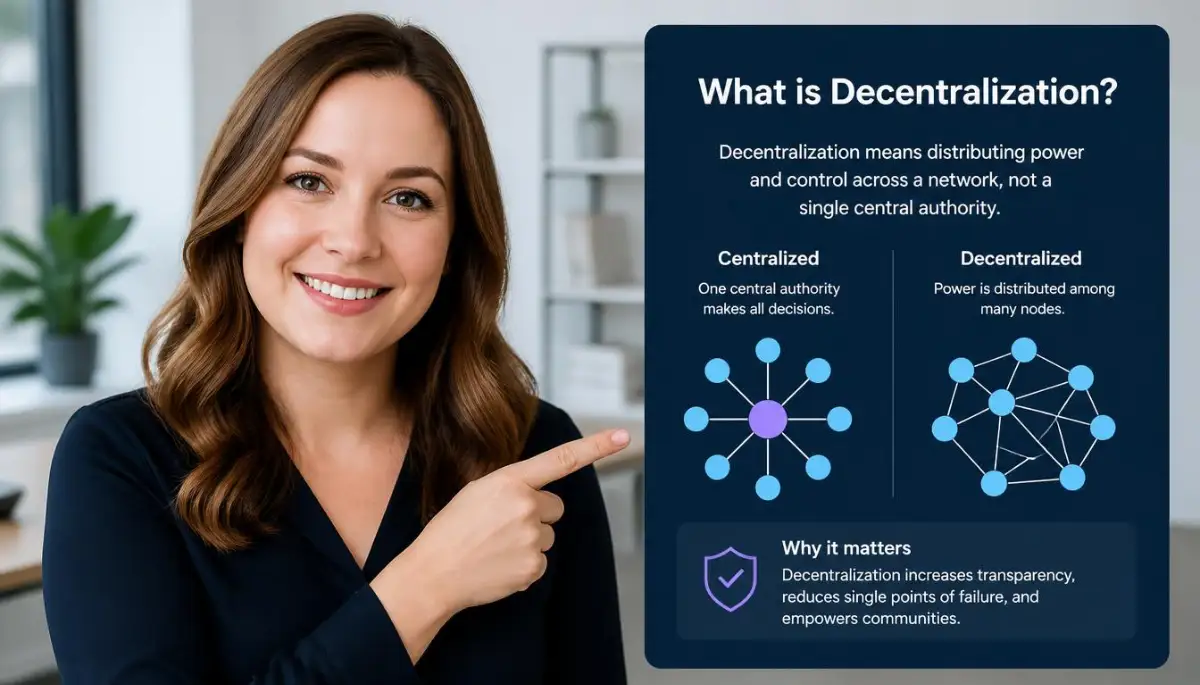
This is the heart of Decentralization. It removes the need to trust one single "boss." Instead, we trust the collective record of the group.
Breaking Down the "Block" and the "Chain"
Let’s make this even simpler. Think of a "Block" as a digital page of transactions.
Each page (block) has three main things:
- The Data: The details of the transaction (who sent what).
- A Hash: Think of this as a digital fingerprint. It is unique to that specific page.
- The Hash of the Previous Block: This is the "glue" that creates the chain.
Because each block points to the one before it, you cannot change a single thing in an old block without breaking the entire chain. If you change one letter on page 1, its fingerprint changes. Since page 2 was looking for the old fingerprint, the link breaks.
This makes the system immutable. "Immutable" is just a fancy word for "it cannot be changed." Once it is written, it is there forever. This gives us a level of honesty that we have never had in human history.
The Magic of Network Consensus
You might wonder, "Who decides which block gets added next?"
In a bank, the bank decides. In a blockchain, the Network decides. This is done through something called a "Consensus Mechanism."
Think of it as a digital voting system. Thousands of computers (called nodes) all over the world look at the new data. They check if the person actually has the money they want to send. They make sure the fingerprints match.
Only when the majority of these computers agree does the "block" get added to the "chain." No one can "cheat" the system because they would have to trick more than half of the computers in the world at the exact same time. That is practically impossible.
Real-Life Scenario: The Broken Trust
Let’s look at a real-life example of why this matters. Imagine a small business owner named Sarah. Sarah sells organic honey.
She wants to prove to her customers that her honey is 100% pure and comes from a specific farm. In the old way, she just puts a label on the jar. The customer has to "trust" her. But labels can be faked.
If Sarah uses a blockchain, every step of the journey is recorded. When the honey leaves the farm, a digital record is made. When it is bottled, another record is added. When it reaches the store, one more record is created.
The customer can scan a code and see the entire history. They don't have to trust Sarah. They can trust the unchangeable record. This is why we call it a "Trust less" system. It doesn't mean trust is gone; it means the system is so solid that you don't need to worry about trust.
Why Digital Transparency is a Game Changer
We live in a world of "fake news" and "deep fakes." It is becoming harder to know what is real.
Blockchain gives us a "Source of Truth." It doesn't matter if you are talking about money, medicine, or voting. Having a record that cannot be deleted or edited by a politician or a CEO is a powerful tool for freedom.
Pro Tip: Most people think blockchain is only for Bitcoin. That is like thinking the internet is only for email. Bitcoin is just the first "app" built on blockchain. The technology itself can be used for almost anything.
The Role of Miners and Validators
You might have heard of "Mining." It sounds like something you do in a dark cave with a pickaxe. In the digital world, it’s a bit different.
Miners are just powerful computers. Their job is to solve very hard math puzzles. Why? Because solving the puzzle proves that they have put in the "work." This keeps the network safe from spam.
If it was free to add a block, someone could flood the network with fake data. By making it cost "work" (electricity and time), the system stays honest. In return for this work, the miners get a small reward. This is how the system keeps itself running without a central company paying for it.
Practical Steps to Understanding the Tech
If you want to grasp this today, you don't need to be a coder. You just need to change how you think about data.
- Stop seeing it as "Coins": Start seeing it as a "Database." It’s just a new way to store info.
- Look for Middlemen: Notice how many things in your life require a "third party." Could those be replaced by a shared record?
- Think about Ownership: On the normal internet, you don't own your photos or your posts. The platform owns them. On a blockchain, you hold the "Key." You are the only one who can move your data.
By shifting your mindset, the "hype" starts to fade away. You begin to see a very logical, very clever way of organizing the world. It is not magic. It is just a better digital notebook.
This is the end of Part 1. We have covered the "Why" and the "How." In the next part, we will look at how this technology is moving into our homes, our hospitals, and our voting booths.
The world is changing. Not because of a market price, but because we have finally found a way to agree on the truth without needing a boss. That is the real revolution.
Mastering the Invisible Gears of Digital Integrity
We have already explored why the old way of doing things—relying on a big middleman—is starting to show its age. Now, I want to take you deeper. If the "block" and the "chain" are the skeleton, then what we are about to discuss is the brain and the nervous system of this technology.
Once you see how these pieces fit together, you will understand why companies are spending billions to integrate this into their systems. It is not about the price of a coin. It is about a fundamental shift in how we handle truth in a digital world.
The Rise of the "Automated Handshake"
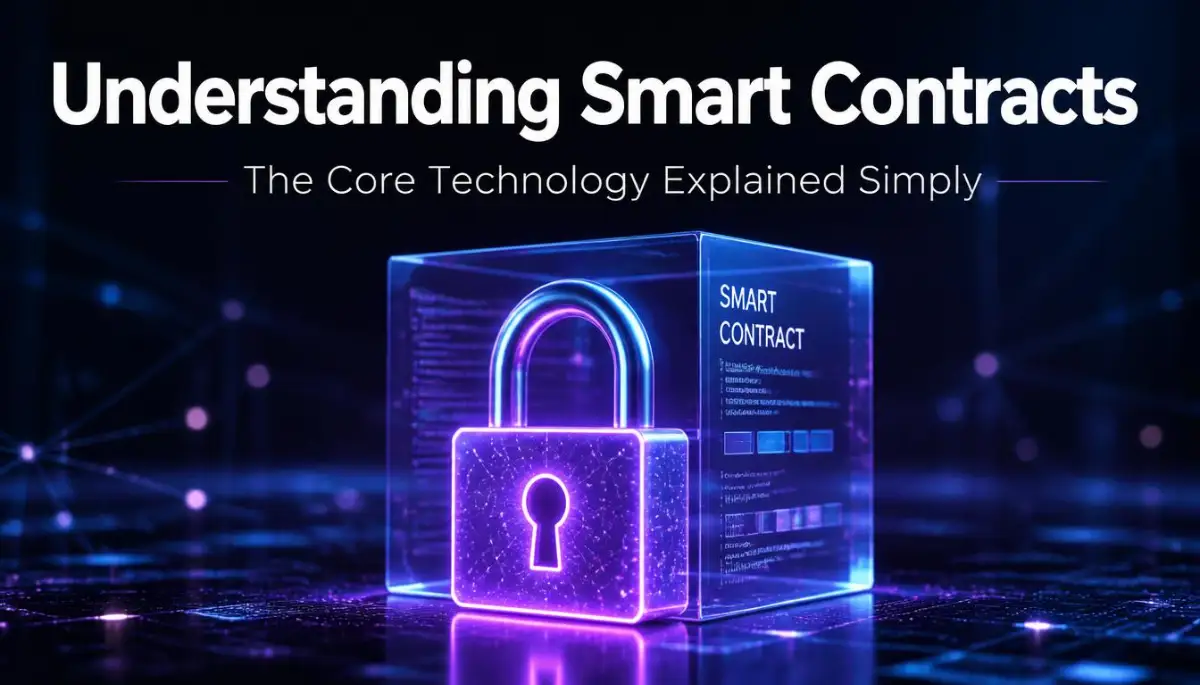
One of the most powerful secrets of this technology is the Smart Contract. Think of this as a digital "if-then" statement that lives on the blockchain. In our normal lives, if I promise to pay you for a service, we might sign a paper contract. If I don’t pay, you have to hire a lawyer and go to court. That costs time and money.
A smart contract removes that friction. Imagine you are a freelance designer. You and your client use a smart contract. The contract says: "If the designer uploads the final logo file, then the payment is automatically sent to the designer."
No one can stop it. No one can change their mind at the last minute. The code is the law. This is exactly how many modern developers are rethinking efficiency. Just as generative AI is changing the way developers write code, blockchain is changing how those same developers ensure their work is paid for and protected.
Reclaiming Your Digital Identity
How many times a week do you click "Login with Google" or "Login with Facebook"? Every time you do that, you are giving away a piece of your privacy. You are letting a giant company track your movements across the web.
Blockchain offers a different path called Self-Sovereign Identity. Instead of a central company owning your "login," you own a digital key. You decide exactly what information to share. If a website needs to know you are over 18, you can prove it without showing your birthday, your name, or your address.
You share a "proof," not the data itself. This puts the power back in your hands. It stops the constant leaking of your personal life to advertisers. It creates a shield around your digital existence that is almost impossible to pierce.
The Secret of Decentralized Storage
Most of us use the cloud to store our photos and files. But "the cloud" is just someone else's computer. If their server goes down, or if they decide to delete your account, your memories are gone.
Advanced blockchain systems use Distributed Storage. Instead of one big server, your file is encrypted, broken into tiny pieces, and spread across thousands of different computers. No single person has the whole file. Only you have the key to pull those pieces back together.
This means your data is not just safe; it is permanent. It is a level of security that makes a standard password look like a toy. For many people, this shift is as important as their physical health. Just as your gut bacteria holds the secret to a stronger immune system, a healthy digital ecosystem relies on a diverse, distributed network to stay resilient against attacks.
Why Transparency Changes Everything for Small Businesses
Let’s go back to Sarah and her honey business. If she uses these advanced tools, she can do more than just prove the honey is pure. She can automate her entire supply chain.
When the temperature in the delivery truck gets too hot, a sensor can record that on the blockchain. The smart contract could then automatically lower the price for the customer or cancel the order. This level of honesty builds a brand that people will never leave.
You don't need a massive marketing budget when you have mathematical proof that you are doing a good job. This is the "secret sauce" that will allow small players to compete with global giants.
The Hidden Traps That Could Cost You Everything
While this technology is beautiful in its logic, the road is full of holes that can swallow your progress. I have seen too many people walk into these traps because they were blinded by the light of "innovation."
The biggest mistake is the Loss of Personal Responsibility. In the old world, if you lose your bank password, you call the bank. They verify your ID and give you a new one. In the blockchain world, there is no "Forgot Password" button.
The Weight of the Private Key
Your "Private Key" is the only thing that proves you own your data or your assets. If you lose it, it is gone forever. There is no customer support line. There is no manager to talk to.
This creates a high level of stress for many users. They treat their digital keys like a grocery list, leaving them on their phone or a sticky note. Then, their phone breaks or the note gets thrown away.
This is a financial disaster that is often permanent. If you find yourself in a situation where you've lost control of your digital assets, it feels much like trying to rebuild your credit score after a major financial disaster. It takes time, learning, and often, starting over from zero.
Chasing the "Ghost" of Complexity
Another common pitfall is over-complicating the solution. Just because a blockchain can solve a problem doesn't mean it should.
I see people trying to put everything on a blockchain—their grocery lists, their daily habits, their coffee orders. This is a waste of energy. Blockchain is for things that need Trust, Security, and Permanence.
If you use it for things that don't matter, you just end up with a slow, expensive system. Always ask yourself: "Do I really need a record that can never be deleted for this specific thing?" If the answer is no, stay with a traditional database.
The Mirage of "Get Rich Quick"
This is the most painful mistake. People see blockchain as a lottery ticket. They ignore the technology and focus only on the price.
This leads to "Panic Selling" and "Panic Buying." They lose their mental peace. They stop sleeping. They check their phone 50 times an hour.
This isn't investing; it is gambling. When you treat a fundamental technology like a casino, you usually walk away with empty pockets. The real winners are the ones who learn how the system works and use it to build something useful.
Confusing Decentralization with Lawlessness
Some people think that because there is no "boss," there are no rules. They try to use the tech to hide from their responsibilities or engage in dishonest behavior.
They forget that a blockchain is Transparent. While your name might be hidden behind a string of numbers, every single move you make is recorded forever. It is actually the worst place to try and hide a mistake. Eventually, the dots get connected. Honest users love this; dishonest users should fear it.
Your Path to a Clearer Digital Future
We are standing at a crossroads. One path leads back to the old way—where we are just "users" of a system we don't own. The other path leads to a world where we are "owners" of our data, our money, and our digital lives.
Choosing to learn this technology is a big step. It is a commitment to a more honest way of living. Deciding to embrace this change is a significant life choice, similar to the logic used when buying a home is smarter than renting. It is an investment in your future self and your long-term security.
A Simple Action Plan for You
You don't need to be a mathematician to start. Here is how you can begin today:
- Read a Whitepaper: Start with the original Bitcoin whitepaper by Satoshi Nakamoto. It is surprisingly short and written in plain English. According to research from the National Institute of Standards and Technology (NIST), understanding the core logic of a ledger is the first step toward digital literacy.
- Use a Non-Custodial Wallet: Small steps matter. Set up a digital wallet where you hold the keys. Don't put much money in it; just see how it feels to be the only person in charge of that "digital box."
- Look for Real Use Cases: Watch how companies like IBM are using blockchain to track food safety. This will help you see the "Hype" vs. the "Help."

![7 Hidden Traps in Decentralized Finance You Must Know [Step-by-Step Defense]](https://topic36.com/storage/uploads/blogs/1788868861_7-hidden-traps-in-decentralized-finance-you-must-know-step-by-step-defense.webp)