The Heartbreak of Seeing Your Hard Work Stolen
Imagine this for a moment. You spent three weeks hunched over your desk. You skipped sleep to perfect that logo or finish that digital painting. It was your best work yet.
You post it online to share your joy with the world. A few months later, you are scrolling through social media. You see a big brand using your exact design on a T-shirt. They are making thousands of dollars. You haven't received a single penny or even a "thank you."
Your heart sinks. Your stomach turns into a knot. You feel violated and small.
I see this happen to talented creators every single day. Most artists think their work is safe just because they signed it. Or they think the law is too complicated to understand.
This confusion is exactly what allows others to take advantage of you. It is not just about a lost drawing. It is about your livelihood and your mental peace.
When you don't know your rights, you live in constant fear. You hesitate to share your work. You stay quiet when someone "borrows" your idea.
Do you feel like you are walking on eggshells with your own portfolio? Are you worried that your best ideas are being quietly harvested by others?
You are not alone in this struggle. The creative world is full of myths that keep people like us from getting paid what we deserve. Let’s break those walls down right now.
The Automatic Shield: You Own It the Moment You Make It
One of the biggest lies in the creative world is that you need a lawyer to own your work. This is simply not true.
In most parts of the world, copyright is born at the moment of creation. If you draw a sketch on a napkin, you own the copyright to that sketch immediately.
You do not need a fancy stamp or a government certificate to be the owner. As soon as your idea is "fixed" in a tangible form, it belongs to you.
This means a digital file, a recorded song, or a written poem is protected the second you save it. This is a powerful realization.
You are already an owner of intellectual property. You don't have to wait for permission to call yourself a "rights holder."
Pro Tip: Always keep your original working files (like .PSD, .AI, or raw camera files). These are your best proof of creation date.
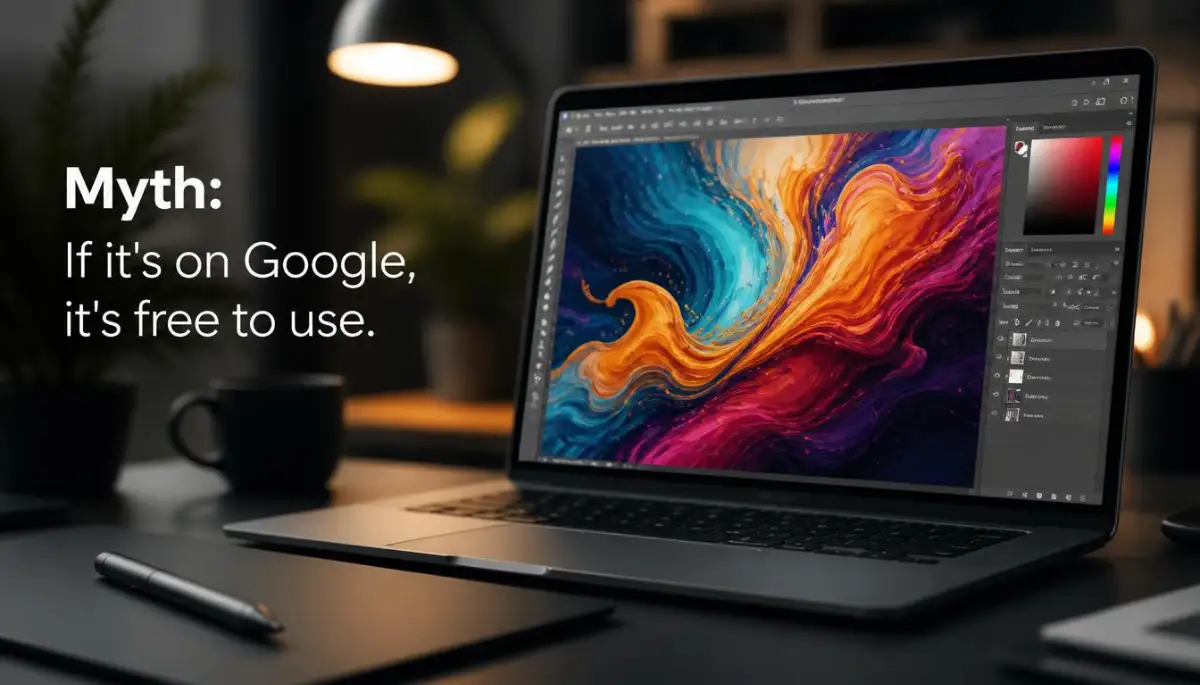
The Google Myth: Why "Found Online" Does Not Mean "Free"
I hear this a lot: "But I found it on Google Images, so it's public domain, right?"
This is a dangerous mistake. Google is a search engine, not an image library.
Just because an image is easy to download does not mean it is free to use. Almost every image you see online is owned by someone.
Using an image without a license is like taking a car because the keys were left inside. It is still theft.
This applies to your work too. People might say they "didn't know" they couldn't use your art.
Ignorance is not a legal defense. You have the right to tell them to take it down or pay for it.
Watermarks: The False Sense of Security
Many artists believe that a watermark is a magic shield. They think a logo in the corner stops thieves.
The truth is that modern AI can remove watermarks in seconds. They often ruin the look of your art for your real fans too.
Watermarks are helpful for branding, but they are not a legal requirement. You own the work with or without that little text in the corner.
Instead of relying only on watermarks, focus on metadata. You can hide your name and contact info inside the digital file itself.
This is much harder for a casual thief to find and delete. It stays with the image even if it gets shared around.
The "Poor Man’s Copyright" Is a Total Waste of Time
Have you ever heard that you should mail your work to yourself? People call this the "Poor Man’s Copyright."
The idea is that the postmark proves the date you created the work. In a modern court of law, this rarely holds up.
It is very easy to forge or mess with a sealed envelope. Judges and lawyers don't take it seriously anymore.
If you want real legal weight, you should register your work with your national copyright office. It usually costs a small fee but offers huge protection.
In some countries, you cannot even sue for damages unless you have registered. If your work is worth thousands, a small registration fee is a smart investment.
The "Work for Hire" Trap: Who Really Owns the Result?
When you work for a client, who owns the final product? Many creatives assume they keep the rights and just "lend" the work to the client.
This depends entirely on your contract. If your contract says "Work for Hire," you might be giving away every single right you have.
In a "Work for Hire" setup, the client is legally considered the "author." You might not even be allowed to put the work in your own portfolio.
Always read the fine print before you sign. If you want to keep your rights, ensure the contract says you are "licensing" the work.
Licensing means you let them use it, but you still own the "soul" of the creation. This allows you to sell the same style or concept to others later.
The Difference Between an Idea and an Expression
You cannot copyright an idea. This is a hard pill for many creators to swallow.
If you have an idea for a story about a wizard boy, you don't own that concept. Anyone can write about a wizard boy.
You only own the specific way you tell that story. You own your specific characters, your dialogue, and your world-building.
This is why we see so many similar movies and games. The law protects the "expression," not the "thought."
If you see someone using a similar style to yours, it might not be a legal violation. Style is very hard to protect.
However, if they copy your specific layout, colors, and character poses, that is where the line is crossed. Understanding this boundary will save you a lot of stress.
Why Small Projects Still Need Big Protection
You might think, "I'm just a small freelancer, I don't need to worry about IP."
This is exactly what scammers love to hear. Small creators are easier targets because they rarely fight back.
Even a simple blog post or a small icon set has value. If you don't value it, no one else will.
Start by having a basic "Terms of Service" on your website. Tell people exactly how they can and cannot use your work.
It doesn't have to be long or full of legalese. Simple, clear language works best.
"You can share this on social media with a link back to my site, but you cannot sell it or use it for ads."
This one sentence can save you hours of legal headaches later. It shows that you are a professional who knows their worth.
The Reality of "Fair Use" in the Digital Age
"Fair Use" is one of the most misunderstood terms in law. People think it means they can use anything for "educational" purposes.
Fair use is actually very narrow. It usually only applies to things like news reporting, teaching, or parody.
Even then, a judge has to decide if it was actually fair. It is not a "get out of jail free" card.
If you are using someone else's work, always ask for permission first. It is the respectful and legal thing to do.
On the flip side, if someone uses your work and claims "fair use," look closely. Are they actually teaching something, or are they just using your art to get clicks?
Don't let people hide behind big words to steal your talent. Stand your ground.
Your Reputation Is Your Most Valuable Asset
At the end of the day, intellectual property is about more than just money. It is about your reputation.
If people see your work being used poorly or in the wrong context, it hurts your brand. You lose the power to choose who you are associated with.
By protecting your IP, you are protecting your future. You are making sure that your name stands for quality and integrity.
We have covered a lot of ground today. You now know that you are a legal owner from day one. You know that Google is not a free store. You know that contracts matter more than stamps.
But this is only the beginning of your journey toward creative freedom. There are specific steps you can take right now to lock down your portfolio and start earning more.
In the next part, we will look at how to handle a thief without spending a fortune on lawyers. We will also discuss how to write simple licenses that clients will love to sign.
You have the talent. Now you have the knowledge. It is time to treat your creativity like the valuable business it really is. Keep your head high and your files backed up. Your best work is yet to come.
Smart Strategies to Guard Your Digital Assets Forever
Now that you know the basics, let's talk about the heavy hitters. Protecting your work is not a one-time event. It is a long-term habit that separates hobbyists from high-earning professionals.
One of the best ways to prove ownership in the digital age is through Digital Fingerprinting. Every time you export a file, you can embed invisible data into it. This goes beyond just right-clicking a file to see its properties.
There are advanced tools that create a unique "hash" for your work. Think of this as a DNA test for your art. If someone steals your image and changes the colors, the hash can often still prove you are the source.
Speaking of digital proof, some creators are now using modern tech to track their assets. You can look into the real power of blockchain technology to understand how a permanent digital ledger helps verify who made what. It is a great way to keep an unchangeable record of your creative timeline.
Mastering the Art of the "Friendly" Takedown
When you find a thief, don't start with a scream. Your first reaction might be to post a public rant on social media. This often backfires and makes you look unprofessional.
Instead, use a tiered approach. Start with a polite but firm DMCA Takedown Notice. Most website owners and social media platforms have a specific form for this.
You don't need a lawyer to send these. You just need to show that you own the original work. Platforms like Instagram, Pinterest, and Google take these notices very seriously.
Often, a simple email works even better. "I noticed you used my illustration without a license. I'm happy to let you keep it if you pay the standard $200 usage fee."
You would be surprised how many businesses will pay up just to avoid legal trouble. This turns a theft into a surprise sale. It is about being a business person first and an artist second.
The Professional Licensing Blueprint
Every time you give work to a client, you should give them a License Agreement. This is a short document that explains exactly what they can do.
Can they use it on a billboard? Can they put it on a coffee mug? Can they use it for 10 years or just one?
If you don't define these limits, they will assume they can do anything. This is where you lose money. By setting clear boundaries, you create "add-on" opportunities.
If they want to use the logo for a second brand, they have to pay an extra fee. This is how you build a sustainable income. You can learn more about managing your creative assets like you would manage your crypto for decades by using secure storage and clear records.
International Rights: Thinking Beyond Your Borders
The internet has no walls. Someone in another country can see and use your work in a heartbeat.
Luckily, most countries follow a set of rules called the Berne Convention. This means if you have copyright in your home country, most other countries will respect it too.
However, enforcing your rights in a foreign country is hard. This is why you should focus on platforms that have global reach.
If a site in another country steals your work, go to their hosting provider. Most big hosting companies are based in places that follow strict IP laws. They can pull the plug on the whole website if the owner refuses to remove stolen content.
Fatal Errors That Kill Your Creative Career
Many creators unknowingly sign away their future because they are "just happy to be hired." This is a dangerous mindset that leads to financial ruin.
The biggest mistake is the Handshake Deal. We live in a world where "my word is my bond" sounds nice, but it doesn't hold up in court.
If it isn't in writing, it basically didn't happen. Even a simple email chain can count as a contract. Never start work until you have a written summary of who owns what.
I have seen artists lose years of work because they trusted a "friend" who later sold the company. Without a contract, the artist had zero claim to the profits.
Losing your intellectual property can lead to a massive financial hit. If you ever find yourself struggling after a legal battle, you might need to know how to rebuild your credit score to get back on your feet. Protecting your IP is just as much about financial health as it is about art.
The "All Rights Reserved" Social Media Trap
When you upload a photo to social media, you are not usually giving away your copyright. But you are giving the platform a Broad License.
This means they can use your work to promote their own site without paying you. They can't sell your photo to a brand, but they can show it in their ads.
The mistake is using social media as your only portfolio. If that platform disappears or changes its rules, you lose control.
Always have a self-hosted website where you set the rules. This gives you a home base that no algorithm can take away.
Over-sharing Your Process Too Early
We all love showing "Work in Progress" (WIP) shots. It builds engagement and looks cool.
But if you share a high-resolution version of an unfinished idea, someone can finish it for you. They can take your sketch, trace it, and claim it as their own.
Only share low-resolution or watermarked versions of your process. Keep the "secret sauce" behind closed doors until the final version is registered and ready.
Ignoring the "Derivative Work" Clause
A derivative work is anything based on your original art. If you make a character, and someone else draws that character in a new pose, that is a derivative work.
The mistake is letting fans or clients create these without your permission. You should always have a policy for Fan Art.
While fan art is great for marketing, you need to make sure nobody is profiting from it. If they start selling stickers of your character, they are stealing your IP.
Address this early. A simple "Fan Art Policy" page on your site can prevent a lot of heartaches later on. It keeps the community happy while keeping your bank account safe.
Turning Your Talent into a Protected Powerhouse
Protecting your rights is not about being mean or greedy. It is about respecting yourself and the hours you have put into your craft.
You are a creator. You bring things into the world that didn't exist before. That is a form of magic, and it has real-world value.
Start today by auditing your current projects. Check your old contracts. See if you have left any "open doors" for thieves.
Don't be afraid to ask for what you are worth. The right clients will respect you more when they see you take your IP seriously. It shows them that you are a professional who understands the industry.
The world of intellectual property can seem scary, but you now have the map. You know how to spot the myths and how to use the law to your advantage.
Take a deep breath. You don't have to fix everything in one day. Just start by making your next contract a little stronger and your next upload a little more secure.
Your future self will thank you for the work you do today. Go out there and create something amazing, knowing that you have the tools to keep it yours forever.
Expert Action Plan:
- Keep every working file as proof of date.
- Use a basic licensing agreement for every client.
- Set up a Google Alert for your name or brand to catch theft early.
- Never sign a "Work for Hire" contract without a higher fee.
![Decoding Complex Legal Terminology in Your Job Offer [Step-by-Step]](https://topic36.com/storage/uploads/blogs/1788064638_decoding-complex-legal-terminology-in-your-job-offer-step-by-step.webp)
![Warning: Are You Missing Out on These 3 Employee Protections? [Blueprint]](https://topic36.com/storage/uploads/blogs/1787202538_warning-are-you-missing-out-on-these-3-employee-protections-blueprint.webp)