Why Learning Decentralized Tech Feels Like Hitting a Brick Wall
I remember staring at my laptop screen until my eyes literally burned. My goal was simple enough: I wanted to understand how this whole decentralized network thing actually worked.
But every article I opened was stuffed with heavy technical jargon, confusing diagrams, and math concepts that made my head spin. I felt incredibly frustrated and honestly, a little bit stupid.
Every time I tried to read a whitepaper, I found myself getting lost in a sea of strange buzzwords. My confidence dropped, and I seriously started to wonder if I was just not smart enough to grasp modern technology.
I was spending hours reading, but nothing was sticking in my brain. It felt like everyone else in the world was moving forward while I was stuck at the starting line.
This is a very real struggle for so many of us today. We hear these big technical words constantly on the news, in podcasts, and at work. We know this technology is changing the internet, but the learning curve feels completely impossible.
When you cannot understand the basic mechanics of how things work, it creates a deep sense of anxiety. You start feeling like you are missing out on important opportunities simply because the explanations are too robotic and complicated.
But I eventually realized something amazing. The actual concepts behind these networks are not difficult at all. The problem was never my brain, and it is certainly not yours.
The real issue is that most experts simply do not know how to explain things to regular humans. They forget what it feels like to be a beginner.
Once I stopped reading boring textbooks and started looking at real-world examples, everything finally clicked for me. I want to share exactly how these systems operate, using plain English and simple stories.
Breaking Down the Digital Notebook (The Core Concept)
Let us forget about computers for a second and imagine a group of ten friends. These friends want to keep track of who owes money to whom when they go out for dinner.
Normally, they would give one person a notebook and trust that person to write everything down correctly. That one person is acting like a traditional bank.
But what happens if that person loses the notebook? What if they accidentally write down the wrong amount? This single point of failure is exactly how our current digital systems operate.
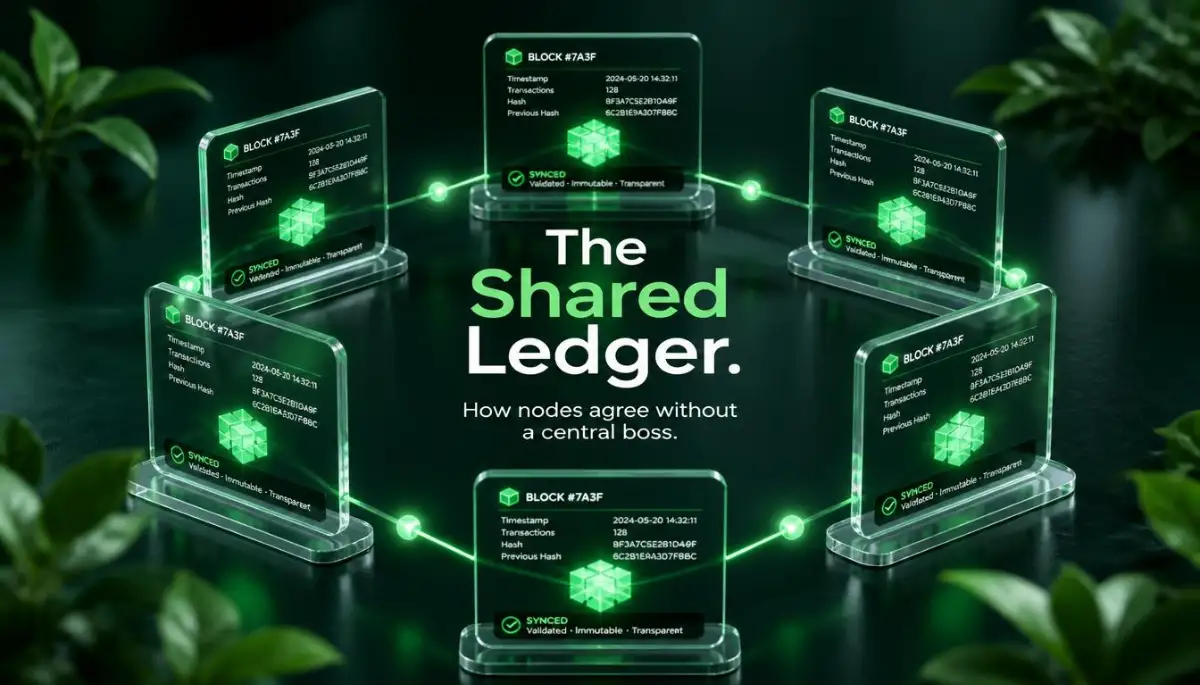
A distributed ledger changes this entire process completely. Instead of one person holding the notebook, all ten friends get their own exact copy of the notebook.
Whenever someone pays for dinner, they announce it loudly to the whole group. Every single person writes that transaction down in their personal notebook at the exact same time.
If one friend tries to cheat and changes a number in their book, the other nine friends will look at their copies and realize something is wrong. They will immediately reject the fake number.
Why This Idea Changes Everything
This simple group notebook concept is the entire foundation of a decentralized system. There is no central boss, no middleman, and no single point of failure.
Because everyone holds a copy of the truth, the system becomes incredibly secure and transparent. You no longer have to place blind trust in one single organization.
When applied to digital information, we call these friends "nodes." A node is simply a computer connected to the network that holds a copy of the exact same data.
Are you struggling to visualize this network in action? Watch this incredibly helpful breakdown before we move deeper into the technical mechanics.
The Secret Anatomy of a Block
Now that we understand the shared notebook, we need to know how the actual data is stored. Think of a block as a digital shipping container.
This container is meant to hold information. That information could be money transfers, medical records, or tracking data for a shipment of coffee beans.
Once this digital container is completely full of verified information, it gets permanently sealed. You cannot open it back up to change anything inside.
The Magic of the Digital Fingerprint
When the container is sealed, it receives a very specific, mathematically generated stamp on the outside. This stamp is called a "Hash."
Think of a hash as a unique human fingerprint. No two fingerprints are ever the same.
If someone somehow manages to break into the sealed container and changes even a single comma in the data, the entire fingerprint changes immediately.
This makes it incredibly easy for the network to spot tampered information. If the fingerprint does not match the original record, the network rejects the container.
Connecting the Chain
Here is where the magic really happens. Every new container (block) that gets created must include the exact fingerprint of the container that came right before it.
Imagine linking physical metal chains together. Each link is permanently welded to the previous link.
If a hacker wants to change a piece of data in an old block, they would have to change its fingerprint. But because the next block carries that old fingerprint, the hacker would have to change that one too.
They would have to successfully alter every single block in the entire chain, across thousands of computers, all at the exact same time. Mathematically, this is basically impossible.
The Reality of Network Agreement (Consensus)
You might be wondering how thousands of random computers around the world agree on what information is true. Since there is no boss, how do they make decisions?
They use something called a consensus mechanism. This is basically a set of strict rules that all computers must follow to verify new data.
The Mathematical Puzzle Approach
One popular method forces computers to solve incredibly difficult mathematical puzzles. Think of it like a giant digital lottery.
The first computer to guess the correct answer to the puzzle wins the right to seal the new block of data. Because they spent a lot of computing power and electricity to solve it, they get a small reward.
If they try to add fake data to the block, the other computers will reject it. The cheating computer would lose all the money they spent on electricity for absolutely nothing.
The Security Deposit Approach
Another popular method does not use heavy math puzzles. Instead, it asks participants to lock up some of their own digital money as a security deposit.
If they do a good job of verifying honest data, they earn small rewards on their deposit. It is very similar to earning interest in a savings account.
If they try to approve fake data or attack the network, they immediately lose their security deposit as a punishment. It creates a system where honesty is always the most profitable choice.
A Quick Insight From My Journey:
I used to spend hours trying to memorize exactly how these math puzzles worked on a coding level. My biggest mistake was focusing on the complex math instead of understanding the basic human psychology behind it. Once I realized these systems are simply designed to financially reward honesty and punish cheating, the entire technology made perfect sense to me.
Traditional Systems vs. Decentralized Networks
To make things even clearer, let us look at a direct comparison. It helps to see exactly how this modern architecture compares to the databases we use every day.
This table shows exactly why so many industries are excited about upgrading their systems. It is not just about digital money; it is about creating unbreakable trust.
Myth vs. Reality: Clearing the Confusion
When you start learning about this topic, you will hear a lot of rumors. Let us clear up some of the biggest misunderstandings right now.
Myth: This technology is completely anonymous and untraceable.
Reality: The entire system is built on total transparency. While your actual name might not be attached, every single action you take is permanently recorded and visible to the entire public.
Myth: It is just a passing trend for tech nerds.
Reality: Major global shipping companies use it to track cargo. Large hospitals are testing it for patient records. It is already operating quietly in the background of many physical industries.
Myth: You need to be a programmer to use it.
Reality: Just like you do not need to understand HTML to use a web browser, you do not need to read code to use decentralized applications. The user interfaces are becoming incredibly simple.
Real-World Scenarios That Make Sense
Let us step away from the theory and look at how this architecture solves actual problems. Imagine a farmer growing organic coffee beans in South America.
Currently, that coffee goes through dozens of different companies before it reaches your local cafe. Information gets lost, and sometimes regular coffee is mislabeled as organic.
If the supply chain runs on a distributed ledger, the farmer logs the harvest time into the system. The shipping company logs the transport data. The customs office logs the border check.
As a consumer, you could simply scan a barcode on your coffee bag. You would instantly see a permanent, unchangeable history of exactly where your beans came from.
Securing Digital Identity
Another massive problem we face today is identity theft. We constantly give our private data to websites, hoping their servers do not get hacked.
With decentralized architecture, you could own a single digital ID on your phone. When a website needs to verify you are over eighteen, your digital ID sends them a quick mathematical proof.
The website never actually gets to see your birthday, your name, or your address. They only receive a verified "Yes" or "No" from the network.
The Hidden Mechanics of Smart Contracts
We cannot talk about this architecture without mentioning smart contracts. The name sounds intimidating, but the concept is actually brilliant and very simple.
Think of a smart contract like a digital vending machine. When you walk up to a vending machine, there is no human standing inside taking your money.
The machine operates on a very simple rule: "If the customer inserts one dollar, then drop a bottle of water." It is entirely automatic and based on pure logic.
A smart contract is just a piece of code that lives permanently on the network. It executes specific actions automatically when certain conditions are met.
Automating Trust
Imagine you are renting an apartment. Usually, you give a large security deposit to a landlord, and you just have to trust they will give it back when you leave.
With a smart contract, your money is held in a neutral digital vault. The rule could be: "If the digital smart lock on the door confirms the tenant has moved out by the 30th, return the deposit automatically."
The landlord does not have to remember to send the money, and the tenant does not have to beg for it back. The math handles the entire transaction perfectly.
This completely removes the need for expensive lawyers or third-party mediators. It builds a system where trust is mathematically guaranteed rather than just promised.
How Information Moves Across the Globe
Have you ever wondered what actually happens when you hit the "send" button on a decentralized network? The journey of your data is fascinating.
First, your request is sent out to the network and placed into a digital waiting room. This waiting room holds all the pending actions from people all over the world.
The active nodes look at this waiting room and start picking up requests. They check the digital signatures to make sure no one is trying to spend money they do not have.
Once your request is verified as honest, it gets packed into the newest block. When that block is finally sealed with its unique hash, your action becomes a permanent part of digital history.
This entire process often happens in just a few seconds. Thousands of computers coordinate their actions smoothly without a single human manager telling them what to do.
It is a beautiful example of how organized networks can operate independently. We are witnessing a complete shift in how global data is managed and secured.
Moving From Beginner to Pro: Mastering Network Mechanics
Now that we understand the basic concept of the shared digital notebook, it is time to look a little deeper. You do not need to become a programmer to master these concepts.
You just need to know how to navigate this new environment safely. The biggest advantage you can have right now is knowing exactly how to protect your own digital space.
When you start interacting with these networks, you will immediately run into the concepts of public and private keys. This is where most people get incredibly confused, but it is actually a very simple system.
Think of your public key like your home address or your email address. You can give this address to anyone in the world safely.
If someone wants to send you a secure digital file, a digital asset, or an encrypted message, they simply send it to that public address.
But your private key is completely different. Your private key is like the physical metal key that unlocks your front door, or the secret password to your bank account.
Whoever holds the private key has absolute control over everything inside that specific address. This brings us to a major shift in how we handle our digital lives.
The Ultimate Responsibility of True Ownership
In our current internet system, we are used to hitting the "forgot password" button when we make a mistake. A friendly customer service agent resets our account and we move on.
A decentralized network does not have a customer service department. Because there is no central boss, there is nobody to call if things go wrong.
When you create a digital wallet to store your assets, the software gives you a master password. This is usually a secret list of twelve or twenty-four random words, known as a recovery phrase.
This phrase is the mathematical root of your private key. If your computer crashes or you lose your phone, those secret words are the absolute only way to recover your data.
To really succeed in this space, you must treat those recovery words like physical gold bars. This means writing them down on a piece of paper and storing them in a fireproof safe.
Never take a screenshot of your secret phrase with your phone. Hackers regularly scan cloud photo storage looking for pictures of these exact recovery phrases.
Recognizing Fake Decentralization
As this technology becomes more popular, many companies are trying to jump on the trend. They will build products that use all the right buzzwords but are actually completely centralized.
You need to know how to spot the difference. A true distributed network is open source, meaning anyone can review the underlying code.
If a company tells you they have a "private blockchain" where only their employees approve the transactions, that is just a regular database wearing a fancy costume.
The real power of this architecture comes from anyone being able to participate as a node. The more independent computers join the network, the stronger and safer the whole system becomes.
If you are running a node from your home computer, you will quickly notice how important your network stability is. You might even need to fix your slow internet connection to ensure your computer stays perfectly synced with the rest of the globe.
How Experts Evaluate Smart Contracts
Earlier, we talked about smart contracts acting like digital vending machines. But what happens if the code inside the machine has a bug?
Unlike a regular computer program that can be patched tomorrow, a smart contract is permanent once it is uploaded to the ledger. If there is a mistake in the code, it stays there forever.
This is why serious projects go through intense technical reviews before they launch. Security experts spend weeks trying to break the code to find hidden weaknesses.
Before interacting with a new decentralized app, always check if their smart contracts have been publicly audited. You can actually find great insights on security standards from organizations like the National Institute of Standards and Technology, which helps define safe cryptographic practices.
Just like discovering the real secret to building products that people actually love, building a successful decentralized app requires extreme attention to user safety and trust. If an app feels rushed or hides its code, simply walk away.

The Painful Traps Waiting for Unprepared Beginners
When people first discover the power of distributed ledgers, they often get overly excited. This excitement leads to rushing, and rushing leads to devastating mistakes.
I want to share these common pitfalls not to scare you, but to protect you. These are the traps that catch smart people completely off guard every single day.
The Tragedy of the Lost Keys
I recently heard a heartbreaking story about a man who stored highly valuable digital assets on an old laptop. He felt very proud of himself for being early to the technology.
But he made one massive error. He saved his secret recovery phrase in a simple text file on his desktop instead of writing it down on physical paper.
One afternoon, he accidentally spilled a cup of coffee completely over his keyboard. The hard drive short-circuited and was totally destroyed.
Because he did not have a physical backup of his secret words, the network locked him out permanently. The assets are still sitting on the ledger today, totally untouched, but he will never be able to access them again.
This is the harsh reality of self-custody. The network did exactly what it was supposed to do by keeping intruders out, but it also kept the owner out.
Sending Data to the Wrong Universe
Another terrifying mistake involves moving assets or data between different networks. You see, not all digital ledgers are connected to each other.
Think of them like different train tracks built in different countries. A train built for a wide track cannot suddenly drive on a narrow track.
Many beginners try to send information from Network A directly to a wallet on Network B. Because the two systems speak completely different mathematical languages, the data gets lost in the void.
Once you hit that send button, there is no way to cancel the transaction. Always send a tiny test amount first to make sure you have the exact right address and the correct network selected.
Trusting the Middleman Trap
It is incredibly ironic how this mistake happens. People get excited about removing middlemen from their lives, so they buy digital assets on a large centralized exchange platform.
Instead of moving those assets to a private wallet they control, they leave everything sitting on the exchange's website. They assume the big company will keep their data perfectly safe.
But if that exchange goes bankrupt, gets hacked, or simply decides to freeze accounts, you lose everything. You do not actually own any assets if a corporation holds the private keys.
As the famous industry saying goes: "Not your keys, not your coins." If you rely on a central company to hold your assets, you have completely missed the entire point of the technology.
If you want to understand how frequently these centralized platforms face security threats, you can look at the annual reports from Chainalysis, a highly respected firm that tracks digital network vulnerabilities.
Blindly Approving Bad Contracts
When you use a decentralized application, your digital wallet will ask you to sign a permission slip. This pop-up screen asks you to approve the smart contract's actions.
Most people just blindly click "Approve" without reading anything, treating it like the terms and conditions on a software update. This is incredibly dangerous.
Some malicious smart contracts are quietly designed to drain everything out of your wallet the moment you give them permission. You must read what the contract is actually asking to do.
If a simple digital art application asks for permission to spend all your assets, that is a massive red flag. Always disconnect your wallet from websites immediately after you finish using them.
Your Personal Action Plan for Tomorrow
You have just absorbed a massive amount of technical knowledge, and you should honestly be proud of yourself. Most people run away the second they hear the word cryptography.
But you stayed, you learned, and you now understand the mechanics better than the majority of the population. The mystery is finally gone.
Just like you might arrange furniture to maximize natural light to make a room feel bigger, organizing your digital knowledge clears away the confusion in your mind.
You now know that a distributed ledger is just a shared notebook synchronized across thousands of computers. You understand that miners or validators are just following strict rules to keep the network honest.
You also know exactly how to avoid the dangerous traps that catch eager beginners. Your foundation is incredibly solid.
Where to Go From Here
Start by exploring block explorers online. These are simply search engines for different ledgers, where you can watch live transactions happening globally in real-time.
You do not need to buy anything to participate in the learning process. Just watching the blocks get sealed one by one is a fascinating way to see the theory in action.
Check out our latest articles and guides here to continue expanding your knowledge on modern technology and practical solutions. The digital world is changing fast, and staying informed is your best defense.
A Quick Final Thought From Me:
I know exactly how overwhelming this tech can feel on day one. But I promise you, taking the time to learn these basics will put you years ahead of the crowd. My biggest piece of advice is to stay curious, take things slowly, and never let complicated jargon intimidate you again!
People Also Ask: Decentralized Networks Explained
Does a distributed ledger always use massive amounts of energy?
Not necessarily. While older mathematical puzzle systems use a lot of electricity, modern networks use security deposit systems instead. These updated methods use 99% less energy and are completely friendly to the environment.
Can a government or company shut down a decentralized network?
It is practically impossible to shut down a true decentralized network. Because identical copies of the ledger exist on thousands of private computers globally, you would have to simultaneously destroy every single node across the entire planet.
Are smart contracts actually legally binding in the real world?
This depends entirely on your local laws and what the contract is doing. While the computer code will execute automatically no matter what, many modern legal systems are starting to officially recognize these digital agreements in court.
What actually happens if I completely lose my private key?
If you lose your private key and have no backup of your secret recovery phrase, your digital assets remain permanently locked on the ledger forever. No hacker, company, or network developer can ever open that digital vault for you.
Can I fix a mistake if I send data to the wrong network address?
Unfortunately, you cannot reverse a transaction once the network seals it into a block. This permanent design prevents digital fraud, but it means you must double-check every single address before you click the send button.
Disclaimer: The information provided in this article is for educational and informational purposes only and does not constitute financial, legal, or technical advice. Engaging with decentralized networks involves significant risks. Always conduct your own thorough research and consult with a certified professional before making any technical or financial decisions.