The Hidden Threat to Everything You Have Built
Imagine waking up on a normal Tuesday. You drive to work, grab your coffee, and go about your day. But on the way home, a small distraction leads to a major car accident.
Suddenly, you are not just dealing with a broken bumper. There are medical bills for others that go way past what your auto insurance covers.
In a few weeks, you get a letter from a lawyer. They are suing you for more than your house is worth. This is where the real panic sets in for most people.
The weight of a lawsuit can feel like a mountain on your chest. You start to wonder if your kids' college fund is safe. You worry if they can take your home or your retirement savings.
This isn't just a scary story. It happens to regular people every single day. We work hard for years to buy a home and save money, but we often leave the "back door" wide open.
Standard insurance policies for your car and home have limits. These limits are often much lower than you think. If a judge orders you to pay $1 million and your insurance stops at $300,000, you are on the hook for the rest.
That gap is where most people lose their peace of mind. It is a scary reality that keeps many homeowners awake at night once they realize the risk.
We live in a world where accidents happen and legal costs are rising. Relying only on basic coverage is like wearing a raincoat that only covers your shoulders. When the heavy storm hits, you are still going to get soaked.
Understanding the Invisible Shield for Your Finances
You might be asking, "What exactly is this extra layer?" Think of it as a safety net that sits right above your existing policies.
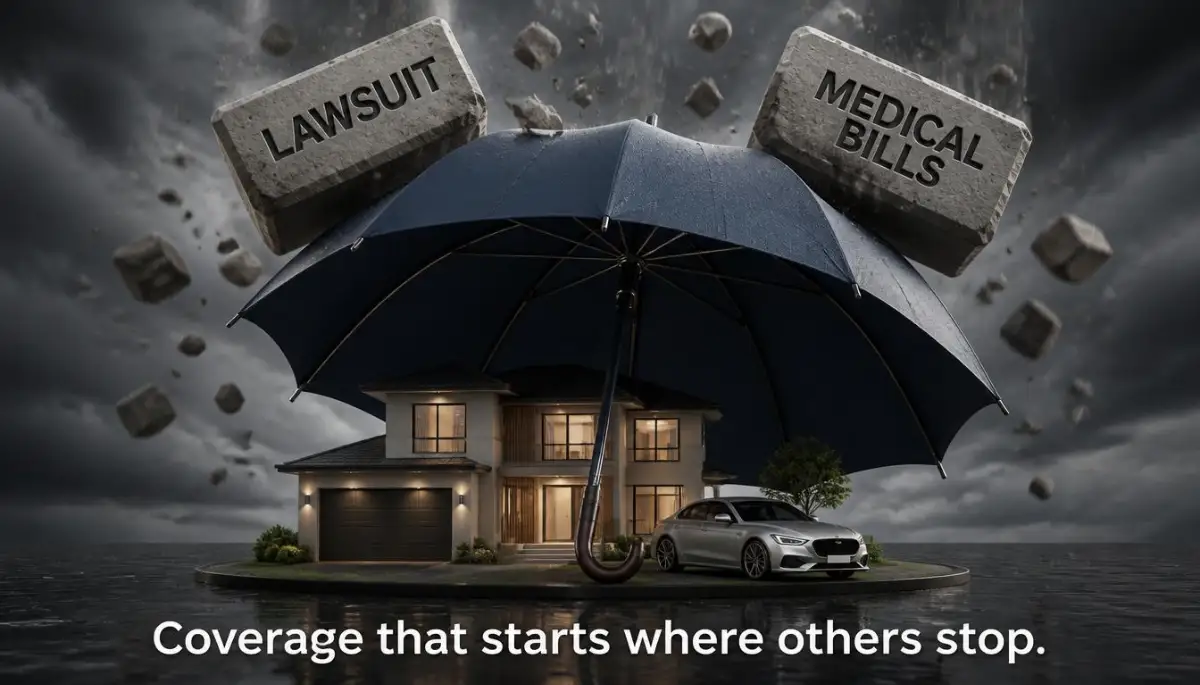
Umbrella insurance provides extra liability coverage. It kicks in only after your basic auto or homeowners insurance reaches its maximum limit.
It is called "umbrella" because it covers everything underneath it. It adds a broad layer of protection over your existing assets and future income.
Most people think this is only for the super-rich. I used to think that too. But the truth is, if you own a home or have a steady job, you have something to lose.
If you are sued for a large amount, the court doesn't care if you are a millionaire. They look at what you own and what you will earn in the future.
Why Your Standard Policy Isn't Enough
Your car insurance is great for small accidents. Your homeowners insurance is perfect for a small kitchen fire.
However, these policies are designed for "average" problems. They are not built to handle "catastrophic" legal claims.
Most auto policies cap out at a few hundred thousand dollars. In a serious injury case, hospital bills alone can pass that limit in just a few days.
Once that limit is hit, your insurance company basically hands you the bill and walks away. You are then left to defend yourself in court and pay the remaining balance.
This is why an umbrella policy is a game-changer. It picks up the bill where the other guys left off. It also pays for your legal defense, which can cost thousands of dollars on its own.
The True Cost of "Not Knowing"
Many people skip this coverage because they think it is too expensive. In reality, it is often the cheapest insurance you can buy for the amount of protection you get.
You can often get a $1 million policy for less than a dollar a day. Compare that to the cost of losing your entire life savings in one afternoon.
The "pain" of paying a small premium is nothing compared to the "struggle" of a decade-long legal battle. We see families lose their homes because of one slip-on-ice at their front porch.
How this Safety Net Actually Works in Real Life
Let’s look at a quick example. Suppose you have a dog. Your dog is usually friendly, but one day it bites a neighbor.
The medical bills and the trauma claim come to $500,000. Your homeowners insurance only covers up to $300,000 for liability.
Without an umbrella policy, you owe $200,000 out of your own pocket. Where does that money come from? It comes from your savings, your equity, or your future wages.
With an umbrella policy, that extra $200,000 is covered. You don't have to sell your car or drain your bank account. You can keep your life moving forward without a financial collapse.
Common Myths About Extra Liability Protection
There is a lot of bad advice out there. Let’s clear up some of the things people get wrong about this topic.
Myth: "I don't have enough assets to worry about."
Reality: Even if you don't have a million dollars in the bank, your future wages can be garnished. You are protecting your future self, not just your current wealth.
Myth: "I'm a safe driver and a good neighbor."
Reality: You can't control other people. You can't control the weather or freak accidents. Being "good" doesn't stop a lawsuit from landing on your desk.
Myth: "My regular insurance will always protect me."
Reality: Every policy has a "ceiling." Once you hit that ceiling, the protection stops.
Who Needs This Coverage the Most?
While everyone can benefit, some people are at higher risk. You should definitely consider this if you:
- Own a home or rental property.
- Have a swimming pool or a trampoline.
- Have a teenage driver in the house.
- Own a dog or other pets.
- Host parties or gatherings often.
- Coach youth sports or volunteer on boards.
The Surprising Benefits You Didn't Know About
Umbrella insurance doesn't just cover the basics. It often covers things that your regular policies ignore completely.
For example, it can protect you against "slander" or "libel." If you post a review online and a business sues you for hurting their reputation, your umbrella policy might help.
It also covers you for "false arrest" or "invasion of privacy." These are modern risks that didn't exist in the same way decades ago.
In a world where everyone has a smartphone and social media, these risks are higher than ever. One wrong post or one misunderstood comment can lead to a legal nightmare.
Legal Defense: The Hidden Value
One of the best parts of this coverage is the legal team. When you have an umbrella policy, the insurance company provides the lawyers.
Legal fees can reach $500 per hour very quickly. Even if you win the case, the cost of defending yourself can ruin you financially.
The insurance company wants to win just as much as you do. They will hire the best experts to protect their money—which in turn, protects yours.
You are essentially hiring a high-end legal team for a few dollars a month. That is a win for anyone who values their security.
How to Choose the Right Amount of Coverage
Deciding how much protection you need isn't as hard as it seems. A good rule is to look at your total "net worth."
Add up the value of your home, your savings, and your investments. If that number is higher than your auto or home liability limits, you have a gap.
Most umbrella policies start at $1 million. You can usually increase this in $1 million steps.
Don't forget to include your future income. If you are young and have a high-paying career ahead of you, you are a target for larger lawsuits.
Does it Cover Professional Mistakes?
It is important to know that personal umbrella insurance is for "personal" life. It does not cover your business or professional mistakes.
If you are a doctor or a lawyer, you need separate professional liability insurance. However, if someone trips at your house during a weekend BBQ, that is where your umbrella policy shines.
Keeping your personal and professional risks separate is a key part of good management. You want to make sure every area of your life has its own shield.
Practical Steps to Get Covered Today
Getting this protection is usually very simple. You generally need to have your home and auto insurance with the same company.
Step 1: Check your current limits.
Most companies require you to have a certain amount of "base" coverage before they sell you an umbrella. This is usually $250,000 or $500,000 on your car and home.
Step 2: Ask for a quote.
Call your current agent. Ask them what it would cost to add a $1 million or $2 million umbrella policy. You might be surprised at how low the price is.
Step 3: Review your "risks."
Tell your agent about your dog, your pool, or any rental properties you own. Make sure everything is listed so there are no surprises later.
A Simple Comparison
As you can see, the difference is huge. One stays close to home, while the other follows you wherever you go.
Final Thoughts on Building Your Safety Net
Risk management is not about being afraid. It is about being smart. It is about knowing that life is unpredictable.
We can't stop accidents from happening. We can't stop people from filing lawsuits. But we can control how much these events affect our families.
By adding this layer of protection, you are putting a lock on your financial future. You are making sure that one bad day doesn't erase twenty years of hard work.
Take a moment today to look at your policies. See where your limits end. If you see a gap, don't wait for the storm to start before you reach for the umbrella.
The peace of mind you get from knowing your assets are safe is worth every penny. You deserve to sleep well at night, knowing your family is protected no matter what happens tomorrow.
Maximizing Your Safety Net: Expert Strategies for Long-Term Protection
Now that you understand the basics, it is time to look at how the pros handle their protection. Just having a policy isn't enough if it isn't set up the right way.
One of the biggest secrets in the insurance world is policy coordination. Your umbrella policy is like the roof of a house. If the walls (your home and auto insurance) aren't the right height, the roof won't fit.
Most umbrella policies require you to have specific "underlying limits." For example, they might require you to carry $250,000 in bodily injury coverage on your car. If you lower your car insurance to save money without telling your umbrella provider, you create a "gap."
If an accident happens, you might have to pay that gap out of your own pocket. This is a nightmare scenario that is easily avoided by a quick annual review with your agent.
The Power of the "Drop-Down" Feature
Did you know that some umbrella policies cover things that your basic insurance doesn't touch at all? This is called a "drop-down" feature.
In these cases, the umbrella policy acts as your primary insurance. It doesn't just sit on top; it steps in to defend you from the very first dollar. This is very common in cases involving personal injury like libel or false arrest.
If you are active on social media or volunteer in your community, this feature is a lifesaver. One misunderstood post could lead to a massive legal claim. Having a policy that "drops down" to cover these modern risks is a massive advantage.
Handling Multiple Properties and Assets
If you are a landlord or own a vacation home, your risk is much higher. You have more "surfaces" for someone to get hurt on.
When you add an umbrella policy, make sure every single property is listed. Some people assume that because they have a policy, it covers everything they own automatically.
This is a dangerous assumption. Always double-check that your rental units are specifically included. If you are debating is buying a home smarter than renting the real money facts, you should also consider the liability that comes with being a homeowner or a landlord.
More property means more potential for lawsuits. A slip and fall at a rental property can quickly exceed the standard $300,000 liability limit.
Why High-Limit Earners Need Even More
Your current net worth is only part of the story. Lawyers often look at your "human capital" or your ability to earn money in the future.
If you have a high-paying career, a court can order a "wage garnishment." This means a portion of your paycheck is taken every month for years to pay off a judgment.
An umbrella policy protects your future self. It ensures that the money you haven't even earned yet stays in your pocket. This is why many financial experts suggest having a policy limit that exceeds your current net worth.
For those who have faced financial setbacks, you know how hard it is to bounce back. If you are currently trying to how to rebuild your credit score after a major financial disaster, the last thing you need is a new lawsuit. Protection is the first step in any wealth-building plan.
Keeping Your Protection Strong Over Time
Your life changes, and your insurance should change with it. I recommend doing a "risk audit" every time you hit a major milestone.
Did you buy a boat? Did you get a new dog? Did your teenager get their driver's license? Every one of these events changes your risk profile.
A pro-tip is to set an "Insurance Day" once a year. Use this day to call your agent and update your asset list. It takes thirty minutes but can save you millions.
You should also check the financial strength of your insurance company. You want a company that will actually be there when you need them. You can check the ratings of various providers through the National Association of Insurance Commissioners (NAIC) to ensure they are stable.

Hidden Traps: What Many Get Wrong About Extra Liability
Even with the best intentions, people often fall into traps that leave them exposed. One of the most heartbreaking things I see is someone who thought they were covered, only to find out they missed a small detail.
The most common mistake is the "Self-Insured Gap." This happens when your auto policy limit is $100,000, but your umbrella policy requires it to be $250,000.
If you have a $500,000 claim, your car insurance pays $100,000. Your umbrella starts at $250,000. You are now responsible for the $150,000 gap in the middle.
This mistake often happens when people switch car insurance companies to save $10 a month. They forget to check if the new policy meets the requirements of their umbrella plan.
The "Business Use" Exclusion
Another big trap is using your personal car or home for business. If you drive for a ride-sharing service or rent out your home on a short-term basis, your personal umbrella might not cover you.
Most personal policies have a strict "business pursuit" exclusion. If an accident happens while you are working, the insurance company can deny the claim.
Always be honest with your agent about how you use your assets. If you have a side hustle, you might need a small commercial rider or a separate business policy.
Ignoring this doesn't make the risk go away. It just makes you the one who has to pay the bill if something goes wrong.
Forgetting the "Household" Definition
Umbrella policies usually cover you and the relatives living in your house. But what happens if your college student lives in a dorm? Or if you have a roommate?
The definition of "insured" can be very specific. If your child is away at school and gets into trouble, you need to be sure they are still under your umbrella.
If they aren't, they are out there on their own. This can lead to a massive financial burden on the family later on. Always clarify who is covered before you sign the paperwork.
The Danger of "Minimum Limits"
Some people try to get the smallest policy possible just to check a box. But in a world where medical costs are soaring, a $1 million policy might not be enough.
Think about a multi-car accident where several people are injured. Hospital stays, surgeries, and physical therapy can easily cross the million-dollar mark.
Choosing a higher limit is surprisingly cheap. Often, moving from $1 million to $2 million only adds a few dollars to your monthly bill.
It is much better to have too much protection than to realize you have too little when it's too late. You can find detailed information on how legal settlements work at the Legal Information Institute, which helps explain why these costs get so high.
Your Blueprint for a Stress-Free Financial Future
Protecting what you love is a noble goal. It shows that you value the hard work you have put in over the years.
Umbrella insurance is not just a piece of paper. It is the wall between your family and the chaos of the legal system.
By taking action today, you are making a choice to be prepared. You are deciding that your home, your savings, and your peace of mind are worth protecting.
Start by calling your insurance provider. Ask the tough questions about gaps and exclusions. Make sure your "floor" and "ceiling" match up perfectly.
A Final Checklist for Your Protection
To make this easy, here is a quick action plan you can use right now:
- Audit your assets: Know exactly what you are trying to protect.
- Match your limits: Ensure your home and auto policies meet your umbrella requirements.
- Check for exclusions: Be clear about business use, specific pets, or high-risk items like trampolines.
- Review annually: Life moves fast; make sure your insurance keeps up.
Remember, the best time to buy an umbrella is before it starts raining. Don't wait for a "close call" to remind you that you are exposed.
You have worked hard to build your life. You have saved, invested, and planned for the future. Don't let one unlucky moment take it all away.
Take the step toward true financial security today. You will sleep much better knowing that your family is sheltered from the storms of life.
Your journey toward a secure future starts with this one simple layer of protection. Stay safe, stay covered, and keep building the life you deserve.


![The Ultimate Guide to Winning Auto Insurance Claims [Stress-Free]](https://topic36.com/storage/uploads/blogs/1788793033_the-ultimate-guide-to-winning-auto-insurance-claims-stress-free.webp)