
The Hidden Struggle of Facing a 500-Page Textbook
Have you ever sat down with a massive textbook, feeling like you are staring at a mountain? You read the same page five times, but nothing sticks.
Your head starts to ache, and the clock keeps ticking. You feel like you are working hard, yet the information just slips through your fingers like sand.
It is a lonely feeling. You look at your peers who seem to "get it" instantly, while you are buried under a pile of messy, yellow highlighted pages.
This stress does not just stay in the classroom. It follows you home, ruins your sleep, and makes you doubt your own intelligence.
I have been there too. I used to think I just wasn't "smart enough" for hard subjects like organic chemistry or advanced physics.
But then I realized the truth. The problem wasn't my brain; it was my system.
Most of us were never taught how to take notes. We just copy what the teacher says or rewrite the book.
That is not learning; that is just manual labor. It is exhausting and it does not work for complex topics.
We need a way to break down big ideas into small, bite-sized pieces that our brains can actually handle.
How to Build a System That Actually Works
To master anything difficult, you need a plan. You cannot just open a notebook and hope for the best.
Let's look at some practical ways you can change how you learn starting today. These are not just tips; they are shifts in how you process info.
The Flow Method: Turning Lectures into Conversations
Most people try to write down every single word the professor says. This is a huge mistake.
When you focus on writing every word, you stop thinking about the meaning. Your brain goes into "transcription mode."
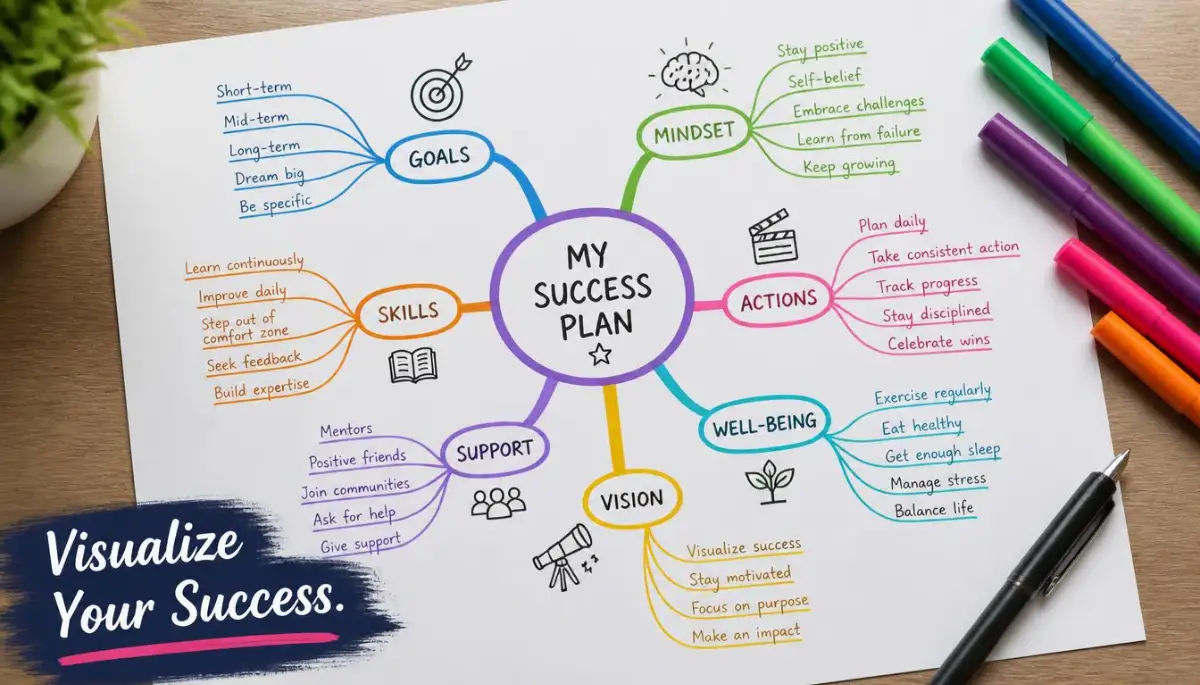
Instead, try the Flow Method. Think of your notes as a map of your personal understanding.
Write down the main idea in the center. Then, draw arrows to related points or examples.
Don't worry about being neat. This is about how your mind connects dots in real-time.
If the teacher mentions a concept that reminds you of something else, draw a line and write it down.
This creates a "web" of knowledge. When you look back at it, your brain remembers the path you took to understand it.
The Power of the Cornell System
If you prefer more structure, the Cornell method is a classic for a reason. It forces you to stay active while you study.
Divide your paper into three sections: a narrow column on the left, a wide one on the right, and a box at the bottom.
Use the wide right column for your general notes during the class. Keep them short and simple.
After class, use the left column to write "Cues" or questions based on those notes.
For example, if your note says "Photosynthesis happens in chloroplasts," your cue could be "Where does photosynthesis occur?"
Finally, use the bottom box to summarize the whole page in just two sentences.
This forces your brain to filter out the noise and keep only the most important parts.
Myth vs. Reality: The Truth About Note-Taking
The Feynman Technique Integration
One of the best ways to master a complex subject is to teach it. But you can do this inside your notebook.
When you come across a very hard concept, try to explain it in your notes as if you were talking to a ten-year-old.
Avoid using big, fancy words. If you find yourself using jargon, it means you don't fully understand the topic yet.
Break it down. Use analogies. Instead of saying "ATP is the primary energy carrier," say "ATP is like a battery for your cells."
This simple change makes the information "stickier" in your memory. It turns an abstract idea into something real.
Why You Should Stop Using Five Different Highlighters
We all love a pretty notebook. But spending twenty minutes picking colors is just a way to procrastinate.
Your brain focuses on the colors, not the content. This is a trap that keeps you from deep learning.
Limit yourself to one pen and one highlighter. Use the highlighter only for terms that will definitely be on the exam.
Everything else should be written in your own words. Your own "voice" is much easier for your brain to recognize later.
The Concept Mapping Strategy
Complex subjects are often like a puzzle. You see the pieces, but you don't see how they fit together.
Concept mapping is about finding those links. It is different from mind mapping because it focuses on the relationship between things.
Draw a circle for "Gravity" and another for "Planetary Motion." On the line connecting them, write "causes."
This helps you see the "Why" and "How," not just the "What."
When you understand the relationship, you don't have to memorize as much. The logic carries you through.
Pro Tip: The "Blurting" Method
After you finish a study session, close your book and take a blank piece of paper.
Blurt out everything you can remember about the topic onto the page. Don't look at your notes.
Write fast. Use sketches. Use messy handwriting. It doesn't matter.
When you are done, open your notes and see what you missed. The things you forgot are your "weak spots."
Focus your next study session only on those weak spots. This saves you hours of time.
Using Visual Cues and Doodles
You don't have to be an artist to use drawings in your notes. Simple shapes can represent big ideas.
A "triangle" could represent a change. A "cloud" could represent a theory.
Our brains process images much faster than text. A small doodle next to a hard concept acts as a visual anchor.
Next time you are in an exam, you might not remember the exact sentence, but you will remember that little cloud you drew.
The Importance of "White Space"
Don't crowd your pages. Leave plenty of room between different ideas.
When your notes are cramped, your brain feels overwhelmed just looking at them.
White space gives your mind room to breathe. It also leaves space for you to add more info later.
Maybe you find a better example in a YouTube video or a different book. You need a place to put it.
Digital vs. Paper: Which One Wins?
This is a big debate. Laptops are fast, but they offer too many distractions.
Paper forces you to slow down. That "slowness" is actually where the learning happens.
When you write by hand, you have to be selective. You can't write everything, so you choose the best bits.
If you must use a tablet, try using a stylus. It gives you the feel of paper with the organization of digital files.
Building a Routine for Review
Notes are useless if you never look at them again. But don't just "read" them.
Set a timer for ten minutes every evening. Quickly scan the "Cues" you wrote in your Cornell notes.
Try to answer the questions without looking at the main notes. This is called Active Recall.
It is the single most powerful way to move information from short-term to long-term memory.
If you do this daily, you won't need to "cram" when the big exam comes around. You will already know the material.
Handling Heavy Vocabulary
Every subject has its own "language." Science, law, and history are full of words we don't use every day.
Keep a small "Glossary" section at the back of your notebook. Every time you see a word you don't know, write it there.
Don't copy the dictionary. Write what it means to you.
Once you master the language of the subject, the concepts become much easier to grasp.
Conclusion of Part 1
Mastering a hard subject is not about how many hours you sit at your desk.
It is about how you use those hours. By changing your note-taking from a passive task to an active one, you unlock your true potential.
You will feel more confident, less stressed, and ready to tackle any challenge that comes your way.
Stay tuned for Part 2, where we will dive into advanced digital tools and how to organize your entire academic life for peak performance.
Mastering the Art of Deep Note Synthesis
Now that we have covered the basics, let's talk about how to level up your game. Mastering a complex subject isn't just about catching information. It is about processing that information so it lives in your brain forever.
Think of your brain like a giant library. If you just throw books on the floor, you will never find what you need. Advanced note-taking is the process of building shelves and labeling every single section.
The Layered Review Technique
One of the best ways to handle hard topics is the Layered Review. Instead of writing everything once, you revisit your notes three times within twenty-four hours.
The first layer happens during the lecture. You write down the raw ideas and main points. Do not worry about being pretty here. Just get the core thoughts on paper.
The second layer happens a few hours later. You sit down in a quiet place and clean up those notes. You add colors, draw arrows, and connect ideas. This is where you start understanding the logic of the subject rather than just memorizing facts.
The third layer is the most powerful. Before you go to bed, you write a three-sentence summary of the whole topic from memory. This forces your brain to decide what is truly important.
Using Logic Chains for Hard Sciences
If you are studying something like physics or chemistry, skip the long paragraphs. Instead, use Logic Chains. A logic chain is a series of "If-Then" statements.
For example, "If the temperature rises, then the molecules move faster." "If they move faster, then the pressure increases."
This format is much easier to scan during an exam. It also helps you spot gaps in your knowledge. If you can't complete the chain, you know exactly what you need to ask your teacher about.
Connecting Digital Tools with Human Intuition
We live in an age where technology can help us organize our thoughts. Many students are now using AI-powered tools to categorize their notes.
Just like how generative AI is changing the way developers write code, you can use apps to turn your messy scribbles into searchable databases. These tools allow you to tag your notes with keywords.
When you need to find everything you wrote about "Newton’s Third Law," you just search the tag. You don't have to flip through hundreds of pages. However, always remember to write the initial notes by hand first. The physical act of writing builds a stronger connection in your mind.
The Comparison T-Chart for Complex Theories
Sometimes you have to study two theories that look almost the same. This is where most students get confused. They mix up the names, dates, and details.
Use a T-Chart to solve this. Put "Theory A" on the left and "Theory B" on the right. Compare them point by point.
What are the goals of each? What are the weaknesses? By seeing them side-by-side, your brain learns to spot the tiny differences. This is a pro-level secret for scoring high on multiple-choice questions.
Why Context Matters More Than Content
I once knew a student who memorized every word of a biology textbook. But when the exam asked him to apply that knowledge to a real-world problem, he failed.
He had the content, but he didn't have the context. In your notes, always include a "So What?" section.
After writing down a fact, ask yourself: "Why does this matter?" If you are studying history, don't just write the date of a war. Write how that war changed the way people live today.
Linking new info to things you already know is like giving your brain a hook to hang the information on. Just as why your gut bacteria holds the secret to a stronger immune system, your academic success depends on how well you nourish your mental connections.

The Danger of Passive Habits: What to Avoid
Many students spend hours at their desks and still feel like they are failing. This usually happens because they fall into the trap of "Passive Learning."
They think that because they are sitting with a book open, they are learning. This is a dangerous lie. It wastes your time and drains your energy.
The Highlight Trap
We have all seen those used textbooks that are almost entirely neon yellow. Highlighting feels good because it makes us feel like we are doing something.
But research from the Journal of Applied Research in Memory and Cognition shows that highlighting is one of the least effective ways to learn.
When you highlight, your brain goes on autopilot. You aren't thinking; you are just painting. Instead of highlighting, write a question in the margin that the text answers. This forces you to think.
Transcribing Instead of Translating
Another big mistake is trying to be a human recorder. If you write down exactly what the teacher says, you are transcribing.
You need to be translating. You must take the teacher’s complex language and turn it into your own simple words.
If you can't explain it simply, you don't know it. When you just copy words, you are only "renting" the knowledge for a few hours.
It is a bit like real estate. In many ways, is buying a home smarter than renting. Buying knowledge through active note-taking means you own it forever. Renting it through transcription means it’s gone as soon as the lease (the exam) is over.
The "Messy Digital" Nightmare
Some students have thousands of digital notes scattered across different apps and folders. This creates mental clutter.
If you can't find your notes in under thirty seconds, they are useless. Pick one system and stick to it.
Whether it is a physical binder or a specific app, keep everything in one place. Organised notes lead to an organised mind.
Waiting Too Long to Review
The "Forgetting Curve" is a real thing. Your brain starts dumping information almost as soon as you walk out of the classroom.
If you wait a week to look at your notes, you will have forgotten 80% of the lecture. You will spend more time re-learning than you would have spent reviewing.
The biggest mistake is thinking you will "remember it later." You won't. Write it down now, and review it tonight.
Your Path to Academic Excellence
Mastering complex subjects is a skill, not a talent. It doesn't matter if you have struggled in the past. You can change your story today.
Note-taking is the bridge between being a confused student and being a master of your craft. When you take control of how you process information, you take control of your future.
Imagine walking into your next exam feeling calm. Imagine looking at a hard question and knowing exactly how to solve it because you built a logic chain for it last week.
That feeling of confidence is worth more than any shortcut. It comes from the hard work of organizing your thoughts and being active in your learning.
The 7-Day Challenge for You
I want you to try something. For the next seven days, pick one of the methods we talked about. Maybe it is the Cornell system or the Layered Review.
Use it for your hardest subject. Don't worry about being perfect. Just be consistent.
By the end of the week, look at your notes. You will notice they look different. They will look like the notes of someone who actually understands the material.
You have the tools. You have the plan. Now, all you need to do is take the first step.
Grab your pen, open your notebook, and start building your library of knowledge. Your future self will thank you for the effort you put in today.
![Write Perfect Academic Papers Every Time [Secret Method]](https://topic36.com/storage/uploads/blogs/1788070619_write-perfect-academic-papers-every-time-secret-method.webp)