
The Frustrating Cycle of Endless Red Ink
I remember sitting in my dorm room at 2 AM, staring at a flashing cursor with a tight knot in my stomach. My latest research paper had just been returned with red ink bleeding across almost every single page. The professor’s note simply said my ideas were buried under terrible grammar and confusing sentences. I felt completely embarrassed and started doubting if I even belonged in university. My confidence hit rock bottom, and writing suddenly felt like an impossible mountain to climb. I realized right then that I needed to completely change how I approached my assignments.
For so many students, this exact scenario plays out every single semester. You spend days or even weeks reading heavy textbooks and doing intense research for a class project. You finally type out your thoughts, hoping that your hard work will naturally shine through the text. But when the grade comes back, you realize the professor could not understand your main points at all. It is incredibly painful to know you have the right ideas in your head, but you just cannot seem to put them on paper correctly.
This constant struggle completely destroys your mental peace and ruins your weekends. Instead of relaxing, you are constantly worrying about whether your sentences sound smart enough or if your commas are in the right places. The fear of getting a bad grade makes you overthink every single word you type. You start using massive words you found in a dictionary, hoping it will make you sound more professional. Unfortunately, this usually makes the paper even harder to read.
The truth is, bad academic writing can hold you back from scholarships, higher degrees, and even future job opportunities. It creates a heavy cloud of imposter syndrome that follows you into every single classroom. You might start believing that you are simply not a "good writer" and that you never will be.
But writing is not a magical talent you are born with. It is just a set of specific rules and habits that anyone can learn and practice. Once you understand exactly what professors are looking for, that heavy anxiety starts to fade away completely.
Transforming Your Thoughts Into High-Scoring Papers
The biggest secret to writing a great paper is realizing that your professor is just a regular person reading your work. They have to grade dozens of papers in a single weekend, and they are usually tired and bored. If you make them work hard to understand your sentences, they will naturally get frustrated and lower your score. Your main goal is to make your ideas as clear, simple, and easy to read as humanly possible.
You do not need to sound like a 19th-century philosopher to get an A on your assignment. In fact, most top-tier academic journals today prefer plain, direct English. Let us look at some highly effective ways to clean up your writing and fix those annoying mistakes once and for all.
Stop Hiding Behind Complicated Words
Many students fall into the trap of using a thesaurus for every other word in their essay. They think that using large, complex vocabulary makes them look intelligent and highly educated. This is completely false and is usually the quickest way to ruin your essay. When you use words you do not fully understand, your sentences lose their natural flow and often make no sense.
Instead of trying to sound smart, focus entirely on being clear. If a 14-year-old cannot understand your main argument, your writing is probably too complicated. Keep your word choices natural and precise.
Myth vs Reality in Academic Writing
- The Myth: You must use long, complex words to prove you understand the topic.
- The Reality: Clear, simple words show true mastery of a subject because you do not need to hide behind confusing language.
A Quick Comparison Table
As you can see, the simpler versions are much faster to read and much easier to understand. Always choose clarity over showing off your vocabulary.
Mastering The Flow of Your Ideas
A good essay is like a well-built house where every room connects naturally to the next. If your paragraphs jump from one random thought to another, the reader will get lost instantly. You need to build a logical path that guides the reader by the hand from your introduction to your final thought.
Every single paragraph you write should focus on one single main idea. Do not try to stuff three different arguments into one block of text. Start the paragraph with a clear sentence that tells the reader exactly what you are about to discuss. Then, use the rest of the sentences in that paragraph to prove or explain that one specific point.
Here is a secret to instantly better grades: I used to write massive, page-long paragraphs because I thought it made my essays look more detailed and heavily researched. My professor finally pulled me aside and told me that my giant blocks of text were literally giving him a headache. I started breaking my thoughts into smaller, highly focused chunks, and my grades shot up the very next week.
Using transition words correctly is another easy way to improve your flow. Words like 'however', 'therefore', and 'for example' act as street signs for your reader. They show the person grading your paper exactly where your argument is heading next. Just be careful not to overuse them, or your writing will start to sound robotic and stiff.
Fixing the Most Embarrassing Grammar Mistakes
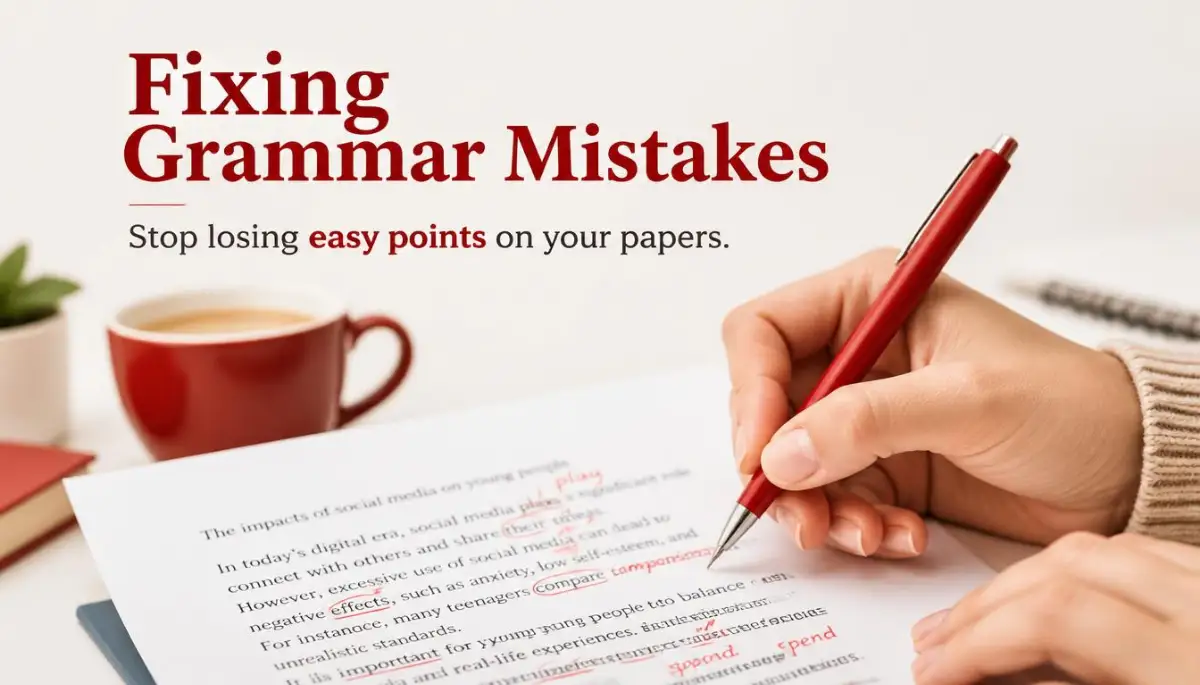
Grammar errors are the fastest way to lose points on an assignment, but they are also the easiest things to fix. When a professor sees basic errors in your paper, they assume you rushed through the work and did not care enough to check it. Let us break down a few of the most common issues that destroy academic papers.
Subject-verb agreement is a major problem for many students, especially when writing long sentences. If your subject is singular, your verb must be singular too. When you place a lot of extra descriptive words between the subject and the verb, it is very easy to get confused. Always read your sentences backward or strip away the extra fluff to check if the main subject and verb match perfectly.
Before we look at the next big mistake, watch this amazing breakdown of writing habits.
This short visual guide completely changed how I look at sentence structure and will help you spot hidden errors in seconds.
Another massive issue is the dreaded comma splice. This happens when you try to connect two complete, independent sentences with just a simple comma. For example: "The study was successful, it proved the main theory." This is grammatically incorrect and makes your writing look highly unprofessional.
You have a few easy options to fix a comma splice today. You can change the comma to a period and create two separate, punchy sentences. You can also use a semicolon if the two ideas are very closely related to each other. Finally, you could keep the comma and add a joining word like 'and' or 'but' to hold the two thoughts together legally.
The Danger of Passive Voice
If there is one thing that academics hate, it is a paper absolutely drowning in passive voice. Passive voice happens when you make the object of an action the subject of your sentence. It makes your writing sound incredibly weak, boring, and much longer than it needs to be.
For instance, saying "The experiment was conducted by the researchers" is passive and dull. It takes the energy right out of your sentence. If you flip it around to active voice and say "The researchers conducted the experiment," the sentence suddenly becomes strong and direct.
Active voice forces you to be specific about who is doing what in your research. It removes unnecessary words and keeps the reader highly engaged with your argument. While passive voice is sometimes okay in scientific lab reports, you should try to use active voice at least 80 percent of the time in standard essays.
To easily spot passive voice in your own work, look for 'to be' verbs like 'was', 'is', or 'were' followed by an action word ending in '-ed'. Whenever you see that pattern, ask yourself if you can rewrite the sentence to put the main actor at the very beginning. It takes a little practice, but it will dramatically transform the quality of your work.
The Art of Brutal Self-Editing
The first draft of your essay is always going to be messy, and that is perfectly okay. The biggest mistake you can make is submitting your paper exactly as you first wrote it. Great academic writing does not happen during the writing phase at all. It happens entirely during the editing phase.
You must create a strict habit of walking away from your computer after you finish a draft. Give your brain at least 24 hours to forget what you just wrote. When you come back to the paper the next day, you will instantly see all the awkward sentences and missing commas that you completely missed before.
One of the most effective techniques in the world is reading your essay out loud to yourself. When you read silently, your brain automatically fixes mistakes and fills in missing words without you noticing. But when you are forced to speak the words, your tongue will physically stumble over badly written sentences. If you run out of breath while reading a single sentence, that is a huge red flag that the sentence is way too long.
You should also read your paper backward, starting from the very last sentence and moving up to the top. This forces your brain to look at the actual grammar and spelling of each individual sentence, rather than getting caught up in the story of the essay. It is a slow process, but it guarantees that you catch those tiny spelling errors that spell-checkers usually miss.
Organizing Your Research Before You Type
Many writing problems actually start before you even touch your keyboard. If your thoughts are messy, your writing will definitely be messy too. Students often try to read a few articles and immediately start typing, hoping the structure will magically figure itself out. This method almost always leads to confusing arguments and a lot of deleted paragraphs.
You absolutely need to build a strong outline before you start your first draft. Think of this outline as the skeleton of your essay. Without it, your paper will just be a floppy pile of random facts and quotes.
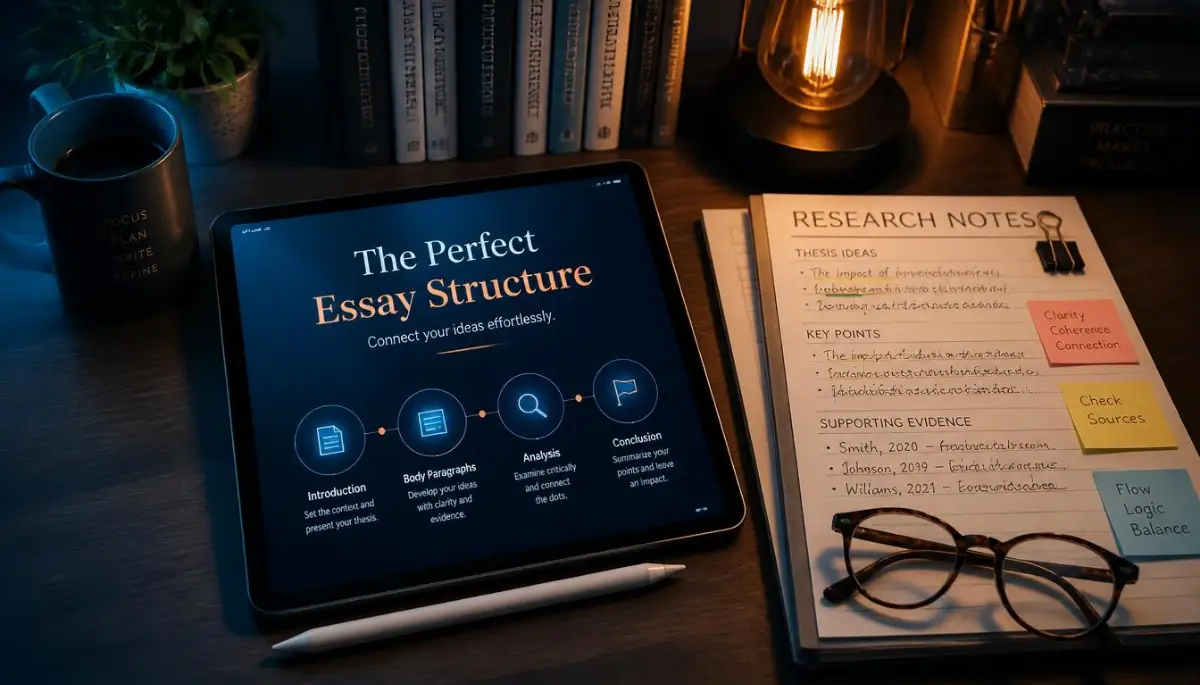
Start by writing down your main thesis statement right at the top of a blank page. This is the big promise you are making to your reader. Next, write down three or four main points that will prove your thesis is true. Under each of those points, drop in the specific facts, quotes, and statistics you found during your research. Once you have this map built, writing the actual essay is just a matter of connecting the dots with simple, clear English.
If you organize your notes properly, you will never have to sit and stare at a blank screen wondering what to say next. You will already know exactly what every single paragraph needs to achieve. This simple preparation step saves you hours of frustration and prevents you from going off-topic in the middle of your assignment.
Taking Your Academic Voice to the Professional Level
Once you have mastered basic sentence flow, it is time to focus on the finer details of your writing style. Many students think that getting good grades means learning a secret, highly complicated academic language. In reality, the best writers in the world simply know how to organize their thoughts with extreme precision.
Building a professional academic voice does not happen overnight, but it is entirely possible with a few smart habits. You need to start treating your assignments less like school chores and more like real-world communication. Writing a research paper is actually a lot like building products that people actually love. You have to deeply understand what your specific audience—in this case, your professor—truly wants to see and experience.
If your professor struggles to find your main argument, they will not give you the benefit of the doubt. Your goal is to guide them smoothly from your introduction all the way to your final thoughts. Let us look at some advanced strategies to make your papers stand out from the rest of the class.
The Secret Power of Reading Like a Writer
You cannot become a great writer if you only read textbooks right before an exam. The human brain naturally mimics the language and tone of the things it consumes most often. If you spend all day reading informal social media posts, your brain will naturally want to write your essays in that exact same casual tone.
To fix this, you need to start reading high-quality academic material regularly. Set aside just twenty minutes a day to read articles published in respected journals within your specific field of study. As you read, do not just focus on the information they are sharing. Pay close attention to how the authors transition between paragraphs and how they introduce different pieces of evidence.
When I started paying attention to sentence structures in published papers, my own writing improved massively. You begin to naturally absorb the rhythm of professional writing without even trying. Seeking out expert advice from places like the Harvard College Writing Center can also completely change your perspective on how a strong essay is supposed to sound.
Designing the Perfect Environment for Focus
Your physical environment has a massive impact on the quality of the words you type. It is almost impossible to write a deep, analytical essay while sitting on a messy bed with the television blaring in the background. Your brain needs clear, quiet space to process complex information and turn it into readable text.
Sometimes, cleaning up a confusing argument in your head is just like trying to maximize natural light in your small space. You just need to remove the heavy clutter so the bright, clear ideas can finally shine through. Set up a dedicated study desk that you only use for serious academic work.
Technical frustrations can also destroy your writing momentum in seconds. Nothing is more annoying than losing your entire train of thought because a webpage refuses to load. Always make sure to fix your slow internet connection before you sit down for a heavy research session. When your environment is peaceful and your tools work perfectly, writing becomes a much more enjoyable experience.
Building a Long-Term Vocabulary Strategy
As we discussed earlier, using massive words to sound smart usually backfires terribly. However, you still need to slowly build a strong, subject-specific vocabulary over time. Every academic discipline has its own unique terms and concepts that you must learn to use correctly.
Instead of searching a thesaurus while writing, keep a dedicated notebook just for new vocabulary. Whenever you come across a powerful, descriptive word in your daily reading, write it down along with its exact definition. Practice using these new words in your everyday conversations before you ever try putting them into a graded paper.
This slow, intentional practice ensures that you completely understand the nuances of a word. Over a few months, you will naturally start using more precise language without forcing it. If you want to explore more general tips for student life and self-improvement, you can always check out our helpful digital resources for extra guidance.
Mastering Citation and Formatting Rules
One of the easiest ways to prove you are a serious student is by mastering your required citation style. Whether your school uses APA, MLA, or Chicago style, you must follow their specific rules perfectly. Professors immediately lose patience when they see sloppy formatting, missing page numbers, or incorrect reference lists.
Learning these rules can feel incredibly boring, but it is absolutely necessary for academic success. You do not have to memorize every single detail, but you should know where to find the answers quickly. Using trusted resources like the Purdue Online Writing Lab makes managing your references incredibly easy and stress-free.
I highly recommend learning how to use a digital citation manager early in your academic journey. These software tools automatically store your research links and generate perfect bibliographies with a single click. This simple habit will save you hours of panic the night before a major assignment is due.
The Hidden Traps That Destroy Good Grades
Even the most dedicated students can fall into dangerous habits when they are stressed or running out of time. The emotional pain of getting a terrible grade on an essay you worked so hard on is completely heartbreaking. I have seen countless students lose massive points simply because they made easily avoidable mistakes.
When you are exhausted, your brain starts looking for shortcuts to finish the assignment faster. Unfortunately, these shortcuts usually lead straight to academic disaster. Let us explore the most common traps that students fall into and exactly how you can avoid them.
The Disaster of Word Count Padding
We have all been in that terrifying situation where a paper needs to be ten pages long, but you run out of things to say by page six. The immediate temptation is to start padding your sentences with useless, extra words. Students will change a simple phrase like "because" into "due to the fact that," hoping to fill up empty space.
Professors can spot this trick from a mile away, and they absolutely hate it. It makes your writing incredibly boring to read and completely waters down your main argument. When a grader realizes you are just trying to hit a word count, they will instantly start deducting points for poor structure.
Instead of stretching your sentences, you need to dive deeper into your actual research. Ask yourself if you have fully explained the "why" and "how" behind your main points. Adding another real-life example or explaining a counter-argument is the correct way to naturally expand your essay without relying on empty fluff.
The Fear of Accidental Plagiarism
Plagiarism is the absolute biggest fear for any university student today. Even if you never intended to steal someone else's work, poor paraphrasing can easily trigger a school's cheating software. If you simply change one or two words from an original source, it is still considered plagiarism.
To protect yourself, you must learn how to read a source, close the book, and explain the concept out loud in your own words. Never look directly at the original text while you are typing your draft. Always double-check your paraphrasing habits against official guides from Turnitin educational resources to ensure your work is completely original.
Another major issue is forgetting to write down exactly where you found a piece of information during your research phase. You might find a brilliant quote on Tuesday, but completely forget the author's name by Friday. Always copy the full web link or book title into your notes the very second you decide to use a specific fact.
Blindly Trusting Grammar Software
Grammar checking software is incredibly helpful for catching basic spelling mistakes and missing commas. However, relying entirely on these automated tools is a massive mistake that many students make. AI checkers do not understand the specific context of your assignment or the deep nuances of human emotion.
These tools will often suggest changing a perfectly good sentence just because it uses a complex structure. If you blindly accept every single suggestion the software gives you, your essay will start to sound robotic and completely lose your personal voice. They also frequently fail to catch words that are spelled correctly but used in the completely wrong context.
A quick story about trusting machines: I once wrote a highly emotional essay about my grandfather and ran it through a popular grammar tool without reading the suggestions. The software changed several of my thoughtful adjectives into completely inappropriate business terms. I submitted the paper without checking, and my professor asked me if a robot had written my conclusion. Never skip the manual proofreading phase.
Answering the Wrong Prompt Completely
This is perhaps the most tragic mistake a hardworking student can make. You spend weeks researching, you write a beautifully structured paper with perfect grammar, and you proudly submit it. But when the grade comes back, you receive a failing mark simply because you completely misunderstood the assignment question.
Professors design essay prompts very carefully to test your understanding of specific course materials. If the prompt asks you to "compare and contrast" two historical events, but you only write a summary of one event, you have failed the task. No amount of beautiful writing can save an essay that goes completely off-topic.
Always break down the assignment prompt before you start researching. Highlight the specific action words like "analyze," "evaluate," or "describe." If you are even slightly confused about what the professor is asking for, send them a polite email asking for clarification immediately. It is always better to ask a simple question early than to write a perfect essay on the wrong subject.
Your Personal Blueprint for Writing Success
Improving your academic writing is a continuous journey of small, daily improvements. You do not have to fix every single mistake in one day. The most important step is simply becoming aware of your own bad habits and making a conscious effort to change them.
Writing is essentially just thinking on paper. If your thoughts are organized, clear, and honest, your writing will naturally reflect those qualities. Start giving yourself more time to edit, read your work out loud, and never be afraid to ask for help from your peers or professors. The more you practice these techniques, the less anxiety you will feel when staring at a blank screen.
Every great writer started out making the exact same messy mistakes that you are making right now. You have all the tools and strategies you need to completely change the way you approach your assignments. I know how scary it feels to hand in a paper when you are unsure of your own skills. But by practicing these simple steps, I completely transformed my own writing, and I know you can do it too.
Common Questions About Fixing Academic Papers
How can I sound more professional in my essays?
The best way to sound professional is to write with extreme clarity and confidence. Avoid using slang words, completely remove contractions like "don't" or "can't," and focus on proving your points with solid evidence. Keep your sentences direct and never use complicated words just to sound smart.
Is it okay to use first-person pronouns in a research paper?
This entirely depends on the specific guidelines set by your professor and your field of study. In the sciences, first-person pronouns are usually discouraged to keep the focus entirely on the data. However, in the humanities or reflective essays, using "I" is often perfectly acceptable.
What is the fastest way to improve my grammar?
Reading your essays out loud is the absolute fastest way to catch hidden grammar mistakes today. When you speak the words, your brain naturally notices when a sentence sounds clunky or is missing a comma. You can also pick one specific grammar rule, like comma splices, and focus entirely on mastering it this week.
How long should an academic paragraph actually be?
A good academic paragraph should be long enough to fully explain one single main idea, usually between four to six sentences. If your paragraph takes up an entire printed page, it is definitely too long and needs to be broken up. Always ensure each paragraph has a clear topic sentence at the very beginning.
Why do professors hate passive voice so much?
Professors dislike passive voice because it makes your writing sound incredibly weak, vague, and unnecessarily long. It hides the person or thing performing the action, which makes scientific or historical claims confusing. Using active voice forces you to be direct, confident, and highly specific with your facts.
Disclaimer: The information provided in this blog post is for educational and informational purposes only. While every effort has been made to ensure the accuracy of the writing tips and strategies shared, individual grading criteria may vary by educational institution and professor. Always consult your specific course syllabus and academic guidelines before submitting any assignments.