The Silent Death of Great Writing: Why Your Readers Are Leaving Too Soon
You sit at your desk for six hours. You research, you type, and you edit until your eyes burn. You finally hit "Publish" on a 3,000-word masterpiece.
Then, you check your analytics. The average time on page is only 12 seconds. Your heart sinks.
It feels like shouting into a void. You know your information is valuable, but people just aren't sticking around to read it. They click, they glance, and they vanish like ghosts.
This isn't just a blow to your ego; it's a disaster for your growth. High bounce rates tell Google that your content isn't helpful, even if it’s the best guide on the internet.
Is it your writing? Is it the topic?
Most of the time, it’s neither. The problem is that the human brain isn't wired to read long blocks of text on a glowing screen.
We are living in an era of "infinite scroll" and "TikTok attention spans." People are mentally exhausted before they even finish your first paragraph.
I’ve been there. I remember writing a guide I thought would change lives, only to see a 90% bounce rate. It felt like I was wasting my life.
But then I stopped looking at grammar and started looking at psychology. I realized that keeping a reader is a battle against the brain’s natural desire to save energy.
If you don't give the brain a reason to stay, it will find the exit. Let’s talk about how we can fix that and turn your "skimmers" into "deep readers."
The Secret Sauce of "Open Loops": Hooking the Brain Instantly
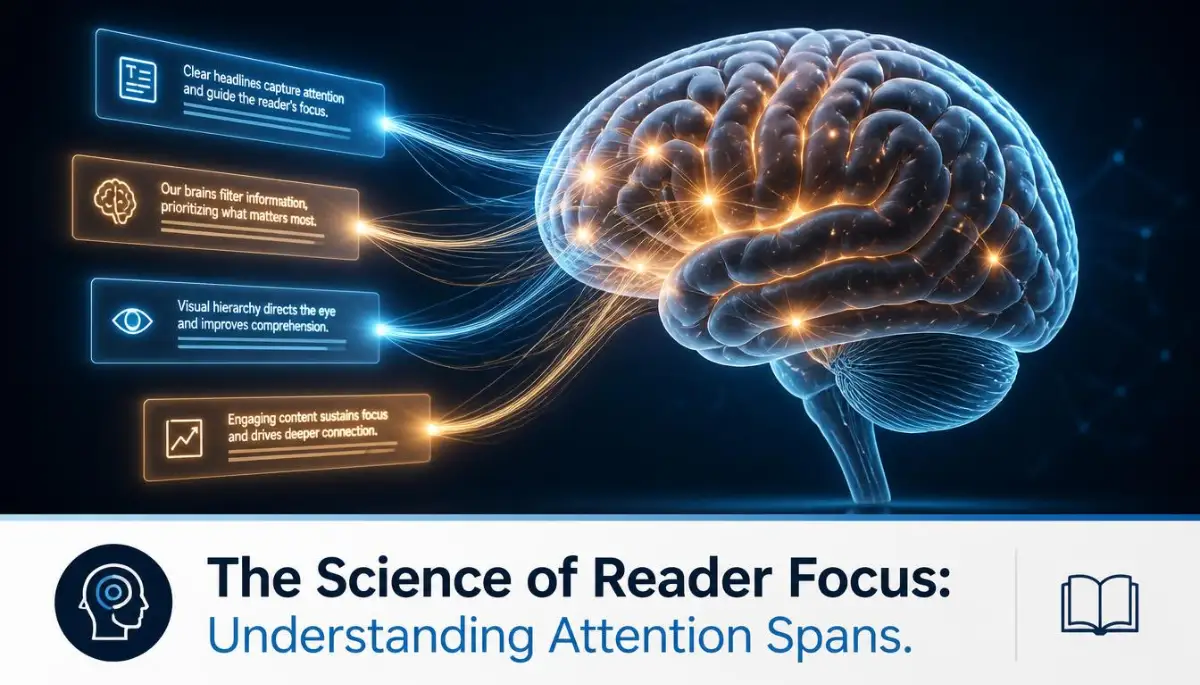
Have you ever wondered why you can't stop watching a Netflix series even when you’re tired? It’s because they use "Open Loops."
In psychology, this is known as the Zeigarnik Effect. It’s the idea that our brains hate unfinished business.
When you start a story or ask a question but don't answer it right away, the reader's brain stays "active" until the loop is closed.
To use this in your blog, start your intro with a mystery. Tell them about a problem you solved, but wait until the middle of the post to explain the exact "how."
Keep them curious. If they feel like they’ve already gotten the "gist" of your post in the first ten seconds, they will leave.
Create a knowledge gap. Make them realize there is something they don't know, and promise to reveal it if they keep reading.
Reducing the "Cognitive Load" Through Smart Formatting
Reading a long-form article shouldn't feel like a chore. If your post looks like a giant wall of text, the reader’s brain goes into "panic mode."
It looks like work. And nobody wants to work while they’re browsing the web.
White space is your best friend. It gives the eyes a place to rest. It makes the content feel "light" and easy to digest.
I always suggest keeping paragraphs extremely short. Two or three sentences is the sweet spot.
Use bold text for emphasis. When a reader is scanning your page, their eyes jump to the bold words.
If your bolded words tell a mini-story, the reader is more likely to slow down and read the whole thing.
The "F-Pattern" and Why Your Subheadings Matter
Eye-tracking studies show that people read web pages in an "F" shape. They read the top, then move down and read across again, then just scan the left side.
This means your subheadings (H2s and H3s) are the most important part of your article for retention.
Don't use boring headings like "Introduction" or "Tips." Use headings that promise a benefit or spark an emotion.
Instead of "How to Sleep Better," try "The Midnight Hack for Instant Sleep."
Subheadings are like signposts. They tell the reader what’s coming next. If the signpost is boring, they’ll just turn around.
Building Trust with "Cognitive Ease"
People like things that are easy to understand. When we understand something quickly, our brain releases a small hit of dopamine.
This is called Cognitive Ease. If you use big, fancy words to sound smart, you’re actually pushing readers away.
Complex language creates "Cognitive Strain." It makes the reader feel frustrated or dumb.
Write like you talk. Imagine you are sitting in a coffee shop with a friend, explaining your topic.
You wouldn't use "academic" jargon there, so don't use it here. Use simple words and direct sentences.
Simple writing is a sign of a true expert. Only someone who truly understands a topic can explain it simply to others.
The Power of "Bucket Brigades" to Keep People Moving
Sometimes, a reader reaches the end of a section and thinks, "Okay, I'm done." You need a way to pull them into the next paragraph.
In the copywriting world, we call these Bucket Brigades. They are short, punchy phrases that end with a colon.
Here are a few examples:
- "But there’s a catch:"
- "Here’s why that matters:"
- "It gets even better:"
- "Think about it this way:"
These phrases act as a bridge. They force the reader to look at the next line to see what happens next.
It’s a simple trick, but it works wonders. It breaks the rhythm and keeps the "eyes moving" down the page.
Using the "Contrast Principle" to Highlight Value
The brain is wired to notice changes. If everything in your article looks the same, the brain tunes out.
You need to create visual and mental contrast. You can do this by using different elements throughout your post.
For example, you can use:
- Numbered lists to break down a process.
- Bullet points for quick facts.
- Blockquotes for a powerful statement.
When the layout changes, the brain "wakes up" again. It signals that something new and important is happening.
Don't let your article become a flat line. Give it peaks and valleys. Give the reader something new to look at every few scrolls.
The "Empathy Bridge": Connecting on a Human Level
People don't just read for information; they read for connection. They want to know that you understand their struggles.
Before you give advice, show them you’ve walked in their shoes. Use "You" and "I" frequently.
If you are writing about productivity, don't just list tools. Talk about the time you felt overwhelmed and couldn't get out of bed.
Shared pain creates a bond. When a reader feels like you "get" them, they will trust your advice much more.
They won't just skim your article; they will read every word because they feel like they are having a conversation with a mentor.
The "Endowed Progress" Effect: Making the Reader Feel Productive
Psychology tells us that people are more likely to finish a task if they feel they have already started making progress.
This is why "Step 1" should always be something incredibly easy. If Step 1 is "Write a 50-page book," the reader will quit.
If Step 1 is "Open a blank document," they feel like they’ve already succeeded.
Give your readers "quick wins." In the first 500 words of your article, give them one small thing they can do right now.
Once they feel the "win," their brain wants to keep going to get the next one. Progress is addictive.
Why "Reading Level" Is Your Secret Weapon
You might think that writing for a "Grade 8" level makes you look less professional. Actually, it’s the opposite.
Most people on the internet are multitasking. They are reading your post while waiting for a bus or during a lunch break.
They don't have the mental energy for a "University-level" thesis. Clear writing is a gift to your reader.
When you make your content easy to read, you are being respectful of their time and energy.
Use tools to check your readability. Aim for short sentences and familiar words.
Your goal isn't to show off your vocabulary. Your goal is to change the reader’s mind or solve their problem.
The "Information Gap" Strategy
Every section of your article should solve one small problem but hint at a bigger one.
Think of it like a chain. Each link connects to the next. Never give away the "Gold" too early.
If you give the best tip in the first paragraph, the reader has no reason to stay for the other 1,500 words.
Tease the value. Tell them what they will learn in the next section.
"Now that you know how to hook a reader, let’s talk about the one mistake that kills 90% of blog posts..."
See what I did there? You probably want to know what that mistake is now. That’s an information gap.
Using "Visual Anchors" to Ground the Reader
Long-form content can feel "floaty." The reader can lose their place or forget why they are there.
Visual anchors are things like images, charts, or even bolded "Key Takeaway" boxes.
They serve as landmarks. If a reader gets distracted by a notification on their phone, a visual anchor helps them jump back into the flow of your article.
Every image should have a purpose. Don't just use "stock photos" of people shaking hands.
Use images that explain a concept or show a result. An image should be worth a thousand words, especially in a long article.
The Psychology of "Storytelling" in Informational Posts
We have been telling stories around campfires for thousands of years. Our brains are literally built for stories.
Even if you are writing a technical guide, you can use mini-stories.
Instead of saying "This method works," say "Last Tuesday, I tried this method on a client's site, and within two hours, the traffic doubled."
Stories are easy to remember. Facts and figures are easy to forget.
When you wrap your information in a story, it becomes "sticky." The reader stays because they want to see how the story ends.
Setting the Stage for Long-Term Success
Retention isn't just about one article. It’s about building a relationship.
When you use these psychological methods, you aren't just "tricking" people into staying. You are creating a better experience for them.
You are making it easier for them to learn. You are making it enjoyable for them to consume your content.
And when a reader enjoys their time on your site, they don't just stay for one post. They come back for more.
They subscribe to your newsletter. They share your work on social media. They become a fan.
This is the foundation of a successful blog. It’s not just about SEO; it’s about humans.
By understanding how the brain works, you can write articles that people actually want to finish.
And once they finish, they’ll be waiting for your next one.
The Master Strategist’s Playbook: Keeping Minds Glued to the Page
Now that we’ve covered the basics of how the human brain reacts to text, it’s time to look at the advanced moves. If you want people to stay for 2,000 words or more, you have to treat your article like a well-paced movie.
You can’t just give information. You have to manage the reader's energy levels. Think about it. When you read something very long, your brain naturally gets tired.
This is where Visual Pacing comes in. It’s not just about what you say, but how it looks on the screen as the reader scrolls. You want to create a rhythm.
One of my favorite secrets is the "Pattern Interrupt." Just when the reader thinks they know what to expect, you change the format.
If you’ve been writing short paragraphs for a while, suddenly drop in a single-sentence line.
Make it bold.
This tiny change acts like a splash of cold water. It wakes the brain up. It tells the reader, "Hey, pay attention, something changed!"
Another pro tip is using "Micro-Conversions." A micro-conversion is a small "yes" from the reader. You get this by asking rhetorical questions.
When you ask, "Do you see how this changes everything?" the reader mentally nods. Every time they nod, they are more committed to finishing the article.
I’ve found that using Specific Logic Bridges helps keep the flow. For example, if you are explaining a complex process, relate it to something they already know.
If you are writing about high-level technical topics, like how generative AI is changing the way developers write code, you need to break down the logic so the reader doesn't feel lost.
The Science of "Sticky" Examples and Analogies
Why do some articles stay in your head for weeks while others are forgotten in seconds? It’s because of analogies.
An analogy is a bridge between the unknown and the known. If you explain a psychological concept using a "leaky bucket" story, the reader can see it in their mind.
Visualizing is staying. If a reader can see your point, they are much less likely to click away.
I once coached a writer who was struggling with a dry topic. I told them to stop writing like a textbook and start writing like a tour guide.
A tour guide doesn't just list dates. They point at things. They tell you stories about why that crack is in the wall.
When you write, point at the problems. Show the reader the "cracks" in their current strategy.
This keeps the brain active. A study by the Nielsen Norman Group shows that people scan for keywords and "catchy" phrases before they commit to deep reading.
So, make your analogies your keywords. Make them so interesting that a person scrolling quickly has to stop and say, "Wait, what does a bucket have to do with my blog?"
The "Open Loop" Mastery: Managing The Curiosity Gap
We talked about open loops in the first part, but let's take it a step further. You can have Nested Loops.
This is when you start a story, move into a tip, start another story, give the solution to the first story, and then end with the second solution.
It sounds complicated, but it’s how the best storytellers keep people engaged for hours. It’s like a chain of curiosity that never breaks.
You also need to understand Cognitive Load Management. If you give too much new information too fast, the brain shuts down.
Mix "heavy" information with "light" segments. Talk about a personal mistake you made. Talk about a common myth.
This gives the reader’s "mental muscles" a chance to relax before the next big point.
Think of it like training at the gym. You don't just lift the heaviest weight for an hour. You do sets. You take breaks.
Your article should be a series of "sets" for the reader's brain.
If you feel like your readers are getting "mental fatigue," it might be because they are physically tired too. Interestingly, your body’s internal health plays a huge role in focus.
For instance, why your gut bacteria holds the secret to a stronger immune system is a great example of how physical health impacts mental clarity. When we are healthy, we can focus longer.
Help your readers focus by making the content as easy to swallow as possible.

The Silent Killers: Mistakes That Drive Readers Away
Even the best psychological tricks won't save you if you fall into these common traps. I see even expert bloggers make these mistakes all the time.
The biggest one? The "Academic Ego." This is when you write to sound smart rather than to be helpful.
If your sentences are fifty words long and full of "jargon," you aren't showing off your intelligence. You are showing your lack of empathy for the reader.
I’ve seen writers lose thousands of readers because they wanted to use a word like "multitudinous" instead of "many."
Don't be that writer. Your reader is probably busy, tired, or looking for a quick answer.
If you make them work too hard, they will leave. It’s an emotional reaction. They feel frustrated, and they associate that frustration with your brand.
Another massive mistake is The Missing "So What?" Every time you share a fact or a tip, you must explain why it matters to the reader.
If you tell me that 70% of people prefer long-form content, I might say, "Okay, cool."
But if you say, "70% of people prefer long-form, which means if you aren't writing it, you are losing 7 out of 10 potential customers," I’m going to listen.
Connect the dots for them. Don't assume they know why a piece of data is important.
I also see people making the mistake of Ignoring the Mobile Scroller.
If your article looks like a solid block of grey on a phone screen, nobody is going to read it. Use plenty of space. Use bullet points.
If you are discussing big life choices, like is buying a home smarter than renting, the reader needs clear headers to compare facts quickly.
If they can’t find the answer on their phone while they’re on the go, they’ll go to a site that makes it easier for them.
The "All-Text" Boredom Trap
We are visual creatures. If your 3,000-word article has zero images or charts, you are fighting a losing battle.
But be careful. Adding "bad" images is just as bad as having none. Don't use those cheesy stock photos of people in suits jumping in the air.
People have "banner blindness" to those. They look like ads, and we are trained to ignore them.
Instead, use Data Visualization. Draw a simple chart. Take a screenshot. Use a quote from an expert.
Even a simple box with a different background color can act as a "visual anchor."
According to research from the American Psychological Association, our brains struggle to switch between different types of tasks, but visual aids actually help reinforce what we read in the text.
It makes the information "double-encoded" in our memory. They see it, and they read it.
The "No Action" Dead End
This is the most painful mistake. You keep the reader for 2,000 words, they love it, and then... nothing.
The article just ends.
This leaves the reader with a feeling of "Now what?" You’ve built up all this energy, but you didn't give them a place to put it.
You must give them a Clear Path Forward. It doesn't have to be a "Buy Now" button. It just needs to be a direction.
"Tonight, go through your top three blog posts and add two bucket brigades."
That is an action. It makes the reader feel like their time spent reading was an investment, not just a distraction.
Your 24-Hour Transformation Action Plan
I want you to stop just "consuming" this information. I want you to use it.
Right now, your brain is full of these psychological triggers. If you don't use them within the next 24 hours, you will forget 80% of them.
Here is what I want you to do.
First, pick your most important article. The one that should be getting more love than it is.
Second, open the editor. Look at the first 200 words. Is there an "Open Loop"? If not, create one.
Ask a question that you don't answer until the end. Tell a tiny part of a story and promise to finish it later.
Third, check your "White Space." If any paragraph is longer than three sentences, break it up.
It might feel weird at first. You might think it looks "choppy." But trust me, on a mobile screen, it looks like heaven.
Fourth, add your "Bucket Brigades." Find the spots where a reader might get bored and add a little "bridge" to the next section.
Finally, look at your subheadings. Do they promise a benefit? If they are boring, rewrite them to spark curiosity.
You have the power to turn your blog into a place where people love to spend time. It’s not about being a "perfect" writer.
It’s about being a "human" writer who understands how other humans think.
You’ve got the tools. You’ve got the science. Now, all you need to do is hit that edit button.
I believe in you. Your voice deserves to be heard, and your words deserve to be read until the very last sentence.
Go out there and make your content impossible to ignore!