
The Unexpected Nightmare on a Tuesday Afternoon
I still remember the exact moment my heart skipped a beat. I was just driving home from a long day at work, listening to my favorite podcast, when out of nowhere—bang. A distracted driver rear-ended my car at a red light.
My hands were shaking as I gripped the steering wheel, trying to process what had just happened. I stepped out of the vehicle, looked at my crushed bumper, and instantly felt a massive wave of panic wash over me.
I had never filed an insurance claim before, and my mind started racing with terrifying thoughts about expensive repair bills. Would my insurance company actually help me, or would they look for a way to deny my claim? I felt completely helpless, frustrated, and entirely alone in dealing with this mess.
That single, unexpected moment threw my entire week into total chaos. We depend heavily on our vehicles for almost everything in our daily lives. Without a car, simple tasks suddenly become impossible mountains to climb.
You cannot easily drive your kids to school, picking up groceries turns into an expensive taxi ride, and commuting to work feels like a logistical nightmare. The physical shock of a crash is hard enough to handle, but the mental burden of what comes next is often much worse.
Regular people face this exact struggle every single day, completely losing their peace of mind over complicated paperwork and confusing phone calls. The fear of making a wrong move and ruining your chances of getting a fair payout keeps many drivers awake at night.
Insurance companies often feel like giant, faceless corporations that speak a completely different language. You might feel like you are fighting an uphill battle just to get what you rightfully deserve.
But you do not have to feel powerless anymore. Over time, I learned exactly how the system works behind closed doors. Now, I am going to walk you through the exact method to handle this situation with total confidence.
Taking Control: The Blueprint for a Stress-Free Settlement
Winning your claim does not require a law degree or inside connections. It requires a calm mind and a very specific sequence of actions right after the incident happens.
Most people panic and make simple errors that give adjusters a reason to lower their payout. We are going to make sure you never fall into those common traps. Let us break down the exact steps you need to take to protect yourself and your wallet.
1. Master the Scene: Safety and Silence First
The first few minutes after a crash are the most dangerous. Adrenaline is pumping through your veins, and your brain is struggling to make sense of the sudden impact.
Before you even think about money or repairs, you must secure your immediate physical safety. If your car is driveable and causing a massive traffic jam, move it slowly to the shoulder of the road. Turn on your hazard lights immediately to warn other drivers approaching from behind.
Once you are in a safe spot, check yourself and your passengers for injuries. Even a small ache in your neck can turn into a major medical issue by the next morning.
Now, here is the most important rule of all: watch your words carefully when you speak to the other driver. It is basic human nature to step out of the car and politely say, "I am so sorry about this."
Do not ever apologize at the scene of an accident.
Insurance companies and police officers can twist a polite apology into an admission of guilt. Ask the other driver if they are okay, be polite, but do not discuss whose fault it was. Keep your conversation extremely brief and focused only on exchanging necessary information.
Call the police right away, even if the damage looks incredibly minor. A police report is the absolute strongest piece of objective evidence you can hand to your insurance company.
If the other driver begs you not to involve the police and offers to pay cash, politely decline their offer. People who promise to pay out of pocket often disappear or stop answering your calls the very next day.
Always wait for a professional officer to arrive, document the facts, and create an official record of the event.
Here is a quick breakdown of what to avoid at the scene:
- Myth: You must leave the cars exactly where they crashed, even in heavy traffic.
- Reality: Always move to safety if the cars are driveable to prevent secondary accidents.
- Myth: You do not need the police for a tiny fender bender.
- Reality: An official police report prevents the other driver from changing their story later.
2. Become a Master Evidence Collector
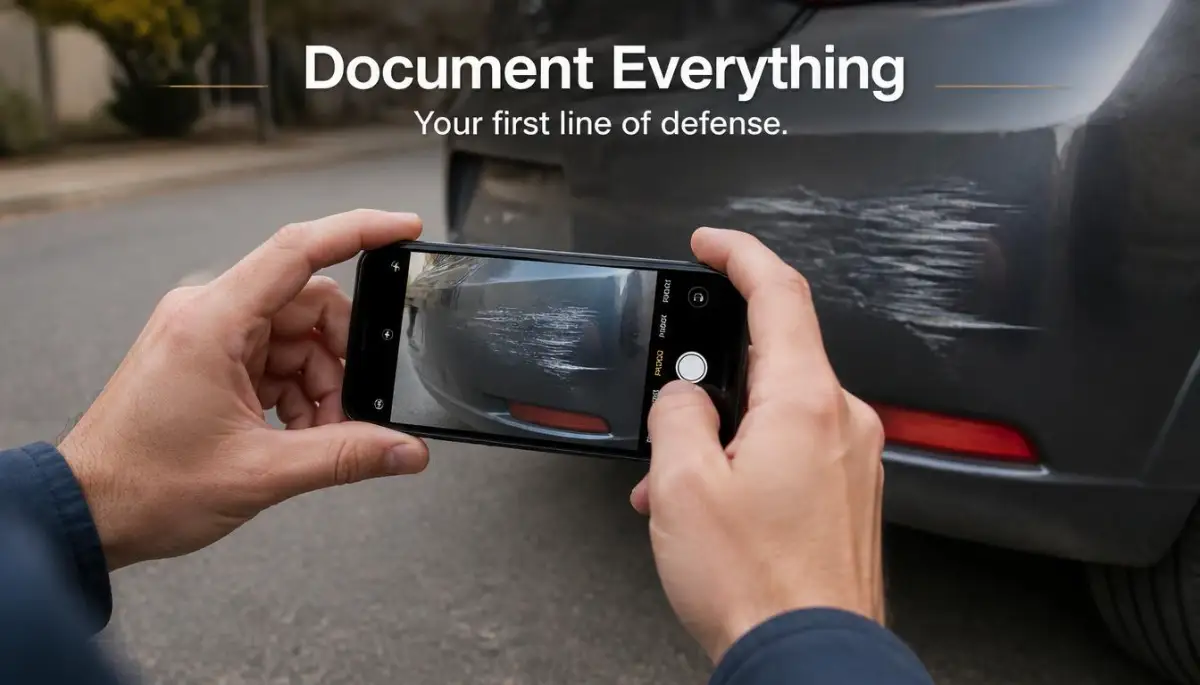
Your smartphone is your absolute best friend during an auto incident. You need to treat the area like a crime scene and document every single detail before the tow trucks arrive.
Do not just take one quick blurry photo of your broken bumper and call it a day. You need to build a visual story that leaves zero room for debate about what actually happened.
Start by standing far back and taking wide-angle photos of the entire intersection or road. Capture the positions of both cars, the traffic signs, and any skid marks left on the pavement.
Next, move in closer and photograph the damage on both your car and the other driver's car from multiple different angles. Make sure you get a clear shot of the other driver's license plate as well.
If there is broken glass on the road or damage to a nearby fence, take pictures of that too.
This brings us to a highly recommended practice:
A Quick Video Can Change Everything
I learned this the hard way during my own messy accident a few years ago. I only took close-up photos of my bumper, and the other driver's insurance argued about how the cars were angled before the crash. My Pro Tip for you is to slowly walk around the entire scene while recording a continuous video on your phone, narrating what you see. It captures the lighting, the weather, and exact positions in a way static photos never can.
Do not forget to gather information from any witnesses who saw the crash happen. A neutral third-party witness can easily save your case if the other driver decides to lie.
Ask anyone standing nearby for their name and phone number before they leave. You do not need to take a formal statement from them on the spot. Just having their contact details allows your adjuster to call them later to verify your side of the story.
3. Decoding the First Call to Your Provider
Many drivers are terrified of calling their insurance provider because they think their rates will instantly skyrocket. Delaying this call is one of the worst mistakes you can possibly make.
Most policies have strict time limits on how long you can wait to report an incident. You should aim to make this phone call within 24 hours of the event, while the details are still completely fresh in your mind.
When you dial the number, remember that the person on the other end is recording the conversation. Stick strictly to the basic facts: the time, the date, the location, and a brief description of what happened.
Do not guess or offer unverified opinions about the crash. If they ask you a question and you do not know the exact answer, simply say, "I am not sure about that detail right now."
Guessing your speed or the distance between the cars can severely hurt your case later on.
Information you must have ready before making the call:
- Your policy number and driver's license.
- The date, time, and exact location of the crash.
- The other driver's name, insurance details, and vehicle information.
- The police report number (if the officer gave you a receipt card).
The representative will likely assign you a claim number and a specific adjuster. Write this claim number down in a safe place, because you will need it for every future conversation.
The adjuster is the person responsible for investigating the crash, reviewing your photos, and deciding how much money you will receive. Treat them with respect, but remember that their primary goal is to save their company money. You must be polite, firm, and heavily rely on the solid evidence you collected at the scene.
4. Organizing Your Financial and Medical Paperwork
Once the initial shock wears off, the real administrative work begins. You are going to start receiving a flood of emails, letters, and phone calls.
If you try to keep all this information floating around in your head, you will quickly become overwhelmed and stressed out. You need to build a rock-solid organization system right now to protect your mental health.
Go to the store and buy a simple physical folder, or create a dedicated digital folder on your computer. Every single piece of paper related to the crash needs to go into this folder immediately.
Keep all the receipts for your tow truck, your rental car, and any emergency medical visits. Even small expenses, like buying a neck brace at the local pharmacy, should be properly documented and saved.
If you suffered any physical injuries, your medical records are the key to a fair settlement. Do not skip your doctor appointments or ignore your physical therapy sessions.
Insurance companies closely monitor your medical treatment to see if you are truly injured. If you claim your back hurts but you skip three doctor appointments in a row, the adjuster will quickly deny your medical compensation. Keep a daily journal noting your pain levels and how the injuries are affecting your daily life.
5. Navigating the Damage Assessment Process
Your insurance company will want to inspect your broken car to figure out exactly how much it will cost to fix. They might ask you to use their mobile app to submit photos, or they might send an appraiser directly to your driveway.
Sometimes, they will ask you to visit one of their "preferred" body shops for a quick estimate. While using their preferred shop is often faster, you have absolute freedom to choose your own mechanic.
If you have a local mechanic you trust with your life, take your car there for an independent estimate. The insurance appraiser will write an initial estimate, which is often surprisingly low.
They usually write estimates based only on the damage they can visibly see on the outside. When your mechanic actually takes the bumper off, they almost always find hidden internal damage that needs fixing.
When this happens, your mechanic will file something called a "supplement" with your insurance provider. A supplement is simply a request for extra money to cover the hidden damages discovered during the repair process.
Do not panic if the first check they send you seems too low to cover the entire bill. This is a very standard part of the process, and good body shops deal with these supplements every single day.
Beyond the Basics: Insider Secrets to Maximize Your Settlement
Now that you have the immediate aftermath under control, it is time to step into the big leagues. Most drivers just accept whatever check the insurance company hands them and quietly walk away.
They assume the professionals always know best and simply accept the first offer out of pure exhaustion. But if you want to truly protect your financial future, you have to look deeper.
We are going to explore a few advanced strategies that adjusters almost never talk about voluntarily. These hidden steps can literally mean the difference between losing money and getting a completely fair payout.
First, let us talk about a closely guarded secret known as a "diminished value" claim. Imagine you have a beautiful, perfectly maintained modern vehicle that gets heavily rear-ended.
Your insurance company pays the auto shop to fix the bumper, the frame, and the fresh paint job perfectly. Your car looks amazing again, but there is a massive hidden problem sitting right under the surface.
When you eventually try to sell this car to a dealership, they will check its history report. The moment they see a major crash on the record, they will instantly drop their purchase offer by thousands of dollars.
Even though the car is fully fixed, the perceived value of your vehicle has permanently dropped. This sudden drop in worth is exactly what a diminished value claim is designed to cover.
You actually have the right to ask the insurance company to write you a separate check for this lost value. You usually have to ask for this specifically, because no adjuster will ever offer it to you proactively.
Real-Life Scenario: The "Total Loss" Negotiation Game
Let us look at another highly stressful situation that catches people completely off guard. Sometimes, the damage to your vehicle is so extreme that repairing it costs more than the car is worth.
When this happens, the adjuster will declare your beloved vehicle a "total loss" and offer you a single lump-sum payment. They base this cash offer on something called the Actual Cash Value of your specific model.
Here is where the major problem starts for everyday drivers. The software that insurance companies use to calculate this value almost always lowballs the current market price.
They will try to give you just enough money, hoping you are too stressed to argue with their math. You do not have to accept their initial calculation if it feels completely unfair to you.
Instead, act like a professional researcher and find exactly what your car is selling for in your local area. Go online and find three or four identical cars being sold at local dealerships right now.
Take screenshots of these higher prices and email them directly to your claims adjuster as hard proof. This simple negotiation tactic forces them to re-evaluate their numbers based on real-world standard auto claims practices and current market conditions.
It takes a little bit of extra effort, but this pushback can easily increase your final check by a huge margin. While you are busy downloading and emailing these heavy image files to your adjuster, you will definitely want to fix your slow internet connection to avoid any frustrating dropouts.
Also, remember that insurance policies should ideally focus on customer care, similar to building products that people actually love. However, the reality is often quite different, and you must advocate for yourself fiercely.
To sustain this positive outcome long-term, you must remain incredibly organized even after the final check clears. Keep your digital folder of evidence and emails safely backed up for at least a few years.
Sometimes, hidden medical issues from a crash can suddenly flare up long after you think the case is closed. Having all your original documentation safely stored away gives you ultimate peace of mind for the future.

The Silent Traps That Will Destroy Your Payout
Even the smartest drivers can accidentally ruin their own cases if they do not know what pitfalls to avoid. The claims process is an absolute minefield of tricky questions and subtle traps designed to save the company money.
I want to walk you through the most dangerous mistakes people make, so you never fall victim to them. Making just one of these errors can instantly give the insurance company the legal right to slash your payment.
The Social Media Surveillance Trap
We live in a world where we naturally want to share every moment of our lives with friends online. When something traumatic like a car crash happens, your first instinct might be to post a picture on Facebook.
You might want to show your friends your smashed car and assure everyone that you are feeling perfectly fine. This is the single biggest mistake you can possibly make right now.
Insurance adjusters act like private investigators, and they will absolutely search for your public social media profiles. Imagine you are claiming serious back pain from the crash, but you post a smiling selfie at a weekend barbecue.
The adjuster will immediately take a screenshot of your smiling face and use it against you. They will confidently argue that if you are well enough to attend a party, your injuries must be completely fake.
My strongest advice is to stop posting entirely on all social platforms until your settlement is officially closed. Do not talk about the crash, do not post recovery updates, and do not let your friends tag you in their photos. Protect your privacy aggressively, because anything you say online will become permanent evidence in your file.
If you are stuck resting at home, feeling a bit isolated from the digital world, try focusing on offline improvements. You might even look for fun ways to make your tiny room look huge with natural light just to lift your spirits naturally.
Falling for the "Recorded Statement" Pressure
Within a few days of the incident, the other driver's insurance agent will likely call your phone. They will sound incredibly friendly, asking how your day is going and expressing deep sympathy for your situation.
Then, they will casually ask if they can record the phone call just for their "internal quality records." Do not ever give a recorded statement to the opposing insurance company without professional legal advice.
Their true goal is to get you talking freely so you accidentally say something that hurts your own case. They will ask confusing, highly specific questions about your speed or exactly where you were looking before the impact.
If you stumble on your words or guess a distance incorrectly, that audio recording becomes a weapon against you. You are only legally obligated to cooperate fully with your own insurance provider, not the other driver's company.
Simply tell the opposing agent that they can speak directly to your adjuster for any official details. This polite but firm boundary protects you from falling into their cleverly designed conversational traps.
Accepting the Very First Settlement Offer
When the dust finally settles, the insurance company will eventually call you to offer a final settlement number. They often try to push this offer on you very quickly, sometimes before you even finish your medical treatments.
They know that you are likely stressed, tired, and desperate for money to pay off your accumulating bills. Because of this pressure, thousands of people eagerly accept the very first check offered to them.
You must understand that the initial offer is almost always a lowball test to see how desperate you are. According to general guidelines from the Consumer Financial Protection Bureau, you should always review financial offers carefully before signing away your legal rights.
Once you verbally accept that first offer and sign their release form, your case is permanently closed forever. Even if you discover you need a massive, expensive surgery next month, you cannot ever ask them for another dime.
Take a deep breath, review the numbers carefully, and never be afraid to say, "I need more time to think about this."
Abandoning Your Medical Care Too Early
Physical recovery can be incredibly exhausting, boring, and highly time-consuming for anyone with a busy schedule. After a few weeks of physical therapy, you might start feeling slightly better and decide to skip your final appointments.
You might tell yourself that you are healed enough and do not need to waste any more time at the clinic. This innocent decision sends a massive red flag straight to the desk of your claims adjuster.
They will immediately assume that your injuries were never actually that serious in the first place. If you stop seeing your doctors, the insurance company will simply stop paying for your future medical compensation.
You must follow your doctor's exact recovery plan religiously, attending every single session until you are formally discharged. Your health is your absolute priority, and maintaining a solid paper trail of continuous treatment proves your pain is real.
For more tips on protecting your overall well-being and managing daily life stress, you can always explore more guides on our main platform at your convenience.
Your Personal Action Plan for Moving Forward
Navigating the murky waters of an auto accident can feel like learning an entirely new, deeply confusing language. At first, the sudden shock, the aggressive phone calls, and the towering stacks of paperwork seem completely impossible to handle.
But as we have explored today, you are actually in the driver's seat of this entire situation. The system might seem massive and intimidating, but it runs on very basic rules of evidence and clear communication.
By taking immediate control of the crash scene, you prevent false stories from taking root. By organizing your documents meticulously, you build an undeniable wall of truth around your financial request.
And by understanding the sneaky negotiation tactics adjusters use, you protect your wallet from unfair, lowball offers. You do not need to be an aggressive lawyer to win; you just need to be calm, prepared, and highly observant.
Every single step you take brings you closer to getting your car fixed, your bills paid, and your life back to normal. Do not let these giant corporations intimidate you into walking away with less than you rightfully deserve.
Always remember to check local regulations through reliable sources like the National Highway Traffic Safety Administration or your local standard DMV reporting guidelines to stay updated on road safety.
I know exactly how overwhelming this whole journey feels right now, but I also know you have the strength to handle it. My best advice is to tackle just one small step at a time, and you will eventually cross the finish line with your head held high.
Frequently Asked Questions About Handling Your Crash
Will my monthly premium instantly go up if I report a crash?
Not necessarily, as it heavily depends on who was at fault and your specific history as a driver. If you were clearly completely innocent, many providers will actually keep your rates exactly the same. However, you must still report the incident quickly to protect your legal right to file a claim.
How long does a typical settlement process actually take?
Every single situation is unique, but simple bumper damages can often be resolved in just one or two weeks. If there are severe physical injuries or deep arguments about who caused the crash, it can easily stretch out for several months. Your best bet is to respond to their emails instantly to keep the ball rolling.
Can I choose my own auto repair shop for the fixes?
Yes, you absolutely have the legal right to pick whatever trusted mechanic you prefer to fix your vehicle. The insurance company might heavily suggest their own preferred shops, but they cannot ever force you to use them. Just make sure your chosen mechanic is comfortable negotiating supplements directly with adjusters.
What should I do if the other driver simply drives away?
If you become the victim of a hit-and-run, never try to chase the escaping vehicle down the street. Pull over to a safe area immediately, call the police, and try to write down the license plate or car color from memory. Your own uninsured motorist coverage will usually step in to pay for your damages in this scary scenario.
Should I hire a lawyer for a simple fender bender?
If nobody was hurt and the cars only have minor scratches, you can usually handle the paperwork easily by yourself. However, if you are experiencing severe physical pain or the adjuster is playing aggressive games, a quick consultation with a lawyer is highly recommended. Many professionals will gladly review your case for free to see if they can help.
Disclaimer: The information provided in this article is for general educational and informational purposes only and does not constitute professional legal, financial, or insurance advice. Always consult with a licensed insurance agent or qualified legal professional regarding your specific personal situation before making any major financial decisions.