
The Crushing Moment of Rejection: My Personal Wake-Up Call
I still remember sitting at my kitchen table with my laptop open, waiting for that final confirmation. The email notification popped up, and my heart sank instantly. I was completely sure the bank would approve my personal loan for a home repair project I desperately needed. Instead, the bold letters staring back at me simply said, "Application Denied."
I felt a massive wave of embarrassment and confusion wash over me in that exact moment. My hands actually shook a little as I closed the screen, wondering what on earth went wrong. I paid my bills on time, I had a steady job, and I thought I was doing everything right. It felt like a personal attack on my financial responsibility.
When a lender says no, it completely ruins your mental peace and leaves you feeling stuck. You start questioning all your life choices. The daily struggle becomes real because the plans you made around that money suddenly fall apart. You have to face the contractor you already hired, or the dealership waiting for your down payment, and admit you do not have the funds.
This rejection creates a heavy cloud of anxiety that follows you to work and keeps you awake at night. You might even feel too ashamed to talk about it with your friends or family. But after going through this painful experience myself, I realized that a denial is not a permanent closed door.
It is just a temporary roadblock, and it is incredibly common. The banking system operates on strict mathematical formulas, not human emotions. Once you understand exactly what the computer algorithm flagged, you can reverse the decision.
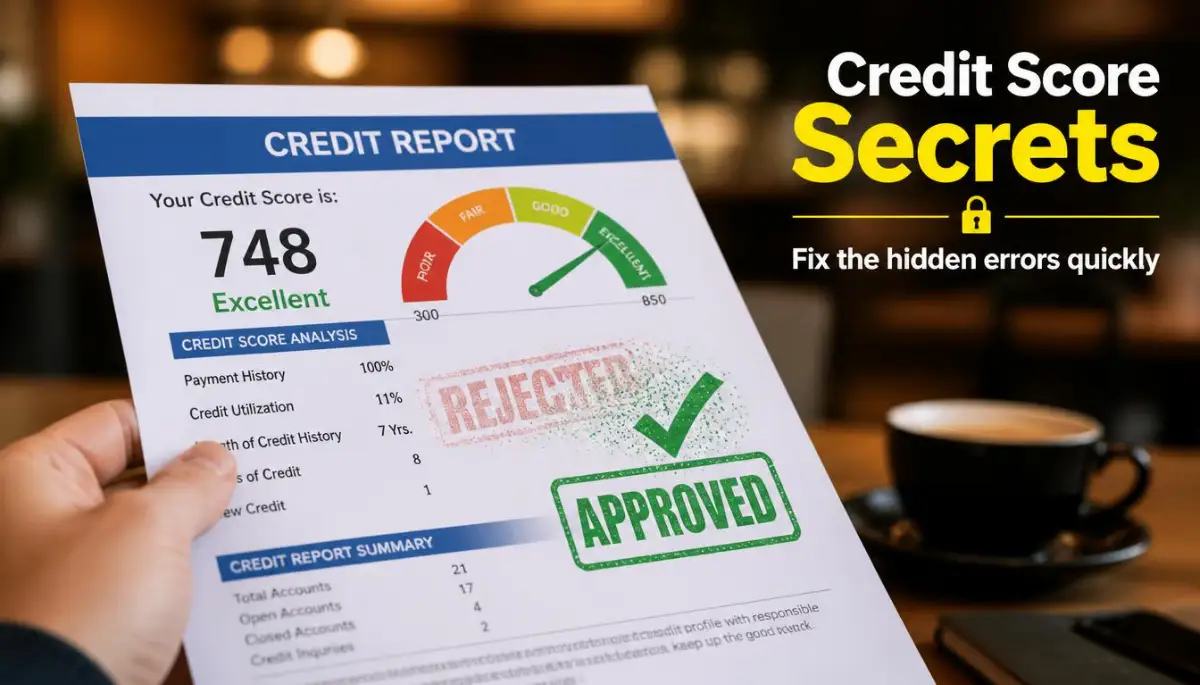
Decoding the Rejection: What Actually Happened Behind Closed Doors?
When your loan application gets rejected, the bank does not just guess. They look at a specific set of numbers and data points to measure risk. To fix the problem, you first need to become a financial detective and understand the specific rules they play by.
Instead of panicking, we are going to break down the exact reasons banks say no. More importantly, we will look at highly practical steps you can take starting this afternoon to clean up your financial profile.
The Hidden Letter You Probably Ignored
By law, when a financial institution denies your request for credit, they must tell you exactly why. They do this by sending you a document called an Adverse Action Notice. Many people throw this letter away because they are too angry to read it.
Do not make this mistake. This letter is your ultimate cheat sheet for your next application. It will list the specific credit bureau they used and outline the exact reasons your score was not high enough.
Usually, the notice will highlight things like "too many recent inquiries" or "balances too high on revolving accounts." Once you read this, you stop guessing and start fixing the exact problem the bank pointed out. You also have the right to request a completely free copy of the credit report they used within 60 days of getting this letter.
The Silent Killer: Your Debt-to-Income Ratio (DTI)
You might have an amazing salary and a great credit score, but still get denied. Why? Because of a little calculation called the Debt-to-Income Ratio, or DTI. This is simply a measure of how much of your monthly income goes toward paying off debts.
Think of your monthly income as a large bucket of water. Every debt payment you have is a hole at the bottom of that bucket. If there are too many holes, the bank knows the bucket will empty out before you can pay them back.
Lenders generally want to see a DTI ratio below 36%. If your ratio is sitting at 45% or 50%, banks see you as a massive risk, no matter how much money you make. They believe you are one small emergency away from missing a payment.
How Lenders View Your DTI
To fix a high DTI, you have two choices. You can either increase your income by taking on a side job, or you can lower your monthly debt payments. Paying off a small credit card balance completely is the fastest way to remove a monthly payment from this calculation.
Want to learn exactly how lenders calculate this behind the scenes? Watch this quick breakdown before you apply again:
Myth vs. Reality: The Credit Score Trap
A lot of people misunderstand how credit scores actually work. We grow up thinking that as long as we pay our phone bill, our credit is fine. Let us clear up some major misunderstandings right now.
- Myth: Paying with a debit card helps build your credit score.
- Reality: Debit cards do not report to credit bureaus at all. Only borrowed money counts.
- Myth: Checking your own credit will lower your score.
- Reality: Checking your own score is a "soft pull" and never hurts your rating. Only a lender checking it causes a "hard pull."
- Myth: Closing an old credit card is a smart way to clean up your finances.
- Reality: Closing old accounts destroys your credit history length and increases your credit utilization, dropping your score significantly.
Understanding these realities puts you miles ahead of the average borrower. When you know how the game is played, you stop making accidental mistakes that lead to rejection.
The "Too Many Inquiries" Red Flag
Every single time you apply for new credit, a hard inquiry is placed on your report. This inquiry stays visible for a long time. If a bank sees that you have applied for five different loans or credit cards in the past month, they get very nervous.
In their eyes, you look desperate for cash. It signals that you are struggling to make ends meet and are looking for a quick lifeline. Even if you were just shopping around for the best interest rate, the system reads it as high risk.
To fix this, you must stop applying for anything immediately. Give your credit profile a resting period of at least three to six months. Let those recent hard inquiries age a bit so they have less impact on your overall score.
I actually learned this the hard way during my own financial journey.
My personal Pro Tip for you: I used to apply for every store credit card just to get a 10% discount at the checkout counter. I thought I was saving money, but I completely ruined my chances of getting a real loan when I actually needed it. Keep your credit applications rare and only apply when it is absolutely necessary.
The Problem of Inconsistent Employment History
Lenders love stability. They want to know that the paycheck you get today is the same paycheck you will get next year. If you change jobs every few months, banks will flag your application as unstable.
This is especially difficult for freelancers, gig workers, and self-employed individuals. Even if you make a lot of money, inconsistent monthly deposits scare traditional banks. They prefer the boring safety of a standard salary.
If your application was denied due to employment history, you need to over-communicate with your lender. Do not just hand them a tax return. Provide a strong paper trail including bank statements, contracts, and letters from steady clients.
If you recently started a new job in the same industry, you can often provide an offer letter showing your new salary. Explaining the context of your job change directly to a loan officer can sometimes turn a "No" into a "Yes."
Unpaid Collections and Hidden Errors
Did you know that millions of people have massive errors on their credit reports right now? You could have a medical bill from three years ago sitting in collections that you never even knew about. Sometimes, someone else's debt ends up on your report just because they have the same name as you.
These hidden errors act like a heavy anchor, dragging your score down into the rejection zone. If the bank denies you, your immediate next step is to pull your full report from all three major bureaus.
Go through every single line with a highlighter. Look for accounts you do not recognize, late payments that you know you paid on time, or old debts that should have fallen off the report.
If you find an error, you must dispute it directly with the credit bureau. By law, they have 30 days to investigate your claim. If the creditor cannot prove the debt belongs to you, the bureau must delete it entirely. Removing just one false collection account can instantly boost your score enough to get approved on your next try.
High Credit Utilization: The Invisible Barrier
Your credit utilization ratio is the amount of credit you are currently using compared to the total amount you have available. Let us say you have a credit card with a $10,000 limit. If your current balance is $9,000, your utilization is sitting at a massive 90%.
Even if you make your minimum payments on time every single month, banks will hate this. High utilization tells the algorithm that you are maxed out and relying heavily on borrowed money to survive.
The golden rule of credit is to keep your utilization below 30% at all times. If you want the best possible score to secure a large loan, try to keep it below 10%.
If you were denied for this reason, the fix is highly actionable. You can pay down your balances aggressively over the next two months. Alternatively, you can call your current credit card company and simply ask for a limit increase.
If they raise your limit to $20,000 and your balance stays at $9,000, your utilization instantly drops to 45% without you paying an extra dime. This simple mathematical trick can heavily influence your next loan application result.
Applying for the Wrong Type of Loan
Sometimes the problem is not you; it is the specific product you applied for. Unsecured personal loans are the hardest to get because the bank has no collateral to seize if you stop paying. If you have a borderline credit score, applying for an unsecured loan is a direct path to rejection.
If you urgently need funds and keep getting denied, you might need to change your strategy. Look into secured loans where you use a savings account or a vehicle as collateral. Because the bank's risk drops to almost zero, they are incredibly willing to approve you, even with a rocky financial past.
You can also look into credit builder loans provided by local credit unions. These institutions are community-focused and often manually review your application instead of relying completely on computer algorithms. Sitting down with a human being at a credit union and explaining your situation is a highly effective way to bypass traditional banking barriers.
Mastering the Bank’s Secret Approval Formula
Now that you know why the rejection happened, it is time to play offense. Getting a "yes" from a lender is not just about fixing past mistakes. It is about actively building a financial profile that makes banks excited to hand you money.
Most average borrowers simply wait a few months and try the exact same strategy again. We are not going to do that. You need to understand the deeper, hidden rules that loan officers use to make their final decisions.
I want to share some expert-level secrets that completely changed the way I look at banking. These are the same strategies financial insiders use to guarantee their applications slide straight through the approval system. Once you apply these methods, you build long-term trust with any financial institution.
The Magic of Relationship Banking
Big national banks rely entirely on cold, emotionless computer algorithms. If your credit score is one point below their requirement, the computer automatically rejects you. There is no human involved in that immediate decision.
To beat this system, you need to shift your focus to local credit unions and community banks. These smaller institutions practice something called relationship banking. They actually care about how long you have been a customer and how well you manage your daily checking account.
If you walk into a local credit union and sit down with a loan officer, you instantly become a real person, not just a file number. You can explain the medical emergency that caused a late payment two years ago. Because they keep their loans on their own books, a human being can manually override a low score and approve you based on your character.
Leveraging the Authorized User Strategy
If your credit file is simply too thin or slightly damaged, you can ethically borrow someone else's good habits. This is called becoming an authorized user on a family member's credit card. It is one of the fastest ways to inject positive history into your own report.
Here is exactly how it works. You ask a trusted parent or spouse who has a spotless credit history to add your name to their oldest credit card. The moment they do this, the entire positive history of that specific account is copied over to your credit report.
You do not even need to carry the physical card or spend their money. Just having your name attached to an account with a long history of on-time payments and low balances will instantly boost your score. The Federal Reserve's Consumer Help center offers great resources on how credit accounts impact your overall standing.
Mixing Your Credit Like a Pro
Did you know that having only credit cards can actually hurt your chances of getting a personal loan? Banks look heavily at your "Credit Mix," which makes up about 10% of your total credit score. They want to see that you can handle different types of borrowed money simultaneously.
Think of your financial profile like a recipe. If you only use one ingredient, the dish is boring and unbalanced. To create a strong financial foundation, just like the real secret to building products that people actually love, you need the right combination of elements.
Lenders want to see a mix of revolving credit (like credit cards) and installment loans (like a small car loan or student loan). If you only have credit cards, consider taking out a small, secured credit-builder loan. Paying that off slowly adds a brand-new type of healthy account to your file.
Timing Your Next Application Perfectly
One of the biggest secrets in the banking world is understanding exactly when creditors report to the bureaus. Every single month, your credit card company sends your current balance to the reporting agencies. This specific date is called the "statement closing date."
If you pay off a large chunk of debt on the 15th, but the bank already reported your high balance on the 10th, your new loan application on the 16th will still show the old, high debt. You will get denied simply because of bad timing.
Always call your current creditors and ask them for the exact day they report to the bureaus. Wait at least three days after that specific reporting date before you submit a new loan application. This ensures the lender sees your newly lowered balances and improved score.
The Art of Manual Underwriting
Most people think a credit score is the only way to buy a house or get a large loan. This is entirely false. There is a hidden, older method of approval called manual underwriting.
If you have zero credit debt and no open credit cards, your score might actually be invisible or "unscorable." Instead of denying you, a good lender will use manual underwriting to look at your real-life bills. They will ask for proof that you pay your rent, electricity, and internet bills on time every single month.
They will review your bank statements to ensure you are saving money and living below your means. If you can prove you have a steady income and a history of paying daily living expenses, you can bypass the traditional credit score system completely.

The Dangerous Traps That Keep Borrowers Rejected
Fixing a denied application is just as much about knowing what not to do. When people face financial rejection, panic usually sets in. This panic leads to rushed decisions that can damage a credit profile for several years.
I have seen smart, hard-working people completely destroy their chances of getting a loan because they fell into these common traps. You must treat your financial profile with extreme care while you are in the rebuilding phase. Let us walk through the most dangerous mistakes you need to avoid right now.
The Desperation Spiral of Panic Applying
The absolute worst thing you can do after seeing a rejection screen is to immediately apply for another loan somewhere else. I understand the urge completely. You need the money, so you think another bank might be more forgiving.
However, every new application puts a hard inquiry on your file. If you apply at five different places in one afternoon, your score will drop rapidly. To the banks, you suddenly look like someone who is desperately hunting for cash to cover an emergency.
When a lender sees a string of recent inquiries, it is an automatic red flag. It acts like a massive warning sign that says, "Stay away, this person is a high risk." Always take a step back, find the root cause of the initial denial, and fix it before ever filling out another application.
Falling for the Credit Repair Scams
When you are stressed about your financial situation, you become a prime target for scammers. You will see ads everywhere promising to "Erase Bad Credit in 30 Days!" or "Legally Remove True Debts!" Do not ever give these companies your money.
The Federal Trade Commission (FTC) strictly warns against these predatory credit repair services. They usually charge you thousands of dollars upfront to do exactly what you can do yourself for free. Worse, they sometimes use illegal tactics like creating fake identities, which can land you in serious legal trouble.
Nobody can legally remove accurate, timely information from your credit report. If you missed a payment, it stays there. Instead of paying a scammer, put that money toward paying down your actual debts to lower your debt-to-income ratio naturally.
Closing Your Oldest Accounts in Anger
Sometimes, a borrower gets so frustrated with their current credit card company that they decide to just close the account forever. They think getting rid of the card will clean up their financial mess. This is a massive mathematical mistake.
A huge part of your score is based on the average age of all your accounts. If you close a card you have had for ten years, you instantly wipe out a decade of good history. Your average account age drops, and your score takes a massive nosedive.
Instead of closing old accounts, just cut up the physical plastic card so you cannot use it. Let the account sit open with a zero balance. Finding the real solution to a financial problem is just like knowing how to fix your slow internet connection; you have to target the actual root cause instead of just unplugging the machine out of frustration.
Ignoring Small Medical Bills
Medical debt is one of the sneakiest reasons loan applications get denied. You might have visited an emergency room three years ago and paid your co-pay. However, a random $50 lab fee might have gotten lost in the mail.
That tiny $50 bill eventually gets sold to a collections agency. It sits on your credit report silently, destroying your score without you even knowing it. Many loan officers will refuse to approve an application if they see any active collection accounts, no matter how small the amount is.
Always pull a fresh copy of your report and scour it for tiny, forgotten debts. Sometimes, simply calling the collection agency and asking for a "pay for delete" agreement can solve the issue. You pay the $50, and they agree to completely erase the negative mark from your file.
Misunderstanding the Power of Collateral
People often repeatedly apply for unsecured signature loans because they want the cash quickly without risking their own assets. But if you have a borderline financial history, banks will simply not take that risk. Continuing to apply for unsecured loans is a waste of your time.
If you are stuck in a cycle of rejections, you need to change the type of product you are asking for. A secured loan is heavily backed by an asset you own, like a car, a piece of equipment, or even a cash savings account.
Because the bank knows they can just take the asset if you stop paying, their fear disappears. It opens up your options and gives you a much better chance of getting the green light. Sometimes, making your financial profile look attractive is just like learning how to maximize natural light; you have to work cleverly with the assets you already have to create a better overall picture.
Your Clear Roadmap to a Guaranteed Yes
Getting denied for a loan is incredibly stressful, but it truly is not the end of your financial journey. It is just a strict wake-up call telling you that your current strategy needs a quick adjustment. Now that you understand the exact mechanics behind the bank's decision, the power is entirely back in your hands.
You no longer have to guess what the computer algorithm wants. You know how to read your adverse action notice and find the exact error dragging you down. You understand the critical importance of keeping your debt-to-income ratio as low as humanly possible.
Most importantly, you know that patience is your greatest weapon. By pausing your applications, paying down small revolving debts, and letting your recent inquiries age, you naturally become a highly attractive borrower. Lenders will eventually fight to give you their best interest rates.
Start taking action this very afternoon. Pull your free credit report, highlight the weak spots, and create a realistic plan to pay down your highest utilization cards. The steps are simple, you just have to stick to them consistently over the next few months. You can explore more helpful guides and strategies directly on our main homepage whenever you need extra motivation.
Going through a financial rejection taught me a massive lesson about patience and personal responsibility. I took a few deep breaths, stopped blaming the banks, and spent three months aggressively cleaning up my own credit profile. When I finally applied again and saw that beautiful "Approved" message, the relief I felt was absolutely indescribable, and I know you will feel that exact same victory very soon.
Common Questions When Banks Say No
How long should I wait before applying for another loan?
You should ideally wait at least three to six months before submitting a new application. This cooling-off period allows your recent hard inquiries to age and gives you enough time to pay down your current debts. Applying too quickly makes you look desperate and leads to automatic denials.
Does a loan denial show up on my credit report?
No, the actual denial does not show up on your credit report. Future lenders will only see the hard inquiry from when you applied, but they will not know if you were approved or rejected. The inquiry itself will temporarily lower your score by a few points.
Will a cosigner guarantee my loan approval?
A cosigner does not guarantee approval, but it drastically improves your chances. If your cosigner has excellent credit and a very low debt-to-income ratio, the bank will base the decision heavily on their financial strength. Just remember, if you miss a payment, it ruins their credit score too.
Can I get a personal loan with a bad credit score?
Yes, it is definitely possible, but your options will be much more limited. You will likely have to rely on local credit unions, secure the loan with collateral, or accept a much higher interest rate. Avoid predatory payday loans at all costs, as they will trap you in a permanent cycle of debt.
Disclaimer: The information provided in this blog post is for educational and informational purposes only and does not constitute professional financial advice. Every individual's financial situation is entirely unique. Please consult with a certified financial planner, your local bank, or a qualified professional before making any major financial decisions, taking on new debt, or attempting to repair your credit history.