
The Heavy Weight of Borrowed Education: My Personal Awakening
I still remember the exact moment my stomach dropped. I had just logged into my federal student loan account after putting it off for months. Seeing that massive number staring back at me felt like a physical weight pressing down on my chest.
I was making payments every single month, yet the principal balance barely seemed to move. It felt like I was pouring buckets of water into a bottomless pit. I spent countless sleepless nights wondering how I would ever afford to buy a house or start a family with this massive financial cloud hanging over my head.
My daily life became a continuous cycle of budgeting stress and quiet panic. Every time I bought a simple cup of coffee, a voice in my head whispered that I should be sending that money to my loan servicer instead. This constant worry completely destroyed my mental peace. I realized I could not keep living in this state of financial anxiety.
Millions of normal, hardworking people share this exact same nightmare. You go to college because you are told it is the right path to a good career. Yet, nobody prepares you for the crushing reality of the monthly bills that follow graduation.
The heavy burden of borrowed education forces people to delay their biggest life dreams. We put off getting married, avoid investing in retirement, and take on second jobs just to stay afloat. The mental exhaustion of juggling bills and living paycheck to paycheck is completely draining.
But I am here to tell you that this does not have to be your permanent reality. There is a way out of this stressful maze, and it starts with understanding the exact tools available to you.
Decoding the Maze of Repayment Strategies
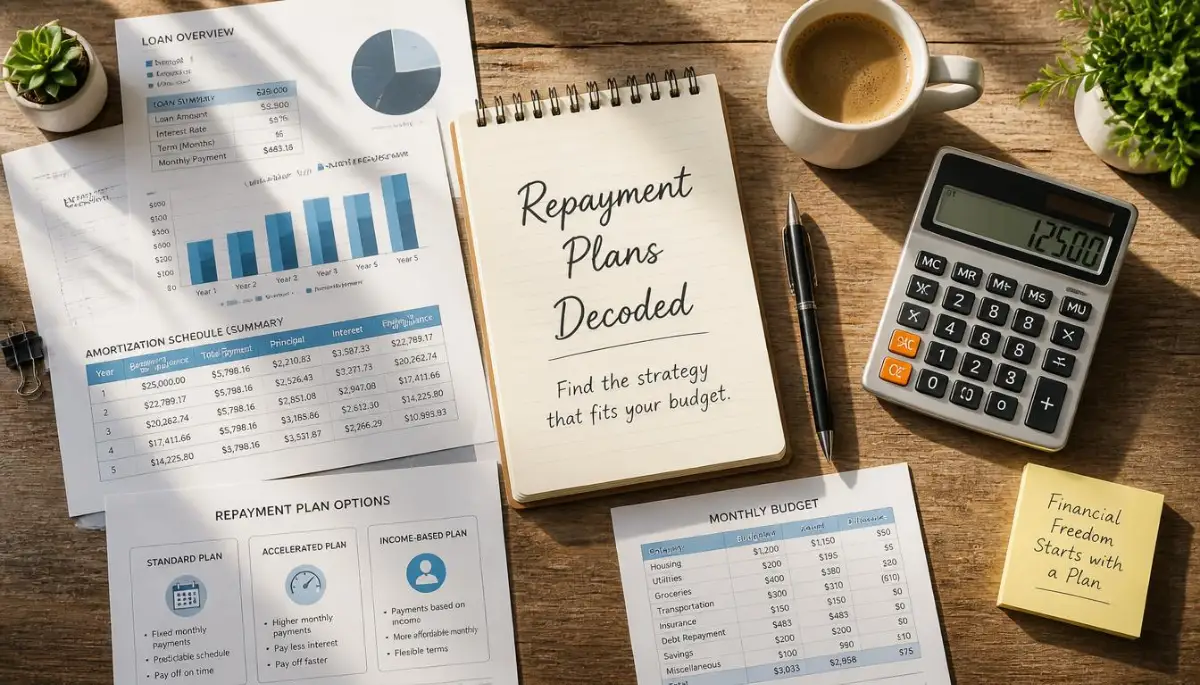
When you first graduate, you are automatically placed on the standard repayment plan. For many people, this default setting is an absolute disaster waiting to happen. The standard plan divides your debt evenly over ten years, resulting in massive monthly payments.
If you are barely making enough to cover rent and groceries, this fixed payment can easily break your bank account. You need a customized strategy that actually fits your real-life income.
The government actually offers several different ways to restructure your debt. The problem is that the system is incredibly confusing, filled with complicated terms and hidden rules. Let us break down these options into simple, actionable concepts you can actually use today.
Aligning Payments with Your Actual Paycheck
If the standard payment is too high, your very next step should be exploring Income-Driven Repayment (IDR) plans. These programs are lifesavers for people who have a high debt-to-income ratio.
Instead of basing your payment on how much you owe, IDR plans base your payment on how much you actually earn. They look at your discretionary income and calculate a fair percentage that you can reasonably afford.
This means if you lose your job or take a massive pay cut, your monthly payment could drop all the way down to zero dollars. Yes, you read that right. A zero-dollar payment can still count as an on-time payment under these specific federal guidelines.
I learned this the hard way. When my income dropped unexpectedly a few years ago, I panicked and put my loans into forbearance, which caused my interest to skyrocket. If I had simply updated my income on my IDR plan, my payment would have dropped to zero, and I would have saved thousands of dollars in capitalized interest. Always update your income whenever it drops!
Understanding the Different IDR Flavors
There is not just one single income-driven plan. The Department of Education offers a menu of options, and picking the right one is essential for your financial health.
You have options like Pay As You Earn (PAYE) and Income-Based Repayment (IBR). Each of these plans calculates your discretionary income slightly differently.
Recently, the government introduced new, highly generous plans that protect a larger chunk of your income for basic living expenses. These updated plans also stop unpaid interest from growing, which is a massive relief for anyone who has watched their balance explode over time.
You do not need to do the complicated math yourself. You can easily use the official federal loan simulator online to see exactly what your payment would be under each specific plan.
Watch This Quick Explainer Video
If you are feeling overwhelmed by all these different acronyms, take a deep breath and watch this incredibly helpful breakdown. It simplifies the entire income-driven repayment process in just a few minutes, making it super easy to digest!
The Truth About Graduated and Extended Plans
What if you make too much money to benefit from an IDR plan, but you still cannot afford the standard ten-year payment? This is where Graduated and Extended plans come into the picture.
A Graduated Repayment Plan starts with very low payments that gradually increase every two years. The assumption here is that your salary will naturally grow as you advance in your career.
This can be a great option for recent graduates entering high-paying fields like medicine or law. However, you must be careful. If your income does not increase as expected, those higher payments down the road will become a massive financial shock.
An Extended Repayment Plan stretches your timeline out to twenty-five years. This dramatically lowers your monthly bill right now, giving your monthly budget plenty of breathing room.
The major downside is that you will end up paying significantly more in interest over the life of the loan. You are basically trading long-term wealth for short-term cash flow.
The Golden Ticket: Public Service Loan Forgiveness (PSLF)
For many borrowers, Public Service Loan Forgiveness represents the ultimate light at the end of the tunnel. If you work in specific fields, the government will completely wipe out your remaining debt after a set period of time.
The PSLF program is designed specifically for teachers, nurses, firefighters, government workers, and non-profit employees. The basic rule is simple: make one hundred and twenty qualifying payments while working full-time for a qualifying employer.
Once you hit that magic number, your entire remaining balance is forgiven tax-free. You do not owe a single penny more to the government.
Myth vs. Reality: The PSLF Program
There is a lot of fear and misinformation surrounding the PSLF program. Let us clear up some of the biggest misunderstandings right now.
Myth: The PSLF program is a scam and nobody actually gets approved.
Reality: In the past, the rules were confusing and rejection rates were high. Today, the system has been entirely overhauled, and hundreds of thousands of public servants are receiving full forgiveness.
Myth: Any job at a hospital or school automatically counts.
Reality: It is not about what you do; it is entirely about who signs your paycheck. You must be directly employed by a government agency or a 501(c)(3) non-profit organization. If you work as a contractor at a non-profit hospital, your time might not count.
The Foolproof PSLF Strategy
If you want to pursue PSLF, you cannot just cross your fingers and hope for the best. You must be incredibly organized and proactive from day one.
First, you absolutely must be enrolled in an Income-Driven Repayment plan. If you stay on the standard ten-year plan, your loan will be completely paid off by the time you reach the ten-year forgiveness mark. There will be nothing left to forgive!
Second, you need to submit an Employment Certification Form every single year. Do not wait until year ten to prove your employment history.
By submitting this form annually, the government will officially update your payment count. This gives you a clear paper trail and protects you from any administrative mistakes down the road.
Specialized Relief for Educators and Professionals
PSLF is not the only game in town. There are other highly specific programs designed to reward people working in high-need areas.
Teacher Loan Forgiveness
If you are a teacher working in a low-income public school, you might qualify for the Teacher Loan Forgiveness program. This program offers a faster timeline than PSLF.
You only need to teach full-time for five consecutive years to qualify. Depending on the subject you teach, you can get up to seventeen thousand and five hundred dollars wiped away.
Math, science, and special education teachers receive the highest forgiveness amounts. Other eligible teachers can receive up to five thousand dollars in relief.
You have to be careful when mixing programs. You generally cannot get credit for both Teacher Loan Forgiveness and PSLF for the exact same period of time. You need to calculate which program gives you the biggest overall financial benefit.
Total and Permanent Disability Discharge
Life is completely unpredictable, and sometimes severe medical issues prevent people from ever returning to work. The federal government has a safety net specifically for this tragic scenario.
If you become totally and permanently disabled, you can have your entire federal student debt completely discharged. You will need to provide official documentation from a physician, the Social Security Administration, or the Department of Veterans Affairs.
Once approved, the burden is lifted instantly. You and your family will not have to worry about paying back loans when you should be focusing entirely on your health and well-being.
The Dangers of Consolidation and Refinancing
When people get frustrated with their loans, they often rush to consolidate or refinance without understanding the consequences. These two terms sound similar, but they have completely different impacts on your financial future.
Federal Direct Consolidation
Federal consolidation simply combines all your separate federal loans into one single loan with one monthly payment. It makes keeping track of your bills much easier.
The new interest rate is just a weighted average of your previous rates. You do not actually save any money on interest by doing this.
Consolidation is often required if you have older loan types and want to qualify for modern forgiveness programs. However, consolidating can sometimes reset your payment count for PSLF, so you must read the fine print very carefully before signing anything.
The Private Refinancing Trap
Refinancing is a completely different beast. This is when a private bank pays off your federal loans and gives you a brand-new private loan.
Banks will often lure you in with promises of much lower interest rates. If you have a high income and great credit, refinancing can indeed save you thousands of dollars in interest over the years.
Here is the massive warning sign. The second you refinance with a private bank, you permanently lose every single federal protection we just talked about.
You lose access to Income-Driven Repayment plans. You are permanently locked out of Public Service Loan Forgiveness. You cannot pause your payments through federal forbearance if you lose your job.
Only refinance if your job is extremely secure, you have a massive emergency fund, and you are absolutely certain you will never need federal forgiveness programs.
Navigating the Speed Bumps: Deferment and Forbearance
Even with the best planning, life throws curveballs. You might lose your job, decide to go back to grad school, or face an unexpected medical emergency.
When you absolutely cannot make your monthly payment, you should never just ignore the bill. Missing payments will destroy your credit score and eventually lead to default. Instead, you need to use federal pause options like deferment and forbearance.
When to Use Deferment
Deferment allows you to legally pause your payments for a specific period. The best part about deferment is how it treats subsidized loans.
If you have subsidized federal loans, the government actually pays the interest that accrues while your loans are in deferment. Your balance does not grow at all during this time.
You typically qualify for deferment if you are enrolled in school at least half-time, serving in the military, or facing severe economic hardship. Always ask your servicer if you qualify for deferment before exploring other options.
The Hidden Costs of Forbearance
If you do not qualify for deferment, your next option is forbearance. Forbearance also allows you to pause your payments temporarily.
However, forbearance comes with a very sharp double-edged sword. While your payments stop, your interest continues to grow on every single type of loan you have.
When your forbearance period ends, that unpaid interest is often added to your principal balance. This means you will literally start paying interest on your interest.
Use forbearance only as a last resort to prevent going into default. If you are struggling long-term, switching to an Income-Driven Repayment plan with a zero-dollar payment is almost always a better financial move than forbearance.
The Tax Bombs of Forgiveness
There is one final puzzle piece you must understand about getting your debt wiped away. Forgiveness is not always completely free.
Under the PSLF program, your forgiven balance is one hundred percent tax-free at the federal level. You will not owe the IRS anything for the massive benefit you received.
However, forgiveness achieved through standard Income-Driven Repayment plans is treated differently. If you make payments for twenty or twenty-five years and have the remaining balance forgiven, the IRS historically treats that forgiven amount as taxable income.
Imagine having fifty thousand dollars forgiven, only to receive a massive tax bill from the government the following year. This is why it is essential to plan ahead.
If you are aiming for IDR forgiveness, you need to start putting a little money away in a savings account right now. Building a tax-bomb emergency fund will save you from a massive financial shock decades down the road.
Managing federal student debt is a marathon, not a sprint. By understanding these specific strategies, organizing your paperwork, and aggressively protecting your income, you can finally break free from the stress.
You are no longer a victim of a confusing system. You now have the exact roadmap needed to take back control of your paycheck, secure your financial future, and permanently eliminate the heavy weight of borrowed education from your life.
Pro-Level Strategies to Master Your Monthly Payments
Once you understand the basic repayment rules, you need to start playing the game like a financial expert. Simply picking a repayment plan and forgetting about it is a recipe for disaster.
Your life is going to change over the next few years. You will switch jobs, maybe get married, or even start a family. Every single one of these life events directly impacts how much money you should be sending to your loan servicer.
To truly take control of your financial future, you have to be proactive. Let us look at some highly effective strategies that most borrowers completely ignore.
The Secret Power of Tax Filing Status
If you are married or planning to get married soon, you need to pay very close attention to how you file your annual taxes. This single decision can literally save you hundreds of dollars every single month.
When you apply for an Income-Driven Repayment (IDR) plan, the government looks directly at your tax return. If you file your taxes jointly with your spouse, the loan servicer uses your combined household income to calculate your monthly payment.
If your spouse makes a good salary, your monthly student loan bill is going to skyrocket. However, there is a completely legal workaround for this exact situation.
If you choose to file your taxes separately, most IDR plans will completely ignore your spouse's income. They will only calculate your payment based on your individual salary, which keeps your monthly bill incredibly low.
You should definitely sit down with a certified accountant to run the numbers both ways. Sometimes the tax benefits of filing jointly outweigh the savings on your loan payment, but you will never know unless you do the math. Exploring this option is just like taking control of your financial future in other areas of your life—you have to explore every single avenue.
Master the Annual Recertification Game
When you are on an IDR plan, your low payment does not automatically last forever. You are legally required to recertify your income and your family size every single year.
If you forget to submit this paperwork on time, the consequences are incredibly painful. Your account will automatically revert back to the standard ten-year payment plan.
This means your payment could suddenly jump from fifty dollars a month to eight hundred dollars a month without any warning. Even worse, any unpaid interest you have accumulated might capitalize, meaning it gets added to your principal balance.
Do not rely on your loan servicer to remind you. Set a recurring alarm on your phone and mark it boldly on your calendar a month before your deadline. You can easily read the official recertification guidelines on the Federal Student Aid website to ensure you have all the right documents prepared.
Updating Your Family Size Immediately
Here is a brilliant hack that many people completely overlook. When the government calculates your discretionary income, they factor in how many people live in your household.
The larger your family size, the lower your monthly payment becomes. You do not have to wait for your annual recertification date to update this information.
If you have a new baby, adopt a child, or suddenly start financially supporting an elderly parent, you should contact your servicer immediately. You can submit a new IDR application that same day to instantly drop your monthly payment.
Preparing for the Unseen Tax Bomb
If you are aiming for loan forgiveness through a standard IDR plan after twenty years, you need to prepare for the end of the journey right now. As we discussed earlier, the IRS might treat your forgiven balance as taxable income.
Do not let this scare you into staying on a standard payment plan. Instead, create a dedicated savings account specifically for this future tax bill.
If you automate a small transfer of fifty dollars every month into a high-yield savings account, you will have a massive safety net waiting for you decades down the road. Treating your personal finances like a business helps you stay incredibly organized. Just as you would secure essential legal papers for business owners to protect your family, you must secure a savings fund to protect your future peace of mind.

Dangerous Traps That Can Destroy Your Progress
Navigating this massive financial system is incredibly tricky. A single misstep can accidentally reset your progress or cost you thousands of dollars in unnecessary interest.
Many hardworking people fall into these common traps simply because they do not read the fine print. Let us shine a light on these massive mistakes so you can completely avoid them.
Ignoring the Mail from Your Servicer
This is by far the most common and destructive mistake anyone can make. When you are feeling financially stressed, it is incredibly tempting to just throw those envelopes directly into the trash.
Ignoring your loan servicer will never make the debt disappear. In fact, it only guarantees that your situation will get significantly worse.
Your servicer might be trying to warn you about a missing signature, a changed deadline, or a new federal program that could actually lower your payments. According to reports from the Consumer Financial Protection Bureau, servicers frequently make administrative errors, and catching them early is entirely your responsibility. Open every single letter and read every single email immediately.
Falling for the "Pay for Help" Scams
When you are desperately looking for a way out of debt, you become a prime target for shady companies. You have probably seen their aggressive advertisements on social media.
These scam companies promise to wipe out your debt overnight or guarantee instant forgiveness for an upfront fee of five hundred dollars. It sounds amazing, but it is a complete lie.
There is absolutely nothing these private companies can do for you that you cannot do for yourself entirely for free. The Department of Education does not charge any fees to consolidate your loans, change your repayment plan, or apply for forgiveness.
Always rely on official government platforms or a trusted home base for genuine resources when looking for factual information. Never give your FSA ID or password to a third-party company over the phone.
Paying Extra on the Wrong Plan
We are all taught that paying extra money toward our debts is a incredibly smart financial move. However, if you are actively pursuing Public Service Loan Forgiveness (PSLF), paying extra is actually a terrible idea.
Under the PSLF rules, your exact remaining balance will be forgiven after you make one hundred and twenty qualifying payments. The amount of debt left over literally does not matter.
If your required monthly payment is one hundred dollars, and you decide to send three hundred dollars instead, you are just throwing two hundred dollars away. That extra money does not speed up your forgiveness timeline at all.
Instead of overpaying your federal loans, redirect that extra cash toward high-interest credit cards, building your emergency fund, or investing for retirement.
Letting Small Frustrations Derail Your Focus
Dealing with loan servicers can be an incredibly annoying experience. You might spend hours on hold, get transferred to three different departments, or have your paperwork randomly rejected for a tiny typo.
It is very easy to throw your hands up in the air and completely give up. But you cannot let temporary administrative headaches destroy your long-term financial freedom.
Think about how you handle minor tech annoyances in your daily life. When your internet cuts out during an important Zoom call, you do not just throw your laptop away. You find simple ways to troubleshoot your slow connection and get back to work.
You must treat your student debt with that exact same persistent mindset. Keep copies of every single document you submit, write down the name of every representative you speak with, and always ask for confirmation numbers.
Your Next Steps Toward Total Financial Peace
The system is undoubtedly broken and confusing, but you now possess the knowledge to navigate it successfully. You are no longer in the dark about how these massive financial institutions operate.
By strategically choosing the right income-driven plan, protecting your tax filing status, and meticulously tracking your paperwork, you can entirely change your financial trajectory. The heavy cloud of debt does not have to block your sunshine forever.
Start today by logging into your federal account and finding out exactly who your loan servicer is. Check your current repayment plan and use the federal simulator to see if you can instantly lower your monthly bill.
It is time to start building a solid foundation for a future where you dictate where your hard-earned money goes. You deserve to buy a home, take vacations, and save for retirement without feeling constantly guilty.
Take a deep breath, gather your financial documents, and make that first phone call today.
I know exactly how suffocating it feels to be trapped under a mountain of educational debt, because I lived that nightmare for years. But taking that first step to restructure my payments completely changed my life, and I am absolutely confident you can achieve that exact same financial freedom starting right now!
Real Questions People Ask About Debt Relief
Can my federal student loans be forgiven after 10 years?
Yes, absolutely. If you work full-time for a government agency or a qualifying non-profit organization, you can get your remaining balance forgiven after exactly ten years. This is done through the Public Service Loan Forgiveness (PSLF) program after making one hundred and twenty on-time payments.
What happens to my debt if I move to another country?
Moving abroad does not erase your federal student debt, and you are still legally required to make payments. However, if you claim the Foreign Earned Income Exclusion on your US taxes, your adjusted gross income might drop to zero. This means your monthly payment on an IDR plan could legally become zero dollars.
Will getting married increase my monthly payment?
It entirely depends on how you choose to file your annual taxes. If you file jointly, your loan servicer will use both incomes to calculate your monthly bill, which usually causes a massive increase. If you file separately, they will typically only look at your individual income.
How do I know if my employer qualifies for public service forgiveness?
You do not have to guess or assume your job counts. You can use the official PSLF Employer Search Tool on the Federal Student Aid website. Just type in your employer's Employer Identification Number (EIN) found on your W-2 to see their official eligibility status instantly.
Can private student loans ever be forgiven?
Unfortunately, private student loans do not qualify for any of the federal forgiveness programs we discussed today. Private banks rarely forgive debt unless you experience extreme circumstances like permanent disability or bankruptcy. If you have private loans, your best option is usually refinancing to find a much lower interest rate.
Disclaimer: The information provided in this blog post is for educational and informational purposes only and does not constitute professional financial, tax, or legal advice. Federal student loan rules, forgiveness programs, and tax laws are subject to change. Always consult with a certified financial planner, tax professional, or your official loan servicer before making any major decisions regarding your personal finances or debt repayment strategies.
![The Secret Truth Behind Student Loan Forgiveness [Step-by-Step]](https://topic36.com/storage/uploads/blogs/1791388180_LVR3XS4A.webp)

![The Ultimate Blueprint to Fix a Denied Loan Application [Step-by-Step]](https://topic36.com/storage/uploads/blogs/1788883415_the-ultimate-blueprint-to-fix-a-denied-loan-application-step-by-step.webp)