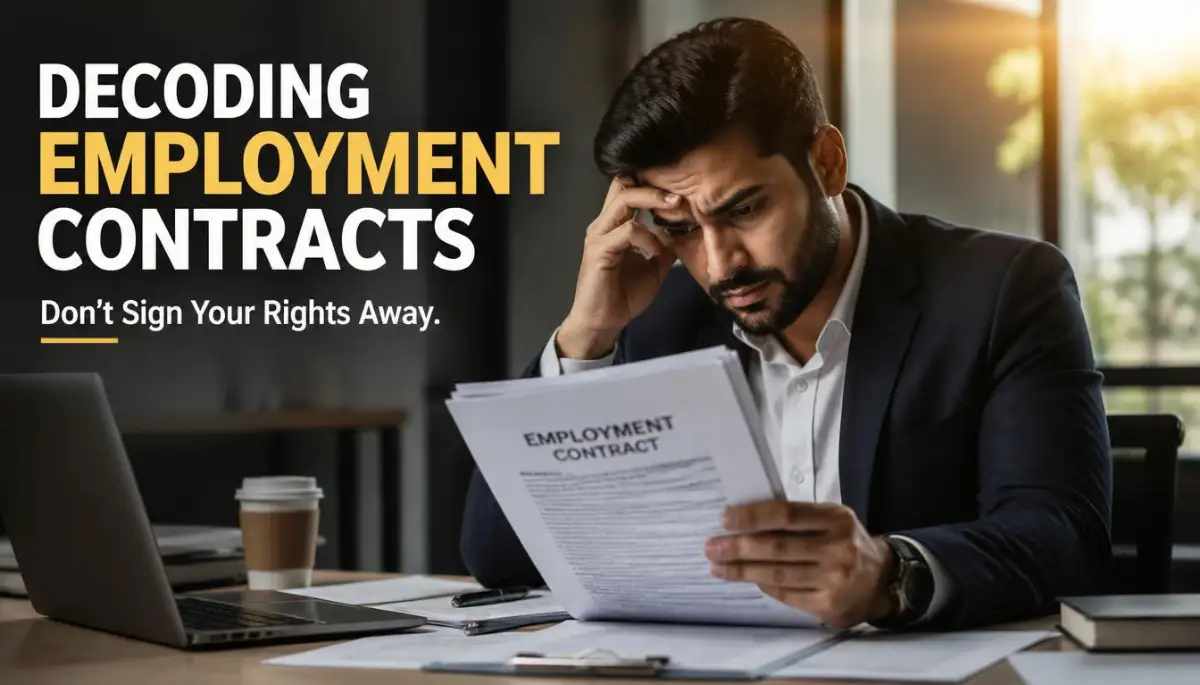
The Shocking Reality Behind That Exciting Job Offer
I will never forget the mix of absolute thrill and pure panic I felt when I received my very first major job offer. My hands were literally shaking as I opened the PDF attachment from the HR department. I expected a simple one-page letter welcoming me to the team, but instead, I was staring at a massive, twenty-page document filled with words I could barely pronounce. I felt completely paralyzed by terms like "indemnification," "severability," and "arbitration." My heart sank because I realized I was about to sign away my professional rights without having a single clue what I was actually agreeing to. I was too embarrassed to ask the hiring manager to explain it, fearing they might think I was difficult or uneducated. I just closed my eyes, digitally signed the bottom line, and hoped for the best.
Sadly, my experience is incredibly common among hardworking professionals today. We spend months polishing our resumes, preparing for interviews, and negotiating salaries. Yet, when the final paperwork arrives, we treat it like the terms and conditions of a software update. We just scroll to the bottom and hit accept.
This blind acceptance is causing a massive amount of hidden anxiety for employees everywhere. People wake up in the middle of the night wondering if they are allowed to start a side hustle. They worry if they will be sued for talking to a former coworker.
The fear of the unknown takes a huge toll on our mental peace. We end up feeling trapped in our own careers, held hostage by legal jargon we never truly understood. When you do not understand the rules of the game you are playing, you walk around with a constant sense of vulnerability.
Many talented individuals stay in toxic work environments simply because they mistakenly believe a confusing clause prevents them from leaving. They let complicated legal language bully them into submission. This lack of clear knowledge steals your confidence and turns what should be an exciting career milestone into a heavy burden.
It is time to stop letting confusing paperwork control your professional destiny. You deserve to know exactly what you are agreeing to before you give a company the best years of your life. Let us break down the confusing legal walls together, right now.

Translating Corporate Jargon Into Plain English
You do not need a law degree to understand your own career boundaries. You simply need a clear translation of the most common legal traps companies use. Let us break down the most confusing sections of a standard job agreement into simple, bite-sized pieces you can actually use.
We will look at these terms logically, stripping away the confusing legal talk. Once you see the real-life meaning behind these words, you will instantly regain your confidence.
The Illusion of Freedom: Understanding "At-Will Employment"
Almost every modern job agreement starts with a bold section declaring that your employment is "at-will." On the surface, this sounds like a great thing. It sounds like you have the freedom to work based on your own free will.
However, the legal reality is heavily tilted in favor of the employer. At-will employment simply means the company can fire you at any time, for any legal reason, without any warning. They do not need a good excuse, and they do not have to give you a two-week notice.
Think of it like renting an apartment without a lease agreement. The landlord can ask you to move out tomorrow just because they feel like it.
On the flip side, it also means you can quit at any time without legal consequences. But let us be honest, the company has an entire HR department to survive your sudden departure. You, on the other hand, might lose your ability to pay rent if you are suddenly let go.
Bold Video Intro: Want to know the exact difference between an at-will employee and a contract worker? Watch this quick breakdown to see how your legal rights change based on your worker classification.
When you see the at-will clause, just remember that your job security is not guaranteed by the contract itself. Your security comes from your performance, your value to the team, and having a solid emergency fund.
The Handcuff Clause: Decoding the "Non-Compete Agreement"
This is easily the most terrifying section of any job offer. A non-compete clause essentially dictates what you are allowed to do after you stop working for this company. The legal language will usually say you cannot "engage in a similar business capacity within a restricted territory for a specified duration."
What does that actually mean for your daily life? It means if you quit, you might not be allowed to work for a competitor for a whole year. In some aggressive contracts, it means you cannot even work in the same industry within a 50-mile radius of your current office.
Imagine you are a brilliant graphic designer working for an advertising agency in your city. If things go sour and you want to leave, a strict non-compete could force you to either change your career completely or move to a different city just to find work.
My Personal Wake-Up Call (Pro Tip)
I once signed a contract without reading the non-compete section, thinking it was just standard boilerplate text. A year later, I found a dream job across the street, only to realize my current contract legally blocked me from accepting it. Always check the time limit and the geographic radius of a non-compete clause, and politely ask HR to reduce the scope if it seems unreasonably broad.
Companies use these clauses to protect their trade secrets, which is fair. However, many companies make these boundaries incredibly wide to scare employees from ever leaving.
Always look for two specific details in this section: the time limit and the location limit. A reasonable non-compete might last six months and cover a small area. An unreasonable one lasts two years and covers the entire country.
The Silence Agreement: What "Confidentiality and NDAs" Really Cover
You will likely see a massive section dedicated to Non-Disclosure Agreements (NDAs) or Confidentiality. The contract will list things like "proprietary algorithms, client rosters, and financial models."
In plain terms, this means you cannot share the company's secret recipes with anyone outside the building. If you learn how the company makes its money or who its best clients are, you have to take that information to your grave.
This seems obvious, but people mess this up all the time in casual ways. For example, if you leave a job and take a USB drive full of presentation templates you created, you might be breaking this clause.
Real-Life Scenario: The Innocent Portfolio Mistake
Let us say you are a marketing manager who ran a highly successful social media campaign. You want to show this off in your personal portfolio to get a better job. If you share exact revenue numbers or specific conversion rates from that campaign, the company could claim you violated your NDA.
To protect yourself, always ask permission before sharing specific data outside the company. You can usually talk about your skills and general achievements, but you must keep the exact formulas and client lists strictly secret.
The Friendship Trap: Breaking Down "Non-Solicitation"
Right next to the non-compete, you will often find the non-solicitation clause. The legal phrasing usually warns against "enticing, inducing, or encouraging current employees or clients to terminate their relationship with the employer."
Let us translate that into normal English. If you quit and start your own business, you are legally forbidden from poaching your favorite coworkers to come work with you. You are also banned from calling up your favorite clients and asking them to follow you to your new agency.
Think of it as a strict "do not steal my friends" rule. If you leave, you have to leave alone.
Many people accidentally break this rule through LinkedIn. If you post that your new company is hiring, and your old coworker applies, are you soliciting them? Usually, a general public post is safe. But if you send a direct message saying, "Hey, you should come work here," you are crossing a dangerous legal line.
Giving Up Your Day in Court: The "Arbitration Clause"
This is perhaps the sneakiest legal trap hidden in modern paperwork. An arbitration clause usually says something about "resolving disputes through binding arbitration rather than civil court litigation."
If your employer mistreats you, fails to pay you, or discriminates against you, your first instinct would be to take them to court. This clause forces you to give up that right entirely. Instead of a judge and a public jury, your case will be heard by a private arbitrator.
- Why companies love this: Private arbitration is completely secret. It keeps their dirty laundry out of the public news.
- Why you should be careful: Arbitrators are often chosen and paid for by the company. The process heavily favors the employer, and you generally cannot appeal the decision if you lose.
You are essentially agreeing to settle all future fights in a private backroom instead of a public courtroom. While you often cannot negotiate this clause away, you must at least be aware that you are signing away your right to a public trial.
Myth vs Reality: Common Contract Misconceptions
Let us pause and clear up some major misunderstandings people have about signing job offers. I see these mistakes happen constantly.
The Everything Belongs to Us Rule: "Intellectual Property Assignment"
If you are a creator, developer, or thinker, this clause is incredibly dangerous. Intellectual Property (IP) assignment clauses dictate who owns the ideas in your head.
The jargon usually reads: "Any works of authorship, inventions, or discoveries created during the term of employment are the sole property of the company."
Here is the scary translation. If you invent a brilliant new app while working for this company, the company owns it. They get the patent, they get the profits, and you get your regular salary.
But it goes deeper than that. Some aggressive contracts claim they own anything you create during your employment, even if you did it on your own computer, on a Sunday night, in your own house.
If you have a side hustle, a personal blog, or an indie game you are building, you must be extremely careful. You need to make sure the contract specifies they only own work created using company equipment or work that directly relates to their specific business. If the language is too broad, you need to ask them to write in an exception for your personal projects.
The Rotten Apple Rule: Understanding "Severability"
Near the very bottom of the document, you will see a tiny paragraph about "severability." It sounds like something out of a medical textbook, but it is actually a clever safety net for the employer.
The text will say that if any single provision of the agreement is found to be invalid, the rest of the agreement remains in full force and effect.
Let us use an analogy. Imagine you buy a basket of apples. If one apple is completely rotten, you throw away that single apple, but you keep the rest of the basket.
If a judge decides that your non-compete clause is totally illegal and throws it out, the company wants to make sure the rest of your contract still applies. The severability clause protects the company from having the entire contract destroyed just because their lawyers made one mistake.
What is "Termination for Cause" versus "Without Cause"?
We talked earlier about at-will employment, but contracts often get very specific about how they can fire you. They will separate terminations into two buckets: "for cause" and "without cause."
Termination "for cause" means you did something terribly wrong. You stole money, you harassed a coworker, or you severely breached company policy. If you are fired for cause, you usually lose all your benefits immediately and get no severance pay.
Termination "without cause" means the company is laying you off through no fault of your own. Maybe they lost a big client, or they are shutting down your department. When this happens, you are usually entitled to whatever severance package or benefits are outlined in your original agreement.
Always read the exact definition of "for cause." Some sneaky companies try to define "poor performance" as a cause to fire you without paying your benefits. Poor performance should ideally be a separate issue, not a fireable offense that strips you of your earned compensation.
The Notice Period: Are You Trapped?
Many agreements outline a specific notice period. They might demand that you give them a thirty-day notice before resigning.
You must ask yourself what happens if you break this rule. Does the contract state that you will lose your unvested stock options? Will they refuse to pay out your unused vacation days?
Sometimes, a new employer wants you to start next week. If your current contract demands a thirty-day notice, you are suddenly caught in a massive legal tug-of-war between two companies. Always negotiate the notice period down to a standard two weeks before you sign the initial offer.
Protecting Your Future Self Today
Reading these documents is incredibly boring. It is tedious, dry, and mentally exhausting. However, you are making decisions for your future self.
The person signing this contract is happy and excited. But the person who might need to rely on this contract later could be stressed, unhappy, and desperate to leave. You owe it to your future self to ask the hard questions right now.
Take a physical highlighter to the printed document. Highlight every single word you do not completely understand. Look up the definitions, or better yet, send a polite email to the HR representative asking for clarification in writing. Having their explanation in an email creates a helpful paper trail if a dispute ever arises later.
Remember, an employment offer is a business transaction. They want your skills, and you want their money and platform. You are an equal partner in this deal. Do not let intimidating legal language make you feel small or powerless.
Take your time. Read the fine print. Ask for changes if something feels completely unbalanced. A good employer will respect a candidate who reads the contract thoroughly and asks intelligent questions. It shows you are careful, detail-oriented, and professional.
Never apologize for protecting your own career. You are your own best advocate. Start treating your signature like the incredibly valuable asset it truly is. Your future peace of mind depends entirely on the boundaries you are willing to set today.
Master Level Tactics For Contract Negotiation
Now that you understand the basic translations of those terrifying legal paragraphs, you need to know how to actually fight back. Most people completely freeze when they spot a massive red flag in their job offer.
They assume the document is permanently carved in stone and cannot be touched. The truth is, almost everything in business is an ongoing conversation. You just need to know exactly how to speak their language without sounding aggressive.
Here is a major secret that completely changed my career trajectory. Human resources professionals do not expect you to blindly sign everything. In fact, when you ask intelligent, polite questions about specific clauses, you immediately command more respect.
Let us walk through some incredibly effective ways to protect your rights without losing the job opportunity you worked so hard to get.
The Polite Email Paper Trail Strategy
Verbal promises from a hiring manager are completely worthless if they are not written down. If the hiring manager tells you on a phone call, "Oh, do not worry, we never actually enforce that non-compete," you are in massive danger.
If they fire you a year later, the new HR director will look at the document, not the phone call you had last year. To protect yourself, you need to create a written paper trail of their true intentions.
Whenever you find a scary paragraph, send a very polite email asking for plain-language clarification. You can write something like: "I am so excited to join the team! I was reviewing the intellectual property section and wanted to ensure I understand it correctly. Does this apply to personal projects I create on my own home computer?"
If they reply via email saying, "No, it only applies to company equipment," save that email immediately. If you ever face a legal dispute, this written clarification serves as powerful evidence of the original intent behind the agreement. To understand how courts view written evidence over verbal claims, you can review the basics of contract integration rules through the Legal Information Institute by Cornell Law School.
Protecting Your Creative Brainchild (The IP Carve-Out)
If you are a creative professional, a developer, or someone with an active side hustle, you must aggressively protect your personal work. Standard job offers often try to claim ownership of every single idea that pops into your head during your employment.
You cannot let a corporation steal your personal passion projects. If you are learning the real secret to building products that people actually love in your spare time, you want to keep the rights to your own inventions.
The easiest way to fix this is to ask for an "Exhibit A" or a "Prior Inventions" form. This is a simple blank page at the end of the agreement where you can list all your current side projects, personal websites, and apps.
By declaring these projects in writing before you start, you build a legal fence around your personal ideas. The company officially acknowledges that these specific projects belong completely to you, no matter what happens in the future.
Handling the Secret Arbitration Trap
As we discussed earlier, signing away your right to a public trial is a massive concession. While many massive corporations will absolutely refuse to remove an arbitration clause, you can still negotiate the terms of it.
If the contract says you must pay half the costs of the private judge, you should strongly push back. Arbitration can easily cost thousands of dollars a day, making it impossible for a regular worker to afford.
You can politely ask HR to update the language so the company covers 100% of the arbitration fees if a dispute arises. You can also research your specific employee rights regarding workplace discrimination through resources provided by the U.S. Equal Employment Opportunity Commission (EEOC). They offer excellent guidance on what rights cannot legally be waived by a private employer.
Requesting a Fair Severance Trigger
If the company insists on giving you a very strict non-compete, you can flip the script and ask for financial protection in return. If they are legally banning you from working in your industry for six months after you leave, how are you supposed to pay for your groceries?
You can politely ask them to include a "Severance Trigger" tied directly to the non-compete. This simply means if they choose to enforce the non-compete when you leave, they must continue paying your base salary during those restricted months.
If they refuse to pay you during the restricted period, they must agree to drop the non-compete entirely. This forces the company to put their money where their mouth is.

The Heartbreaking Errors Most Professionals Make
Even with the best intentions, smart people constantly stumble into massive legal traps. I have seen incredibly talented friends ruin their financial futures simply because they were too excited to read the fine print.
These mistakes usually happen because we let our emotions take over during the final stages of the hiring process. We feel a massive sense of relief that the job hunt is finally over, and we just want to start celebrating.
Let us look at the most dangerous pitfalls you must actively avoid. If you ignore these warnings, the consequences can follow you around for the rest of your working life.
Falling for the Exploding Offer Trap
One of the most toxic psychological tricks companies use is the "Exploding Offer." This happens when a recruiter hands you a massive legal document on a Friday afternoon and demands that you sign it by Saturday morning.
They create a fake sense of extreme urgency to prevent you from getting professional advice. They know that if you actually sit down and read the terms carefully, you might try to negotiate.
Never let a recruiter bully you into rushing a signature on a binding legal document. A healthy, professional company will always gladly give you a full weekend, or at least 48 to 72 hours, to review an agreement.
If a company threatens to take the job offer away just because you asked for two days to read the paperwork, consider it a massive red flag. That kind of aggressive behavior is exactly how they will treat you once you actually start working there.
Ignoring the "Entire Agreement" Clause
There is a sneaky little paragraph usually hidden at the very bottom of the last page. It is often labeled the "Integration Clause" or the "Entire Agreement" clause.
This short sentence legally wipes out every single promise the hiring manager made to you during your interviews. It states that only the words printed on this specific piece of paper matter.
Imagine the recruiter promised you a massive performance bonus after six months, or guaranteed you could work from home three days a week. If those exact promises are not typed into the final document, they legally do not exist.
Ignoring this rule is like ignoring a massive tech issue in your home office. Just like you would immediately try to fix your slow internet connection before an important video presentation, you must fix missing promises in your contract before your first day of work. You cannot just hope the problem will magically resolve itself later.
Believing You Cannot Afford Professional Help
Many regular workers assume that hiring an employment attorney is only for wealthy CEOs and celebrities. This is a very expensive myth.
If you are signing a document that dictates your salary, your creative rights, and your ability to work for the next few years, an expert review is completely worth the cost. You do not need to hire a lawyer for a massive court case.
You simply need to pay an attorney for one single hour of their time to review the PDF and highlight the bad parts. This small investment can save you tens of thousands of dollars in lost wages later.
If you are unsure where to even start looking for reputable legal help, you can check the public hiring guidelines published by the American Bar Association (ABA). They help regular people connect with certified professionals in their exact location.
Assuming Company Policy is the Law
Just because a company prints something on a piece of official letterhead does not magically make it a binding legal law. Companies try to put highly questionable rules into their employee handbooks all the time.
For example, many employers put strict rules in their contracts forbidding you from discussing your hourly wages or salary with your coworkers. They make it sound like a fireable offense to talk about money.
However, under federal labor laws, employees have a highly protected right to discuss their compensation with each other to ensure fair treatment. You can read up on your protected concerted activities on the official National Labor Relations Board (NLRB) website to see exactly what an employer cannot legally ban you from doing.
Do not let intimidating corporate stationery trick you into giving up your fundamental worker rights.
Taking Back Your Professional Power
Navigating the murky waters of modern corporate paperwork does not have to be a terrifying experience. Once you learn how to read past the confusing jargon, you instantly take back control of your own professional journey.
You stop being a passive participant who just accepts whatever terms are pushed across the table. Instead, you become an active, empowered professional who advocates for their own worth.
Just as a few clever design tricks can entirely make your tiny room look huge, a little bit of specialized knowledge can massively expand your career potential. You start seeing opportunities where others only see roadblocks.
When you sit down to read your next job offer, bring a highlighter, a cup of coffee, and a sense of absolute confidence. Read every single line slowly.
Ask questions without any fear of looking silly. The more questions you ask, the more you establish yourself as someone who values detail, precision, and fairness.
For even more tips on personal growth and building a smarter career strategy, you can always explore the resources available on Topic36. Building a strong foundation of knowledge is the best way to secure your financial future.
My Personal Final Thoughts
I spent years letting confusing paperwork bully me into accepting less than I actually deserved. Once I finally decided to educate myself and push back, my entire career transformed, and my daily anxiety completely vanished. You have incredible value to offer the world, so never apologize for making sure your professional boundaries are fiercely protected.
Frequently Asked Questions About Job Offers
Can I actually ask HR to change a written contract before I sign it?
Yes, absolutely. An employment offer is just a starting point for a business negotiation, not a final demand. If a specific clause is completely unreasonable, you can politely request that they remove or modify it before you officially agree to the terms.
What exactly happens if I simply refuse to sign a non-compete agreement?
If a non-compete is a mandatory condition of employment for that specific company, refusing to sign it usually means they will withdraw the job offer. However, you can often negotiate the time limit or the geographic restrictions to make it much fairer for your future career.
Should I really hire a lawyer to read my standard job offer?
If the document includes confusing language about intellectual property, strict non-compete rules, or complex equity compensation, paying for one hour of an attorney's time is highly recommended. It is a very small investment to ensure your long-term income and creative rights are fully protected.
Does an email from a hiring manager count as part of the legal contract?
Generally, no. Most modern agreements contain an "integration clause" which legally voids any previous verbal or emailed promises that are not physically printed in the final document. If a manager promised you something special via email, you must demand that it gets officially typed into the final paper agreement before signing.
Can a company legally fire me for refusing to sign a new contract years later?
In an at-will employment state, a company can generally terminate your employment if you refuse to sign updated paperwork or new policy agreements. If they introduce a new, highly restrictive non-compete years into your job, you should immediately seek legal counsel before putting your name on the dotted line.
Disclaimer: The information provided in this blog post is for educational and informational purposes only and does not constitute legal, financial, or professional advice. Employment laws vary heavily depending on your specific location and jurisdiction. Always consult with a qualified employment attorney or legal professional in your area before making any binding decisions or signing legal documents related to your career.
![Warning: Are You Missing Out on These 3 Employee Protections? [Blueprint]](https://topic36.com/storage/uploads/blogs/1787202538_warning-are-you-missing-out-on-these-3-employee-protections-blueprint.webp)